Power and Capacity of a Charging Station – What’s the Difference When you need to understand how to choose a charging station, first it’s important to distinguish between two parameters – power ...

09Oct


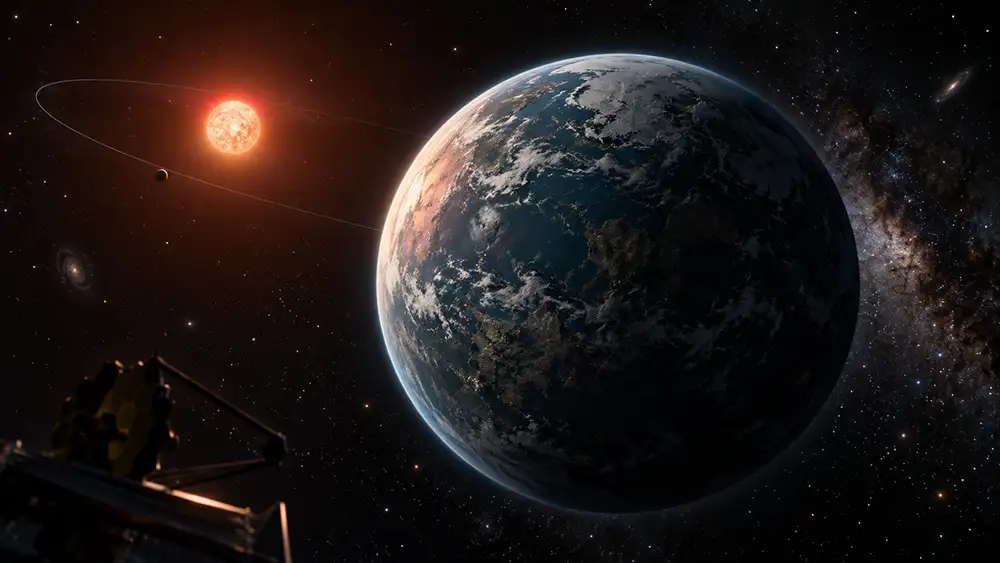
LHS 1140 b is often called one of the most interesting candidates for the status of ‘another Earth.’ But accuracy is important here. The planet was not discovered recently—the announcement of its existence came back in 2017. The new findings from observations by the James Webb Space Telescope have significantly improved our understanding of its composition and possible atmosphere.
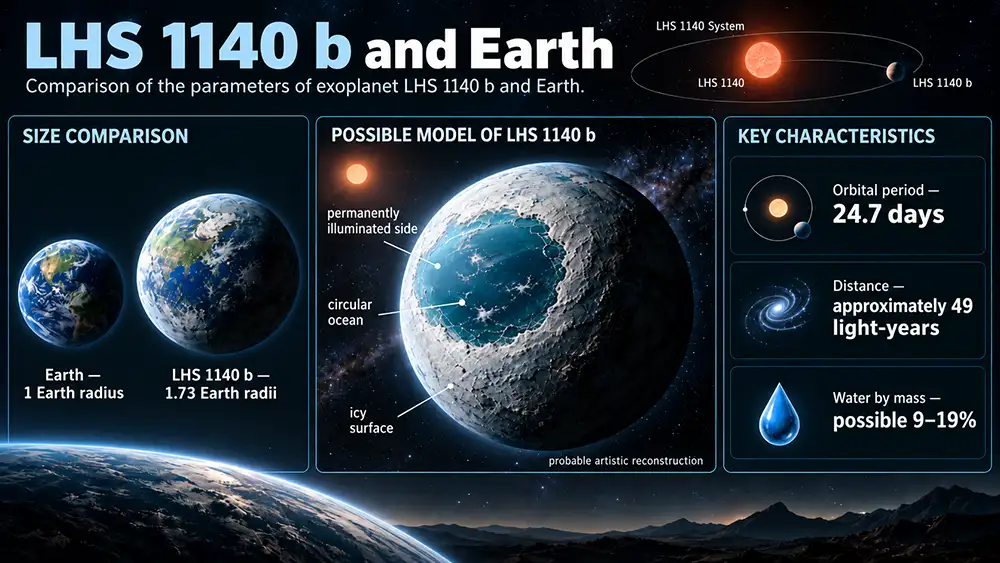
According to the NASA catalog, LHS 1140 b belongs to the class of super-Earths, has a radius of approximately 1.73 Earth radii, a mass of about 5.6 Earth masses, and completes a full orbit around its star in 24.7 days. The distance to the system is approximately 15 parsecs, or about 49 light years.
The main parameters of LHS 1140 b are as follows:
These figures make the planet particularly interesting. It lies in the zone where, under suitable atmospheric and other conditions, water could theoretically exist in a liquid state.
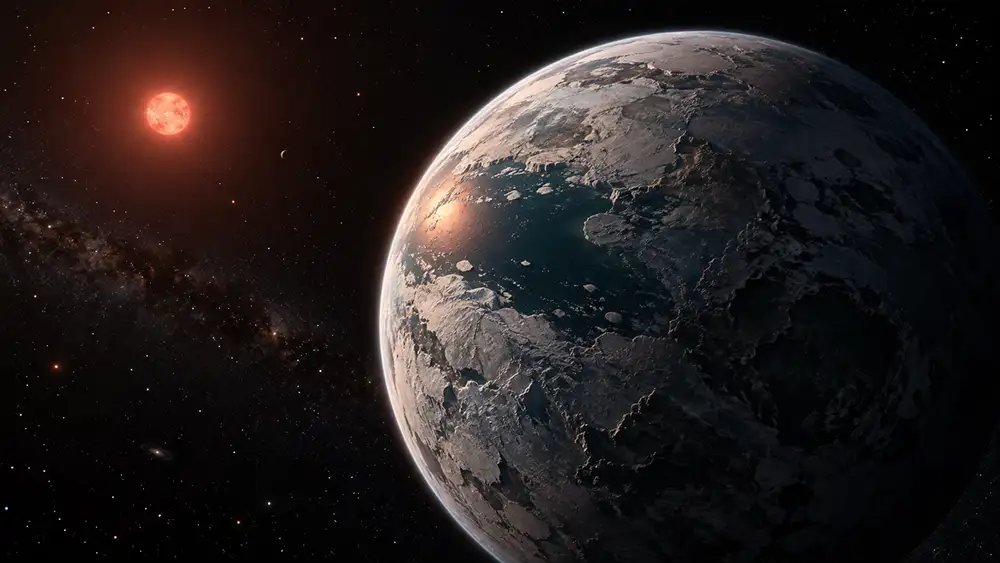
After the discovery, LHS 1140 b was described as predominantly a rocky planet similar to Earth, just larger. New measurements of its mass and radius changed the picture.
A 2024 study published in The Astrophysical Journal Letters showed that the planet’s density is too low for a world with a purely Earth-like rocky composition. Two scenarios remained the most realistic: a small mini-Neptune with a hydrogen-helium envelope, or a world where a significant part of the mass consists of water. According to models, the water fraction could be approximately 9-19% of the planet’s mass.
Then James Webb allowed testing the first scenario.
JWST observations using NIRSpec have shown that the spectrum of LHS 1140 b does not correspond to the expected spectrum of a planet with a light atmosphere rich in hydrogen. In that case, the telescope would have detected much more pronounced traces of methane or carbon dioxide. These were not found in the expected form.
Another team analyzed observations from JWST/NIRISS. The obtained data gave a preliminary signal compatible with light scattering in an atmosphere dominated by molecular nitrogen. The statistical significance of this signal was about 2.3 sigma, so it is too early to confirm a nitrogen atmosphere. At the same time, hydrogen atmosphere models were rejected at over 10 sigma significance.
The sequence of obtained results can be described as follows:
It was the fourth point that generated headlines about the ‘second Earth.’ However, the scientific picture is much more interesting—and complex.
If the planet truly has a heavy atmosphere and significant water content, its surface might resemble a global icy world rather than modern Earth.
Climate models allow for an even more interesting scenario. LHS 1140 b is likely tidally locked—one hemisphere constantly facing its star. With a certain atmospheric composition, most of the surface could remain covered in ice, while a region at the star-facing point could maintain liquid water.
Modeling suggests possible characteristics:
This is a model, not a photograph of the surface. Without confirmation of the atmosphere and its composition, determining the real climate of LHS 1140 b is impossible.
The search query ‘Earth-like planet’ often leads to one simplification: if a planet is in the habitable zone, it is suitable for life. In reality, the habitable zone primarily describes the distance from the star where, under certain atmospheric conditions, liquid water can exist on the surface.
For a real assessment, other data are needed:
Therefore, ‘second Earth’ is currently a convenient popular term, not a scientific status for LHS 1140 b.
James Webb does not take photographs of oceans on LHS 1140 b. During the planet’s transit, some light from its star passes through the outer layers of its atmosphere. Different molecules absorb light at different wavelengths, and researchers try to find these weak signals in the spectrum.
For small planets, this is extremely difficult. NASA notes that the atmospheric signal of a rocky exoplanet might change the overall light flux by less than 0.02%. Searching for potential biosignatures on LHS 1140 b in an optimistic scenario could require about 10-50 transits, or roughly 40-200 hours of Webb observations.
This is why a single spectrum rarely provides a definitive answer.
In August 2026, a new preprint appeared analyzing four transits of LHS 1140 b observed by JWST/NIRISS from 2023 to 2026. The authors searched for helium in the upper atmosphere, as earlier ground-based observations indicated a possible signal of its escape.
JWST did not detect such absorption in any of the four observations. The authors explicitly state that the nature of LHS 1140 b remains uncertain until future spectroscopic studies are completed. This does not rule out a possible nitrogen atmosphere but shows how carefully one must treat individual signals.
In terms of size, it is not a copy of our planet. Nor is it likely in terms of water content. Even a confirmed atmosphere would not automatically mean the presence of life.
However, LHS 1140 b has a rare combination of characteristics: it’s relatively close, transits its star, lies in the habitable zone, and is large enough for detailed spectroscopic observations. That is why NASA includes it in a small group of potentially habitable worlds whose atmospheres can realistically be studied with Webb.
For the status of ‘second Earth,’ science still needs much more evidence. First and foremost, it is necessary to:
Therefore, today it is more accurate to call LHS 1140 b one of the most promising candidates for searching for a watery world with an atmosphere, rather than a proven ‘second Earth.’
