LHS 1140 b is often called one of the most interesting candidates for the status of ‘another Earth.’ But accuracy is important here. The planet was not discovered recently—the ...

21Sep


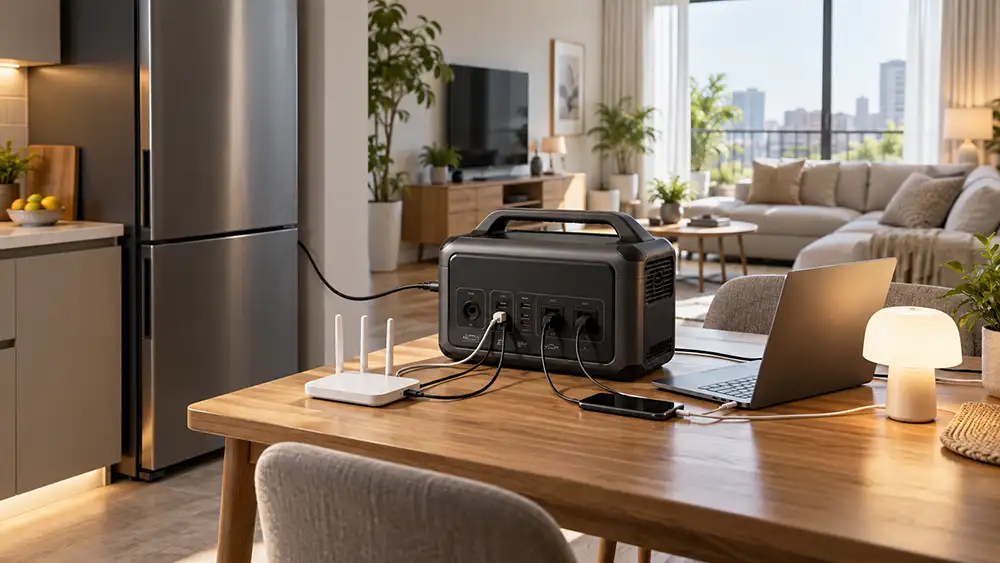
When you need to understand how to choose a charging station, first it’s important to distinguish between two parameters – power in watts and capacity in watt-hours. They answer different questions.
Power in watts, or W, indicates what load the station can supply at a given moment. If a model has a rated output power of 1000 W, it does not mean it stores 1000 W of energy.
This parameter determines which equipment can be connected simultaneously:
That’s why choosing a model based only on battery capacity is incorrect. First, you need to determine the maximum simultaneous load.
Capacity in Wh indicates the energy reserve. For example, a battery of 1024 Wh theoretically holds approximately 1.024 kWh of energy.
In simplified terms, a 1000 Wh station could power a 100 W device for about 10 hours. But in practice, the result will be less due to inverter operation, the electronics’ own consumption, temperature, load mode, and battery management system limitations.
The most accurate approach is first to list the equipment that needs to work during an outage. It’s unnecessary to include everything in the apartment.
Calculations can be done in this sequence:
This method is much more precise than simply choosing “a station with 1 kW should be enough.” It’s important to distinguish 1 kW of power and 1 kWh of energy reserve.
You can use the formula for an approximate calculation:
Operating time = station capacity × efficiency coefficient / average load power.
For example, we have a charging station of 1024 Wh and a load of 100 W. We take a conditional coefficient of 0.85 for the calculation.
1024 × 0.85 / 100 = 8.7 hours.
The coefficient 0.85 here is used only as an example. The actual available energy of a specific model may differ, so for an accurate prediction, check test results or manufacturer data specifically for the AC output.
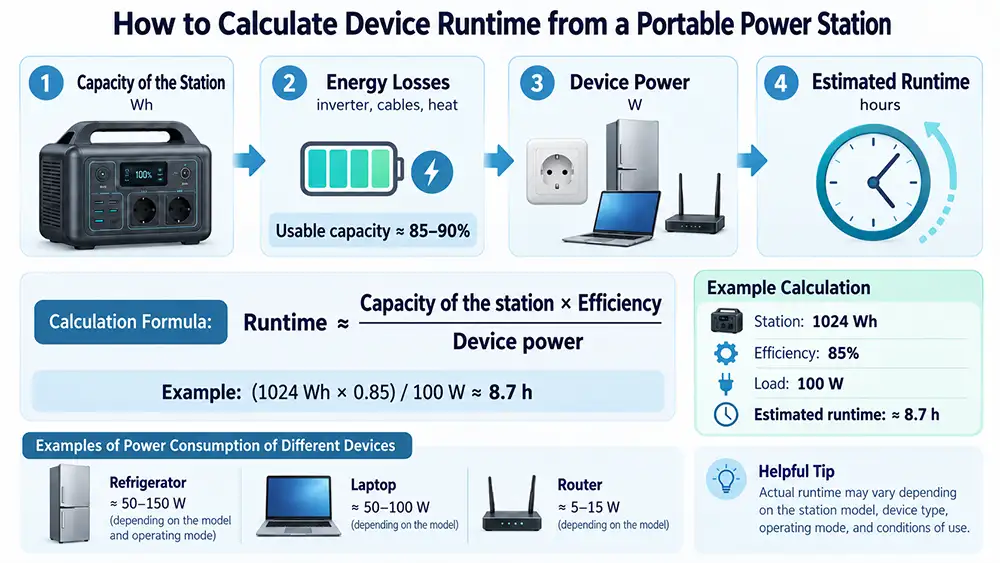
The declared 1024 Wh does not mean you can reliably get exactly 1024 Wh through the 230 V outlet. Part of the energy is lost inside the system.
The results are affected by:
Therefore, when comparing two models, the Wh number alone is not enough. It’s useful to look for independent tests of actual energy output through AC outlets.
The refrigerator compressor, pump, or another electric motor at startup can briefly consume significantly more power than during stable operation.
Because of this, the station might show sufficient Wh reserve but still turn off when the compressor starts.
In the specifications of a charging station, check at least two indicators:
The starting power for the refrigerator is best determined by the technical documentation or by measuring with a wattmeter that has a peak power recording function. Relying only on the number the refrigerator consumes after compressor start is risky.
The question “how long does a refrigerator run on a charging station” has no single correct answer. A refrigerator doesn’t consume the same power around the clock – the compressor periodically switches on and off.
So it’s better to focus on the average energy consumption per day.
For example, if the energy label indicates 250 kWh per year:
250,000 Wh / 365 = approximately 685 Wh per day.
For a hypothetical station of 1024 Wh with a calculated coefficient of 0.85, the available reserve will be about 870 Wh.
870 / 685 × 24 = approximately 30.5 hours.
This is a calculated figure, not a guaranteed operating time. Temperature in the apartment, number of products, frequency of door openings, thermostat settings, and compressor model can significantly affect the result.
In the ENERGY STAR catalog for household refrigerators, you can compare the declared actual annual energy consumption of specific models. The kWh per year value is more useful for calculating refrigerator autonomy than instantaneous compressor power readings.
There is no universal number. A charging station for an apartment should fit the specific usage scenario.
The logic of choosing for different tasks is as follows:
These are not normative limits but practical categories for preliminary selection. The final calculation should be done in Wh based on the actual equipment consumption.
Heating devices consume a lot of energy. Even if the charging station inverter allows turning them on, the battery may discharge very quickly.
For example, a 2000 W device in 15 minutes theoretically consumes about 500 Wh. For a station of 1024 Wh, that is already a significant part of the total reserve.
Therefore, during long outages, it’s more reasonable to reserve energy for the refrigerator, communication devices, laptop, lighting, and other critical equipment.
With frequent use, not only the initial energy reserve is important. You need to consider the battery’s lifespan.
When comparing models, check:
For regular cyclical use, stations with LiFePO4 batteries are often considered. But evaluate the whole design – battery, BMS, inverter, cooling system, and warranty conditions.
A large lithium battery requires proper handling, especially during charging and working under heavy loads.
The State Emergency Service of Ukraine recommends using original or manufacturer-approved charging cables, not placing the station near open flames, in damp or excessively hot places, and not using equipment with damaged cases or sockets. Rescuers also warn against connecting the station to the apartment network with a “plug-to-plug” method. Detailed rules are provided in the article SES on the use of alternative power sources.
Before use, perform a few simple steps:
These rules are important regardless of the station’s brand and capacity. A large battery should not turn backup power into an added risk.
Capacity and maximum power are just the beginning. For an apartment, the entire set of characteristics matters.
Before buying, check:
For backup power of a refrigerator, the main factors are capacity, peak power, and the refrigerator’s actual consumption. For a home workstation, priority shifts to sufficient number of ports, autonomy of laptop, router, and monitor.
