Power and Capacity of a Charging Station – What’s the Difference When you need to understand how to choose a charging station, first it’s important to distinguish between two parameters – power ...
09Oct


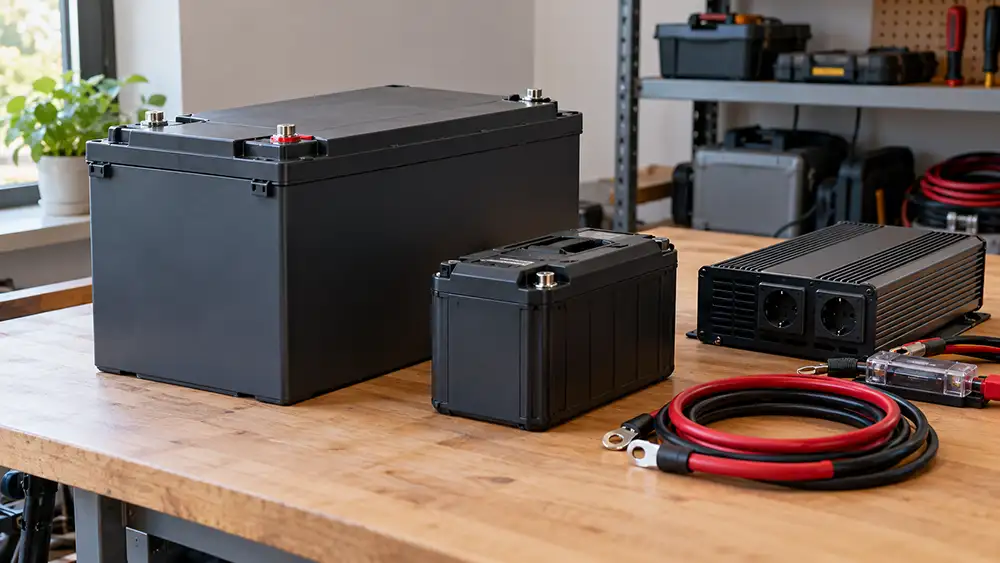
The LiFePO4 battery is a type of lithium-ion battery in which the cathode is made based on lithium iron phosphate. Therefore, the phrase “LiFePO4 or Li-ion” is technically not entirely accurate. LiFePO4 belongs to the Li-ion family.
In practice, when people refer to a regular lithium-ion battery, they most often mean cells with NMC, NCA, or LCO cathodes, which are used in smartphones, laptops, electric vehicles, portable charging stations, and other devices.
A lithium iron phosphate battery has a nominal voltage of a single cell of approximately 3.2-3.3 V. For many other Li-ion systems, the typical value is 3.6-3.7 V. Maximum charging voltage, lifespan, specific energy, and behavior at high temperatures also differ.
| Parameter | LiFePO4 | Typical Li-ion NMC/NCA |
|---|---|---|
| Nominal cell voltage | approximately 3.2-3.3 V | approximately 3.6-3.7 V |
| Specific energy | about 90-120 Wh/kg | approximately 150-220 Wh/kg depending on chemistry |
| Lifespan | often about 2000 cycles or more | often about 1000 cycles, but greatly depends on usage |
| Thermal stability | higher | lower for many NMC/NCA systems |
| Weight for same energy | greater | less |
| Typical application | UPS, solar systems, home batteries, campers | portable electronics, electric vehicles, compact batteries |
The figures should not be taken as exact specifications for every battery. Cell construction, temperature, depth of discharge, current, operating voltage, and BMS algorithm can significantly affect the actual lifespan.
Battery University reports specific energy for LiFePO4 around 90-120 Wh/kg, while individual NMC and NCA systems provide significantly higher values. This is why standard lithium-ion batteries remain advantageous where weight and compactness are critical.
For backup power, lifespan is often more important than minimum weight. Here, LiFePO4 holds a strong position.
In Battery University’s reference specs for LiFePO4, the lifespan is around 2000 cycles or more, whereas traditional Li-ion configurations often list about 1000 cycles. The actual result depends on the residual capacity level the manufacturer considers as the end of life and the test conditions used.
Depth of discharge also matters. Partial cycles usually wear a lithium battery less than regularly discharging nearly to the minimum allowed level. High temperature and long storage at full charge also accelerate aging.
For a home system that can charge and discharge daily, the difference in cycle lifespan becomes much more significant than for an emergency UPS that turns on only a few times a month.
If the primary goal is to get maximum energy at minimum weight, NMC or NCA often have the advantage.
LiFePO4 has lower specific energy. This means a battery of the same capacity will usually be heavier or larger. For stationary systems, this drawback often isn’t critical. For an electric bike, drone, or other portable equipment, the situation is the opposite.
Lower energy density is cited as one of the main trade-offs of LFP by the U.S. Department of Energy. At the same time, the agency notes better cycling and higher thermal stability of LFP compared to common NMC systems.
Low temperature is especially critical during charging. Charging LiFePO4 below the manufacturer’s specified cell temperature can lead to metal lithium plating on the anode and irreversible cell damage.
For many batteries, the critical threshold is about 0 °C. For example, the current Victron Energy documentation for Lithium SuperPack NG allows charging at battery temperatures from 0 to 60 °C. Below 0 °C, charging is blocked by the BMS, and in models with heating, the heater activates first.
Discharge at subzero temperatures is allowed by some batteries, but available capacity and power may decrease. Limits must be checked specifically in the datasheet of the particular model.
Do not connect LiFePO4 to a charger just because it matches the nominal voltage. The charging algorithm and final voltage are important.
Before connection, check several parameters:
It’s especially undesirable to use equalization modes intended for lead-acid batteries; they may apply voltage that does not meet LFP requirements.
BMS monitors individual cell voltage, current, temperature, and critical modes. In a multi-cell battery, it can also perform balancing.
The mere label “LiFePO4” on the case does not replace a quality BMS. For backup power, it’s important to check the permissible continuous battery current and compare it with the inverter’s maximum power.
For stationary backup power, the LiFePO4 battery often better matches the load profile. Additional kilos matter less, but the battery regularly undergoes charge and discharge cycles.
The advantages are especially noticeable when the system operates daily:
These features explain why LFP is popular not only in home setups but also in large energy storage systems. At the same time, LiFePO4 is not completely fire-safe technology – damage, short circuit, improper charging, or cell defect can still create dangerous conditions. The U.S. Department of Energy explicitly states that thermal runaway incidents are possible even in LFP systems.
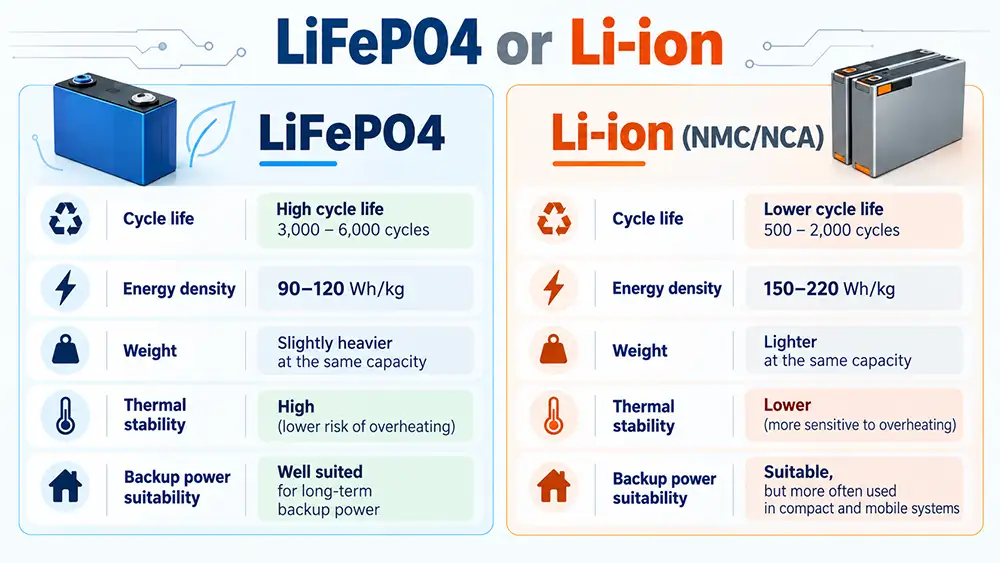
The choice does not depend on the technology name but on the battery’s operating mode. Priorities differ for various applications.
For backup power in apartments or houses where battery weight is not a defining factor, LiFePO4 often offers a more practical combination of lifespan and thermal stability. For portable devices, advantage may shift to NMC or NCA due to higher specific energy.
Identical “12 V 100 Ah” markings do not mean identical quality and capabilities of batteries.
Before purchasing, compare:
You must carefully read the conditions under which the manufacturer specifies lifespan. The label “6000 cycles” without specifying depth of discharge, temperature, and final residual capacity provides insufficient information for proper comparison.