What Is the Fundamental Difference Inheritance passes to the heir after the owner’s death. The basis may be a will or statutory inheritance. Gifting works differently: the owner voluntarily ...

29Sep



In Ukraine, divorce can be processed through the Civil Registry Office (DRAСS), the “Diia” app, or a court. The choice of procedure depends on the mutual consent of the spouses, the presence of common minor children, and other legal circumstances.
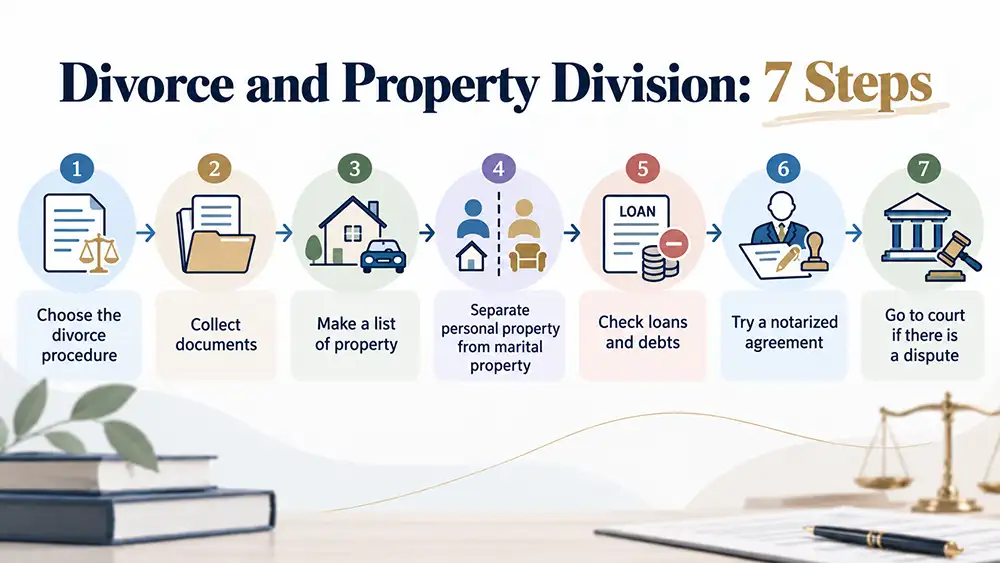
Divorce itself does not terminate ownership rights to jointly acquired assets. Property division can be done during the marriage, simultaneously with divorce, or afterward. Therefore, it is not necessary to resolve all financial issues in a single court process.
The procedure is regulated by the Family Code of Ukraine, specifically Articles 60-74 and 104-114.
Article 106 of the Family Code provides for administrative divorce if the husband and wife agree on the divorce and have no common minor children.
The procedure consists of several steps:
A dispute regarding the apartment, car, or savings does not prevent administrative divorce if other legal conditions are met.
From September 3, 2026, spouses can use the online divorce service in the “Diia” application. For this, both must agree to the divorce, be adult citizens of Ukraine, have no common minor children, and meet digital identification requirements.
One spouse forms the application, and the other confirms it through the app. The procedure then involves remote interaction with the Civil Registry Office, and information about the termination of the marriage is reflected in electronic documents.
The court procedure is applied if one spouse does not agree to divorce or the couple has common minor children.
There are two main options:
According to Article 109 of the Family Code of Ukraine, spouses with children submit a written agreement regarding children’s residence, maintenance, and parental participation in upbringing. The alimony payment agreement requires notarization.
The court dissolves the marriage upon the claim of one spouse if it establishes that further cohabitation and preservation of the marriage contradict essential interests of one of them or their children.
It is also important to consider legislative changes: previous restrictions on filing claims during the wife’s pregnancy and within the first year of the child’s life were removed from Article 110 of the Family Code in 2024.

According to Article 60 of the Family Code, property acquired by spouses during marriage generally belongs to both. The lack of independent income by one partner due to studies, childcare, or household management does not deprive them of property rights.
Property division most often concerns the following assets:
If a husband purchased an apartment during marriage and registered it only in his name, it does not automatically mean the housing belongs solely to him. To determine the legal status, the court examines acquisition timing, source of funds, and other circumstances.
Article 57 of the Family Code of Ukraine defines categories of personal private property. Typically, such property is not included in the joint mass.
They include:
However, the status of personal property can change. For example, if an apartment acquired before marriage significantly increased in value due to joint labor or financial costs, Article 62 of the Family Code allows the court under certain conditions to recognize it as joint marital property.
The rules on the emergence and protection of property rights are further explained in the article “What the Civil Code of Ukraine Is in Simple Words” on Poshuk.info.
Article 70 of the Family Code establishes a presumption of equal shares. In absence of another agreement or prenuptial contract, each spouse usually has the right to half of the joint property.
At the same time, the court can adjust the share ratio if significant circumstances exist as prescribed by law. For example, if one spouse concealed property, destroyed it, or spent joint funds contrary to the family’s interests.
The minor children living with one parent does not automatically increase that parent’s share. The court also considers adequacy of alimony and children’s needs for development and treatment.
If husband and wife reach an agreement, they can arrange property division voluntarily. This requires identifying joint property composition, evaluating assets, and agreeing who will own what.
The voluntary resolution procedure involves several steps:
The property division agreement regarding real estate requires notarization. If the apartment is mortgaged, the arrangement between former spouses does not relieve the borrower of obligations to the bank.
A detailed list of documents for voluntary and court resolution is provided in the Poshuk.info article “Division of Spousal Property: Documents Needed for Peaceful Agreement or Court”.
If no agreement is reached, one spouse can go to court. It’s important to properly define property claims and back them up with evidence.
The court may determine shares, assign an indivisible object to one spouse under proper legal conditions, or decide on compensation. The specific method depends on the dispute subject.
Not every loan taken during marriage automatically becomes joint debt. The court considers loan purpose, actual use of funds, and family interests.
If spouses bought an apartment with mortgage funds, dividing ownership rights does not automatically divide the credit agreement. Bank rights remain valid, and changing the borrower usually requires creditor’s consent.
For calculating court fees in 2026, the subsistence minimum for able-bodied persons as of January 1 is 3,328 UAH.
| Court Claim | Fee Amount |
|---|---|
| Divorce claim | 1,331.20 UAH |
| Property division in divorce | 1% of the claim amount |
| Minimum fee for such property division | 1,331.20 UAH |
| Maximum fee for such property division | 9,984 UAH |
The rates are confirmed by court-published calculations for 2026.
+1 For a separate property claim not subject to the special rate for property division in divorce, applicable rates and caps should be checked.
If the claim amount for property division in divorce is 600,000 UAH, one percent equals 6,000 UAH. This is above the minimum fee and below the maximum.
If claims for divorce and property division are filed simultaneously, fees for each are calculated separately. Additionally, there may be expenses for expert assessments, valuations, and lawyers. Before payment, one should check grounds for discounts and possible use of a legally provided coefficient for electronic submission.
Article 72 of the Family Code provides a three-year limitation period for property division claims after divorce.
However, the count starts not automatically from the day of divorce, but from when the ex-spouse learned or could have learned about violation of their ownership right. While the marriage lasts, the limitation does not apply to claims regarding joint property division.
For example, if the ex-husband started disputing the wife’s right to a joint apartment several years after divorce, the violation date must be established considering the evidence and circumstances of the specific case.
Yes. One spouse can file a claim independently. Lack of consent from the other party does not prevent divorce.
Yes. Article 69 of the Family Code permits division of joint property irrespective of divorce.
As a general rule, no. Property inherited by one spouse belongs to them personally, although certain circumstances may affect the legal status of a specific object.
For agreements requiring notarization or registration, the law requires written consent of the other spouse, notarized. Violating these requirements can be grounds for court disputes.
The presence of children does not automatically change the principle of equal shares. The court may consider additional circumstances provided in Article 70 of the Family Code and the interests of the children.
No. Both issues can be addressed together or separately. The choice depends on the complexity of the property dispute, availability of evidence, and procedural expediency.
