The boundary between classic search engines and AI is gradually disappearing. Previously, a user would enter a query, receive a list of links, and find the answer across several websites ...

16Oct


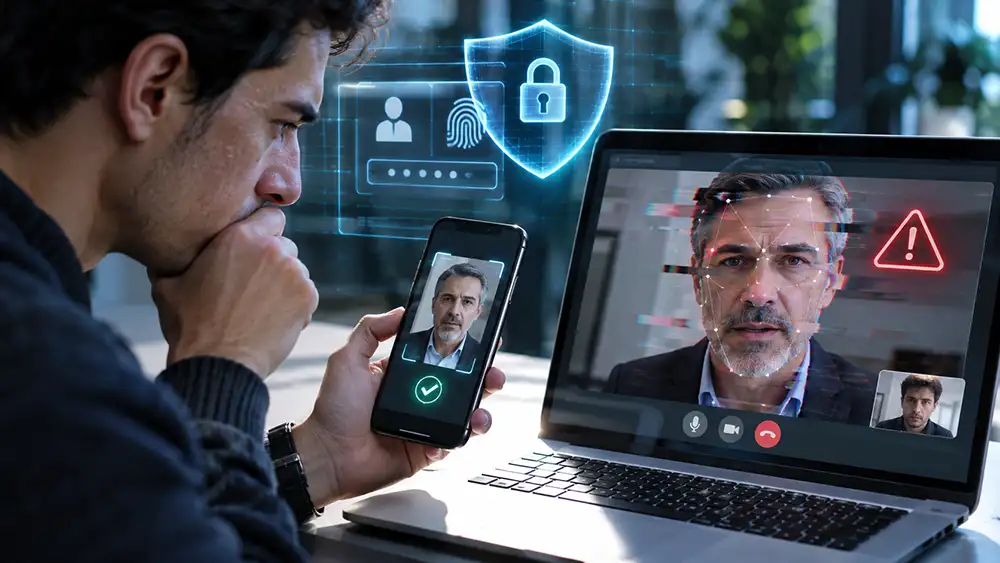
To protect yourself from deepfake attacks, verify the identity of your interlocutor through an independent communication channel, do not transfer money based on voice or video requests without confirmation, and use multi-factor authentication. Modern technologies allow scammers to convincingly fake a person’s voice, face, and behavior, so even a realistic video call does not guarantee the authenticity of the interlocutor.
Deepfake is artificially created or altered audio, photo, or video content in which machine learning algorithms imitate the appearance, voice, or actions of a real person.
Scammers use this technology to steal money, obtain confidential information, blackmail, and spread disinformation.
Malefactors do not always need special technical knowledge. Available AI tools allow automating a large part of the work.
A typical scheme includes several steps:
The danger lies not only in the quality of the forgery. Scammers often create a situation where the person must make a decision immediately.
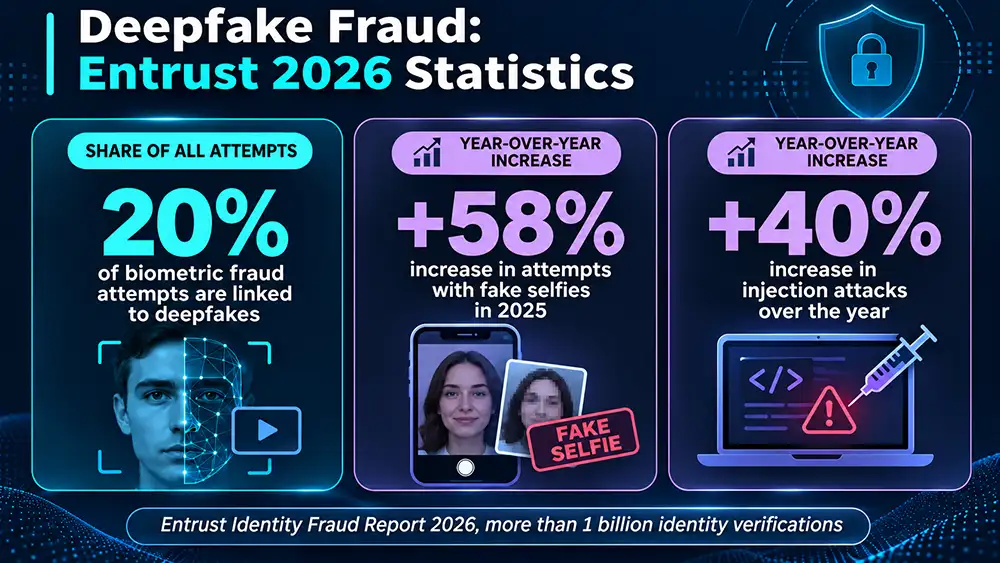
According to the 2026 Identity Fraud Report by Entrust, researchers analyzed over 1 billion identity verifications in 195 countries across more than 30 industries. The results showed that deepfake has become a noticeable tool of biometric fraud.
| Indicator | Result |
|---|---|
| Share of deepfake among biometric fraud attempts | 20% |
| Increase in attempts with fake selfies in 2025 | 58% |
| Annual growth of injection attacks | 40% |
| Volume of identity verifications analyzed | Over 1 billion |
These figures relate to the sample of Entrust identity verification systems, not all cases of internet fraud worldwide. Injection attacks do not always involve the use of deepfakes.
Most often, malefactors try to substitute the identity trusted by the victim. The specific scenario depends on what data or funds they want to obtain.
| Type of Attack | How Scammers Act | Main Protection |
|---|---|---|
| Voice Cloning | Pretend to be a relative and urgently ask to transfer money | Call back on a known number |
| Deepfake Video | Pretend to be a manager or partner | Confirm instructions via a separate channel |
| Fake Advertisement | Use the face of a famous person to advertise investments | Verify official sources |
| Biometric Forgery | Try to bypass remote identity verification | Multi-level identity verification |
| Deepfake Blackmail | Threaten to spread edited intimate materials | Preserve evidence and contact police |
Speech synthesis algorithms can reproduce timbre, intonation, and manner of speaking. Because of this, a person sometimes hears a relative’s voice, even though they are actually talking to a scammer.
Messages about accidents, arrests, health problems, or urgent payment needs are especially dangerous. Such scenarios exploit fear and limit time for verification.
Individual signs might arouse suspicion, but none alone proves forgery.
When watching a video, pay attention to:
Important: modern deepfake may not have noticeable visual flaws. Meanwhile, poor internet or normal video artifacts do not necessarily mean the interlocutor is using a fake.
The best is to verify the person and the circumstances of the request, not the image quality.
Asking the interlocutor to turn their head or wave their hand is possible but not a reliable test. Some systems can alter images in real time.
Personal security depends on identity verification rules, protecting accounts, and controlling public information.
First of all, take the following actions:
These measures do not make deepfake creation impossible, but complicate its use for stealing money and account access.
A separate issue is data privacy when using AI. How local data processing works without mandatory cloud transfer can be read in the article “What is On-device AI and why is it becoming important”.
For businesses, the main risk is unauthorized transfers, leakage of commercial information, and substitution of management instructions.
In the NSA recommendations on combating deepfake, multimedia forensics expert Candice Rockell Gerstner emphasizes: “Organizations and their employees need to learn how to recognize deepfake methods and have a response plan to minimize the consequences of an attack” (translated from English).
Companies should apply several independent levels of protection:
Special attention should be given to accounting, finance department, management, and technical support staff.
When choosing corporate AI solutions, it is also necessary to consider access policies and data protection. These issues are discussed in the article “AI for business in 2026 – what is really worth comparing”.
AI detectors analyze images, audio signals, digital artifacts, and other file characteristics. However, results of such checks have limitations.
Programs may falsely classify real videos as fakes or fail to detect high-quality deepfakes. It is particularly challenging to analyze short, compressed, or repeatedly uploaded recordings.
A more reliable check combines media file analysis, source verification, confirmation of circumstances by independent parties, and content origin verification.
The course of action depends on whether scammers managed to get money, data, or account access.
If scammers threaten to publish fake intimate videos, do not rush to pay. Payment does not guarantee removal of materials and may lead to new demands.
Yes. Some AI systems can generate animated images from a single photo. However, the quality of the result depends on the model, the source material, and the task set.
Yes. Voice conversion systems can change speech in real time. Therefore, a familiar voice does not replace independent identity verification.
It helps prevent unauthorized login but does not directly protect against psychological deception. A scammer can persuade a person to manually provide a code or confirm an operation.
Not always. A platform can remove a specific publication, but copies sometimes remain on other resources. Therefore, it is important to quickly secure evidence and submit complaints.