On-device AI is artificial intelligence that performs part or all of the data processing directly on a smartphone, laptop, tablet, or other user device. The request does not necessarily need to ...

28Sep



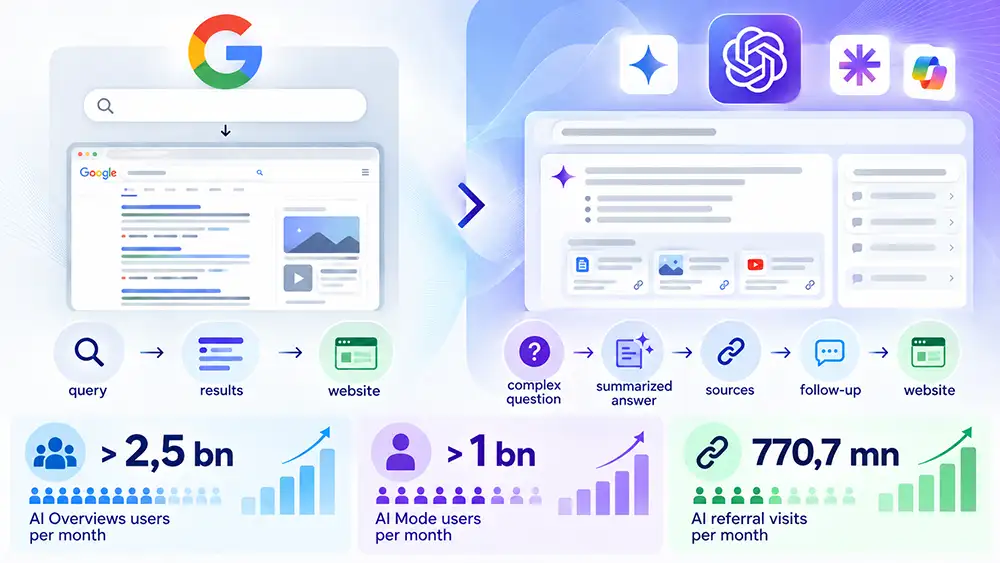
The boundary between classic search engines and AI is gradually disappearing. Previously, a user would enter a query, receive a list of links, and find the answer across several websites themselves. Now ChatGPT, Gemini, Claude, Perplexity, and other systems can immediately gather information, compare options, and formulate an answer in natural language.
Google itself is moving in the same direction. AI Overviews and AI Mode effectively combine traditional Google search with generative artificial intelligence.
According to Google, AI Overviews had more than 2.5 billion monthly active users in 2026, while AI Mode exceeded 1 billion. At the same time, Google reports not a decline, but a record overall number of search queries.
This is an important point. AI does not yet replace Google Search as a separate product. It changes the very principle of information search.
Classic search works well when a person knows exactly what they want to find. For example: an official company website, store address, specific product, exchange rate, law, video, or news.
AI handles queries better where it is necessary not just to find a page but to process information.
Typical advantages of AI search look like this:
That is why queries like “which laptop is better for graphic work under a certain budget” naturally suit chatting with AI rather than classic search fields.
More about how local AI models already impact search, SEO, and advertising can be found in the Poshuk.info article on on-device AI.
A generative model creates an answer. A search engine primarily finds information. These are different tasks, even if modern services increasingly combine both functions.
For queries like “dollar exchange rate now,” “match result,” “today’s news,” “store hours,” or “is the product in stock,” up-to-date data is needed.
An AI system can get this via web search, but then it depends on search indexes, websites, databases, and other external sources.
In legal, medical, financial, and other YMYL (Your Money or Your Life) topics, a brief AI answer is not sufficient.
Users often need to open:
Therefore, AI can speed up the search but does not eliminate the need to verify original sources, especially when health, money, or legal decisions depend on the information.
A query like “PrivatBank,” “YouTube,” “Rozetka,” or a specific company’s name has a navigational purpose. The person wants to go to a specific site, not just read a paraphrase of its content.
Such scenarios remain a strong suit of traditional search.
Site owners’ concerns are understandable: if AI shows a ready-made answer, why would the user click through to the site?
Some search sessions indeed end without a click. However, the picture is more complex.
According to Similarweb research, from June 2025 to May 2026, generative AI platforms drove on average about 770.7 million site clicks (referrals) monthly. Over a year, this grew by 117.4%. Meanwhile, for most sites, AI-referral traffic still accounts for only a small portion of total traffic.
Detailed data is provided in the Similarweb study on AI referral traffic.
Thus, a simple “Google vs. ChatGPT” model is not forming; instead, a new user journey emerges: AI answer – additional search – site – information verification – decision.
The strongest argument against the thesis of a quick “death of Google” is that Google is not standing aside from AI development.
AI Overviews create a brief answer right above traditional results. AI Mode works even closer to a chat assistant: supporting complex queries, comparisons, clarifications, and searches across several related directions.
Google describes the “query fan-out” technology, where the system breaks a complex question into sub-queries and simultaneously searches for information on various fronts.
Official recommendations for site owners are available at Google Search Central.
Previously, the choice looked like “search engine or AI.” Now the search engine itself gains AI functions.
Therefore, a more realistic scenario is not the disappearance of Google but the transformation of the classic search results page into an intelligent interface for working with the web.
SEO does not disappear with the appearance of generative answers. On the contrary, search and AI systems still need pages that contain verified information.
Google explicitly states that to appear in AI Overviews and AI Mode, no special “magic” optimization is required. The basis remains indexing, crawlability, quality content, internal linking, clear page structure, and alignment with the search intent.
For site owners, priorities can be formulated as follows:
Thus, SEO is gradually expanding. The goal is no longer just to get into the top ten results but to become a source that search and AI systems can use for answers.
To compare the capabilities of various platforms, you can also check the Poshuk.info material “ChatGPT, Gemini, Claude or Copilot – which AI is really useful for business in 2026”.
Most likely, users will stop clearly distinguishing traditional search from artificial intelligence. The system itself will determine when to show a list of sites, when to generate a short answer, and when to launch a deeper search comparing dozens of sources.
For commercial queries, classic results will also remain important. People still need to go to the product page, check the price, delivery terms, seller reputation, or place an order. Therefore, organic search and search advertising do not lose their meaning solely due to the appearance of AI answers. The role of such traffic is covered separately in the Poshuk.info article about contextual advertising and search demand.
For some informational queries – it already partially replaces it. If you need to explain a concept, compare several options, or quickly analyze large amounts of information, the dialog format is often more convenient.
But for navigational, local, commercial, and urgent queries, search engines remain critically important.
It depends on the task. AI is convenient for analysis and explanations, while search is suitable for verifying sources, current facts, and accessing specific resources.
For complex questions, the most reliable approach is to use both tools together.
Yes. Generative models can misinterpret a source, mix facts, or create plausible but false statements.
That is why important facts must be verified by original sources.
Current data do not show that. On the contrary, Google reports record search activity levels alongside the rapid spread of AI features.
What changes is not people’s need to search for information. What changes is how they get the answer.
