A missing document stops everything: applying for status, enrollment, marriage registration, and processing aid. And traveling to get it is not always possible. The procedure for remote document ...

08Oct



Division of marital property is a legal procedure that determines which assets—such as an apartment, house, car, business, land plot, funds, household appliances, corporate rights, or other jointly acquired property—belong to the husband or wife. This issue most often arises during divorce, but the law also allows for property division without terminating the marriage.
As a general rule, property acquired by spouses during the marriage is considered joint or marital property, even if one spouse did not have an independent income for valid reasons. Spouses have the right to divide such property by mutual agreement, and an agreement on the division of real estate must be notarized.
Property division during divorce is not only necessary when there is an open conflict between the parties. Often, a properly drafted marital property division agreement helps avoid court, save time, reduce expenses, and formalize arrangements before disputes arise.
Most often, division of property between spouses occurs in the following situations:
Proper document preparation is a key stage because evidence determines which property is joint, which is personal, its value, and whether there are grounds to deviate from equal shares.
Property division covers not everything the family has used, but only that which holds the legal status of joint ownership. Personal property received before marriage, inheritance, gift agreements, or purchased with personal funds generally does not enter the joint estate unless the other party proves a significant joint contribution.
The following are usually included in joint property:
If property was acquired during marriage but paid for with one spouse’s personal funds, proof of the money’s origin is important. Without such evidence, the court may consider the property as joint marital property.
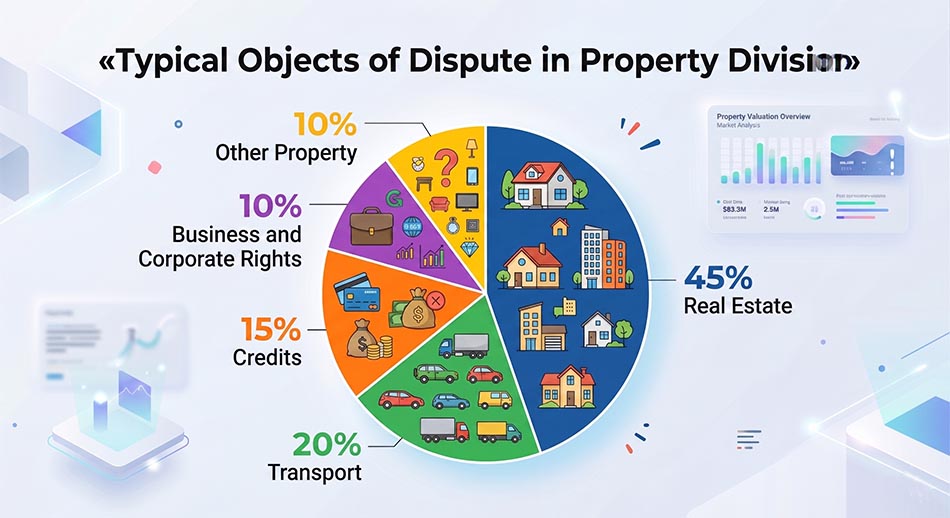
The answer to the query “what documents are needed for property division” depends on the method—through a notarized agreement or court. However, the basic document package almost always includes proof of marriage, ownership rights, property value, and sources of acquisition.
For preparing an agreement or claim, the following documents are usually required:
In court disputes, it is advisable to additionally prepare copies of all documents for the parties, evidence of claim submissions, correspondence, photos of property, residence registration info, and documents on expenses for repairs or maintenance.
The marital property division agreement is a voluntary way to resolve property issues without a lengthy court process. It can be concluded during marriage, in the process of divorce, or after marriage termination.
The division agreement may include:
If the subject is a house, apartment, other real estate, or allocation of property to one spouse, the marital property division agreement must be notarized. This is important, as without the proper form, the document may not produce the expected legal effects.
If the parties cannot agree, division of joint property is carried out through court. In this case, the claim must list the property, its value, justification of the right to a share, and the specific method of division.
The claim should preferably include:
The court usually starts from equal shares of husband and wife but may deviate from this principle due to significant circumstances, such as concealment, destruction, damage of marital property by one spouse or spending it to the detriment of family interests.
In 2026, the subsistence minimum for able-bodied persons is 3,328 UAH. The court fee for filing a claim on property division upon divorce is 1% of the claim price but not less than 1,331.20 UAH and not more than 9,984.00 UAH. For other property claims by individuals, the maximum limit may be up to 16,640 UAH.
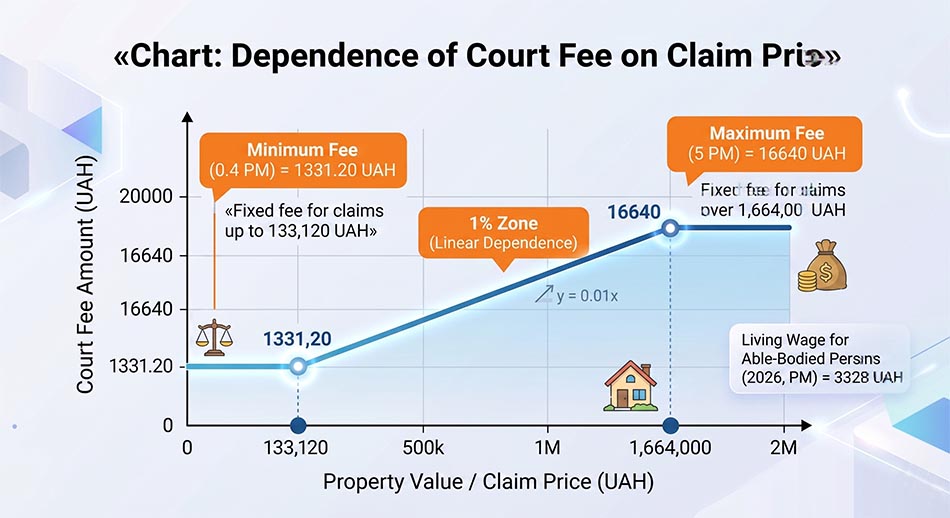
Additional costs to consider include property valuation, notarial actions, attorney fees, obtaining extracts from registers and technical documents. If the case is complex and includes business, real estate, corporate rights, or loans, preparing the evidence base can be more important than the claim text itself.
On this page you can request a consultation with family law attorneys and get answers to your questions as well as information about lawyer fees.
Until the marriage is dissolved, the statute of limitations for claims related to marital property division does not apply. After divorce, a three-year period applies, counted not automatically from the date of divorce but from the day one co-owner discovered or could have discovered the violation of their right.
This means that a marital property division agreement after divorce or a court claim should not be delayed unnecessarily. The more time passes, the harder it is to find receipts, bank statements, contracts, repair evidence, sources of funds, and proof of actual asset values.
Before signing a marital property division agreement or filing a claim, an asset audit should be conducted. This helps to understand the real picture: what property belongs to the spouses, what is personal, which objects are encumbered by loans, and which can be divided without dispute.
To make property division legally safe, take the following steps:
Proper preparation reduces the risk of losing shares, contesting the agreement, or protracting court proceedings. This is especially important for real estate, vehicles, business, loans, or property registered in only one spouse’s name.
Division of marital property is not a formality but a legally significant procedure where documents play a decisive role. Voluntary resolution requires a properly drafted marital property division agreement, while court cases require a full set of evidence, property valuation, proof of ownership, and a well-reasoned position on shares.
The best strategy is to gather documents in advance, verify registries, define joint property composition, and choose the optimal division method. In many cases, a marital property division agreement after divorce is faster and cheaper than court. However, if there is no agreement, a well-prepared claim will help protect property rights.