Power and Capacity of a Charging Station – What’s the Difference When you need to understand how to choose a charging station, first it’s important to distinguish between two parameters – power ...

09Oct


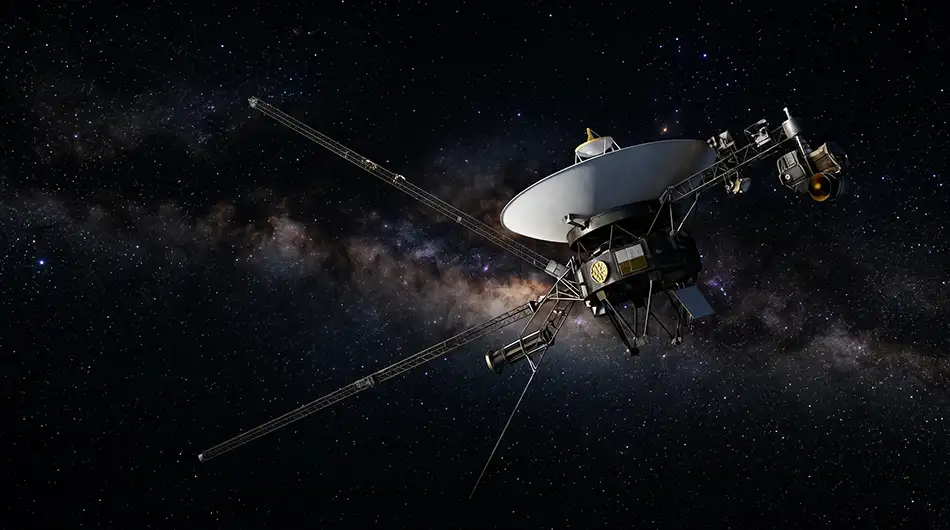
On August 4, 2026, NASA announced an engineering operation that extended Voyager 2’s scientific mission. Specialists from the Jet Propulsion Laboratory managed to free up some scarce electrical power without turning off another scientific instrument. The team gave this decision the expressive name “Big Bang.”
Engineers simultaneously turned off some power-consuming equipment and replaced it with less energy-intensive alternatives. At the same time, they had to maintain sufficient temperature inside the probe — excessive cooling could cause the aging electronics to stop functioning properly.
This was not a “resurrection” of a dead probe. Voyager 2 continued operating. But without this new energy-saving method, NASA would have had to turn off another scientific instrument by the end of 2026. Now three instruments can work at least approximately one year longer.
Solar panels won’t help here. Voyager 2 generates electricity from three radioisotope thermoelectric generators (RTGs). They convert the heat generated by the radioactive decay of plutonium into electrical energy.
The power supply steadily decreases. According to NASA data, each Voyager loses about 4 watts of available electrical power per year. After nearly half a century, even a few watts determine whether the next scientific instrument can operate.
The main reasons for this energy crisis are as follows:
Thus, the team has been gradually turning off heaters, unnecessary equipment, and scientific systems over the years without which the mission can still continue. In 2023, engineers even began using a reserve electrical supply that was previously saved for the power surge protection system.
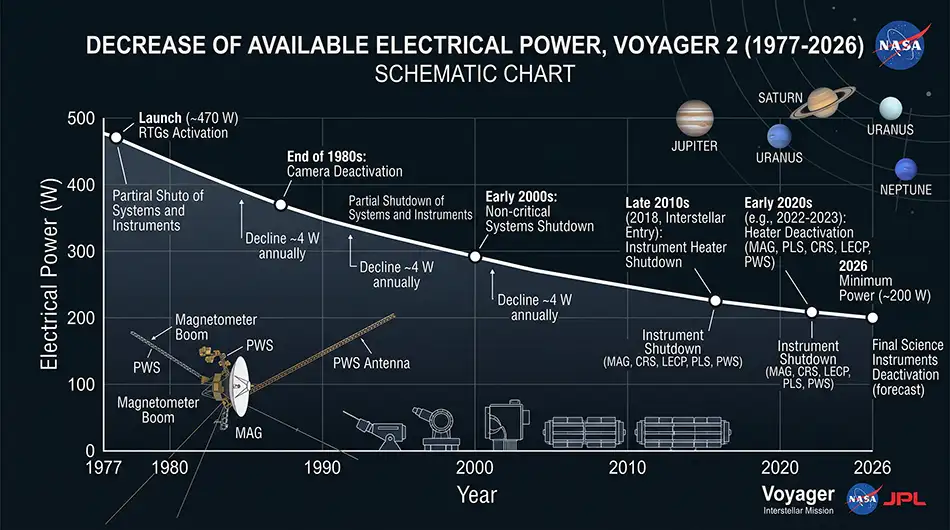
Initially, the spacecraft had a set of 10 main scientific instruments. Some equipment became unnecessary after planetary flybys, while NASA later turned off some to save energy.
Since 2024, a power shortage forced the team to turn off two more Voyager 2 instruments, among them a plasma science instrument and a low-energy charged particle detector. After that, the probe continued collecting data with three systems.
These are the ones NASA is trying to preserve as long as possible:
These measurements are difficult to replace with data from another mission. Voyager 1 and Voyager 2 remain the only spacecraft to have operated beyond the heliosphere — the region dominated by the influence of the solar wind and the Sun’s magnetic field.
Voyager 2 launched on August 20, 1977, from Cape Canaveral. The probe was primarily designed to study outer planets, but its trajectory turned out unique. It flew by Jupiter, Saturn, Uranus, and Neptune and remains the only spacecraft to have visited Uranus and Neptune.
Its key milestones can be outlined by year:
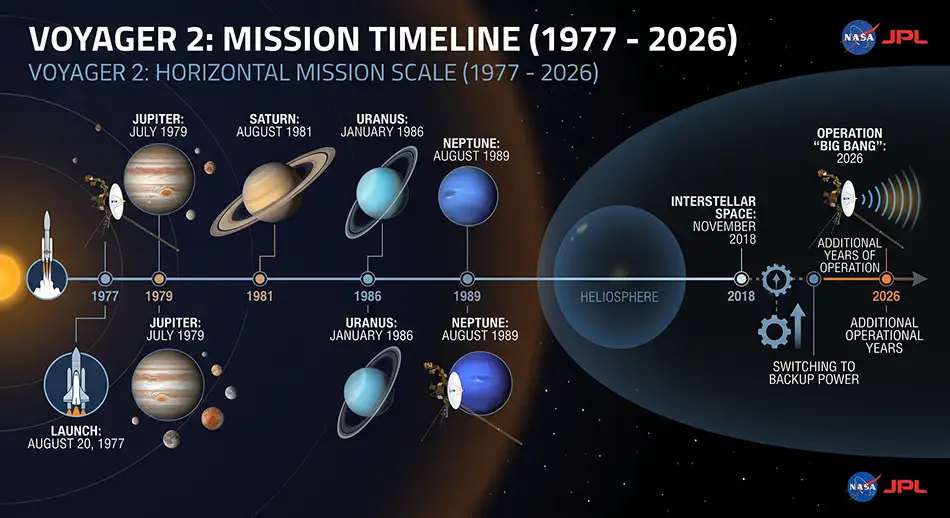
As early as March 2025, NASA reported that Voyager 2 was more than 13 billion miles, or 21 billion kilometers, away from Earth. The radio signal took about 19.5 hours just one way.
There is no exact end date for the mission. After the “Big Bang” operation, NASA expects the three active scientific instruments on Voyager 2 to have at least an additional year of operation. Engineers plan to apply a similar scheme to Voyager 1.
Previously, the team estimated that under favorable conditions, at least one scientific instrument on each Voyager could potentially operate into the 2030s. This is not guaranteed. Nearly 50 years in deep space leaves many unknowns — from electronics aging to problems with orientation thrusters and communications.
Now each additional watt means more time. And every month Voyager 2 operates provides science with data from a region of space where humanity has not yet sent any new replacements.