How to Plan a Trip from Ukraine in November and December As of October 13, 2026, civilian flights from Ukrainian airports are not operating. The current EASA bulletin regarding the airspace over ...
13Oct


Coolcation is a summer trip to a place with mild or cool weather instead of the traditional vacation under the scorching sun. The name combines the English words “cool” and “vacation.” The traveler does not give up summer. They just want to walk during the day, sleep without a constantly running air conditioner, and not check the fire map every hour.
Search queries such as “coolcation Europe,” “cool summer vacation,” “where to go in Europe without heat,” and “vacation in northern Europe” describe one clear shift. Comfortable temperature has become a separate booking criterion alongside price, safety, and transport.
Europe is warming more than twice as fast as the global average. According to Copernicus and the World Meteorological Organization, 2025 brought the continent its second most severe heatwave in recorded history. High temperatures reached even subarctic Fennoscandia, where the longest local heatwave was recorded.
Tourists don’t read this as an abstract climate report. For them, heat means daytime closed routes, risk of forest fires, water shortages, postponed excursions, and a hotel room they don’t want to leave.
The numbers require precision. In 2025, the European Travel Commission recorded an 8% drop in interest for southern destinations. At that time, 81% of Europeans said climate change somewhat impacts their travel, 15% sought milder weather, and 14% avoided places with extreme heat risks.
In spring 2026, demand for the south recovered: nearly 60% of respondents planned trips to Southern or Mediterranean Europe. Coolcation hasn’t canceled the sea. It takes part of July and August bookings and moves others to May, September, or October.
In the same ETC 2026 study, 82% of Europeans planned travel between April and September — the highest level since 2020. Pleasant and stable weather was named a selection criterion by 15% of respondents. It ranked just behind safety at 22% and ahead of good deals at 14%. Temperature is now directly competing with discounts.
According to Trip.com data published by the Global Sustainable Tourism Council, in 2026 searches for cool destinations grew 74% year over year. During the previous summer season, the increase reached 237% compared to summer 2024. This is no longer a niche trend for fjord lovers.
People change their route for several practical reasons:
Coolness has become a tourism resource. But booking a “cold summer” blindly is unwise: rain, wind, and sharp temperature changes are common here, and heatwaves reach even the Arctic Circle.
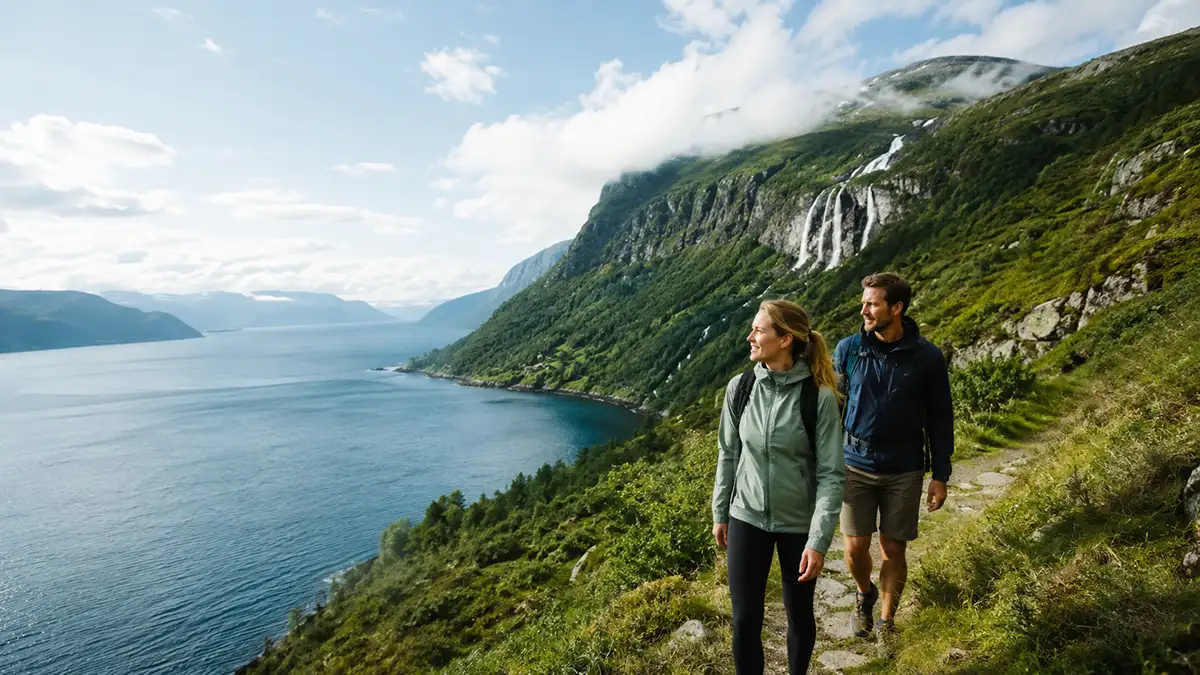
Norwegian fjords, Bergen, the Lofoten Islands, and the coast around Stavanger combine sea routes, hiking, and long summer evenings. Iceland adds volcanoes, glaciers, thermal pools, and waterfalls. According to Trip.com, searches for flights to Iceland for summer 2026 grew 85% year over year.
The Finnish lakeland is suitable for peaceful cottage vacations, saunas, kayaking, and fishing. Sweden offers the Stockholm archipelago and national parks; Denmark — sea coasts, cycling routes, and short city trips. Here nature easily combines with museums and gastronomy.
These destinations attract with green landscapes, ocean trails, castles, and temperatures that rarely force a daytime walk to be canceled due to heat. However, a raincoat is needed more often than a swimsuit. This unpredictability shapes the local style of summer vacation.
Not everyone is ready to fly to Iceland. The Alps in Switzerland, Austria, Slovenia, and northern Italy offer a similar effect without fully changing the region: cooler nights, lakes, cable cars, and mountain trails. But altitude doesn’t guarantee stable temperatures. Before booking, check not only the valley forecast but also conditions on the specific route.
Coolcation requires a different suitcase and a bit more careful logistics. The north often costs more, and the weather changes faster than near the Mediterranean.
This plan leaves freedom but reduces the risk of spending a costly vacation battling the weather. If the route still leads to Italy, avoid the heat peak with early excursions or the off-season, and the Rome guides rating helps prearrange the pace and duration of walks.
Spain, Italy, Greece, and Portugal do not lose tourists but extend the season. Cities develop shaded routes, move activities to morning and evening, promote mountains, lakes, and the Atlantic coast instead of the hottest resorts.
For travelers, the choice no longer boils down to “north or sea.” In July, one might go to Norway; in September — to Greece; and leave Rome for October. Coolcation transforms temperature from a coincidence to a route parameter checked before buying a ticket.