Tax accounting for a sole proprietor of Group 3 is primarily built around the correct determination of income. It is from the revenue received that the single tax and military levy are ...

25Sep



Victoria Ishchenko is the director and founder of “Consulting-Top”, a company specializing in accounting and tax support for businesses. The company works with sole proprietors and legal entities, particularly in trade, manufacturing, HoReCa, services, and IT sectors, offering services including accounting, tax calculation, report preparation, HR accounting, and consulting support.
For an entrepreneur, financial optimization is not just about reducing expenses. First and foremost, it is about establishing a system that allows you to see the real profitability, control money, forecast payments, and make decisions before cash gaps occur.
Starting only with searching for cheaper suppliers or cutting staff is a mistake. First, the owner needs to understand exactly how the company earns and where the money goes.
For a basic financial diagnosis, at least three managerial reports are needed:
These documents solve different tasks. Profit does not mean the same amount is in the account.
That’s why accounting and management accounting should not be mixed. Ukrainian Law No. 996-XIV defines accounting as a system for forming information about enterprise activities for decision-making. The current version can be checked on the official website of the Verkhovna Rada of Ukraine.
No. Revenue shows the scale of sales but says almost nothing about the quality of the financial model.
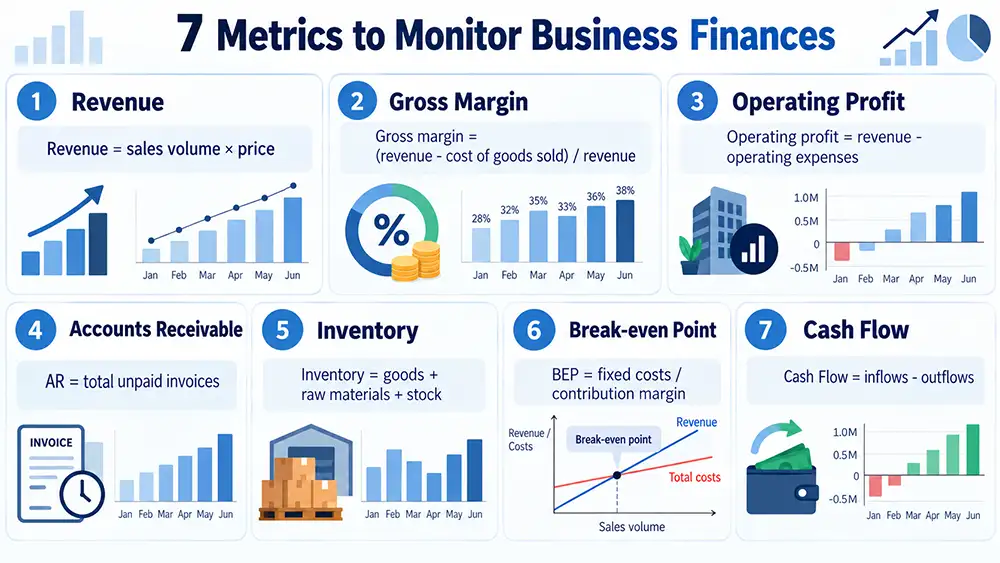
In management reports, you should regularly monitor:
It’s not necessary to create dozens of KPIs. It’s better to have 7-10 indicators that the owner actually reviews weekly or monthly.
For example, if the revenue is 2 million UAH per month and the gross margin is 30%, the business earns 600 thousand UAH gross profit before administrative, marketing, financial, and other expenses. If the company then spends 500 thousand UAH, the profitability margin reserve is only 100 thousand UAH, or 5% of revenue. A decrease in margin by just a few percentage points can turn the result negative.
The reason often lies in working capital.
A company may sell goods for 500 thousand UAH and record income but give the client 45 days to pay. Meanwhile, the supplier needs to be paid in 10 days, salaries at the end of the month, and taxes on a legislated schedule.
On paper, there is a profit. But there is a shortage of money in the account.
To reduce the risk of cash gaps, financial work can be organized as follows:
Even a simple table often reveals problems earlier than a bank account balance. This gives time to negotiate with clients, suppliers, or the bank.
Accounts receivable effectively means that the business finances its customers with its own funds. The longer the payment terms, the more money is tied up in turnover.
It’s necessary to analyze not only the total debt amount but also its age structure: up to 30 days, 31-60, 61-90, and over 90 days. For large clients, credit limits should be set and payment discipline assessed separately.
If the company needs liquidity, one option can be factoring. On Poshuk.info, there is a separate material about how factoring differs from business loans and how such operations are reflected in accounting.
Not the most expensive, but the inefficient ones.
Rent costing 100 thousand UAH may be economically justified if the location generates 700 thousand UAH in marginal income. Meanwhile, an advertising channel with a 30 thousand UAH budget might be unprofitable if it does not attract clients with sufficient margin.
This is why before cutting expenses, they should be divided into:
After this classification, optimization becomes more precise. The business does not just “slash the budget” but removes low-return expenses.
Tax planning should start with checking the real business model: turnover, activities, expense structure, employees, contractors, VAT, and legal form.
Artificial business splitting, fictitious transactions, or documents without real economic substance cannot be considered normal financial optimization.
If a company wants to revise its accounting model, on Poshuk.info there is a category of accounting services for sole proprietors and LLCs. Before changing the tax scheme, it is also worth checking primary documents and possible tax inspection risks – a separate step-by-step guide on preparing for a tax audit is dedicated to this.
Accountants are primarily responsible for accurate accounting and reporting. Financial management answers other questions: where the company earns, where margin is lost, how much money is needed for growth, and which decisions can be financed without losing liquidity.
Consultant engagement is advisable when:
The National Bank of Ukraine also notes that Ukrainian banks continue to increase business lending, with a significant portion of the corporate portfolio formed by loans to small and medium-sized businesses. This makes the quality of financial reporting, cash flow forecasting, and understanding debt load particularly important when attracting external financing. The current financial sector assessment is published by the National Bank of Ukraine in the Financial Stability Report.
Not “to pay less for everything.” The goal is to make financial results predictable.
The owner should understand how much the company earns in each key area, how much money is needed in the next 30-90 days, where unprofitable expenses accumulate, and how results will change if sales, margin, or exchange rates fluctuate.
It is this kind of financial optimization that turns accounting figures into a business management tool.
