How to Plan a Trip from Ukraine in November and December As of October 13, 2026, civilian flights from Ukrainian airports are not operating. The current EASA bulletin regarding the airspace over ...

13Oct


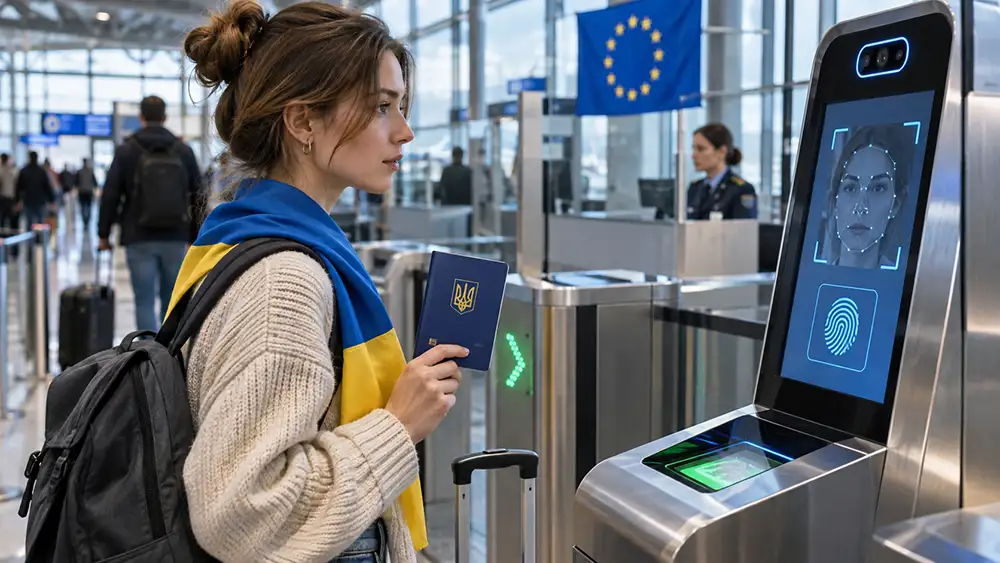
As of November 3, 2026, the entry rules to Europe for Ukrainians include biometric registration through the EES system, which has been fully operational since April 10, 2026. The second system, ETIAS, is expected to introduce a prior electronic travel authorization but is not yet accepting applications. The visa-free regime remains: Ukrainian citizens with biometric passports can stay in the Schengen area for up to 90 days within any 180-day period.
The European Union is moving from passport stamps to digital external border control. New technologies allow automatic verification of foreigners’ length of stay, identity confirmation, and detection of migration law violations.
For Ukrainian citizens, two separate procedures are provided:
These systems have different functions. EES records the actual border crossing, while ETIAS, after launch, will check travelers before their trip.
| Criterion | EES | ETIAS |
|---|---|---|
| Purpose | Registration of entry and exit | Prior travel authorization |
| Status as of 03.11.2026 | Fully operational | Not yet launched |
| Launch date | 12.10.2025, fully from 10.04.2026 | Expected in Q4 2026 |
| Number of countries | 29 | 30 |
| Where to complete procedure | At Schengen external border | Online before travel |
| Biometrics | Facial photo and fingerprints | Not required during application |
| Cost | Free | 20 EUR, with exceptions |
| Validity period | Registration of border crossings | Up to 3 years or passport validity |
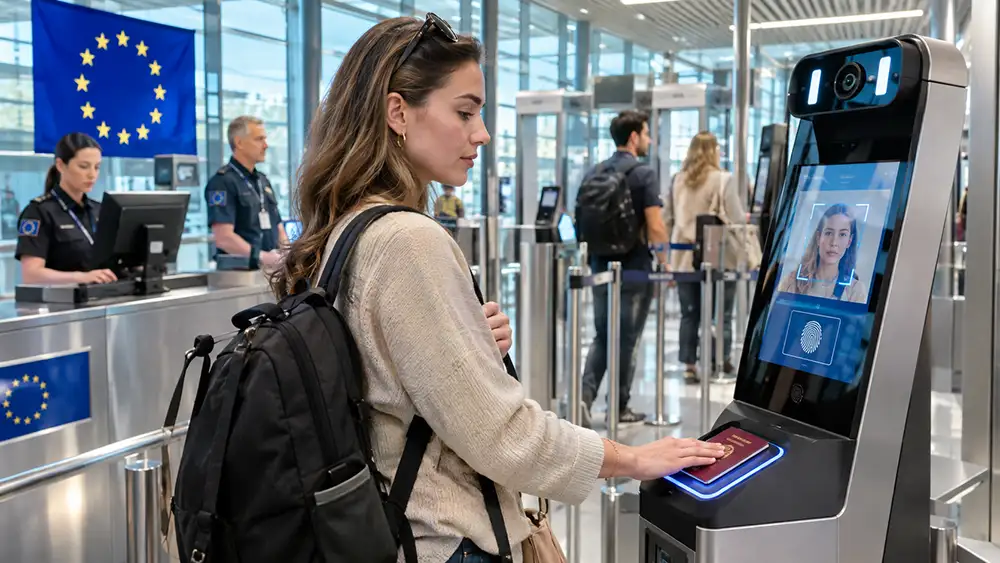
EES automatically records information about non-EU citizens when they arrive in the Schengen zone for short stays or when they leave it.
During the first registration, a traveler goes through several steps.
On subsequent border crossings, the system uses the already registered data to verify identity. Full re-registration is not required on each trip, though border guards may conduct additional biometric checks.
Children under 12 years old are exempt from fingerprint scanning. However, the system can register a facial photo of the child and their passport data.
Children aged 12 and above follow standard biometric registration rules unless other legal exceptions apply.
EES helps detect overstays, use of forged documents, and cases of traveling under someone else’s identity.
According to official data from the European Commission, since EES implementation until April 10, 2026, the system has registered over 52 million entries and exits and more than 27,000 refusals of entry.
EU Commissioner for Home Affairs and Migration Magnus Brunner called the full functionality of EES an “important milestone in modernizing and strengthening the security of Europe’s external borders” (translation from English).
ETIAS is planned to launch in the last quarter of 2026, but as of November 3, the system is not yet operational. The EU promises to officially announce the exact start date for accepting applications in advance.
After launch, ETIAS will be mandatory for Ukrainians traveling with biometric passports without a visa and not belonging to categories exempt from authorization.
ETIAS is not a Schengen visa. It does not grant the right for long-term residence or employment and does not guarantee automatic border crossing.
The official application fee will be 20 euros.
Exemptions from payment include:
Exemption from payment does not always mean exemption from the need to obtain the authorization itself.
Current fees, exceptions, and application conditions are published on the official EU ETIAS portal.
For most Ukrainian tourists, the procedure will involve online application without visiting consulates.
Most applications should be processed within minutes. The standard processing time can be up to four days, with additional checks lasting up to 30 days in some cases.
ETIAS authorization will be valid up to three years but not beyond the passport’s expiry. A new authorization must be obtained after passport replacement.
Not all Ukrainian citizens fall under the new requirements. Not only citizenship matters but also the legal basis for staying in Europe.
Ukrainians benefiting from temporary protection under the EU Directive are exempt from EES registration and the need to acquire ETIAS.
To confirm the exemption, a document certifying temporary protection status must be presented. Its form depends on the country.
Temporary protection in the EU is extended until March 4, 2028. This status should not be confused with the usual visa-free tourist regime.
Ukrainians with a valid long-term visa or residence permit issued by an EES member state, as a rule, are not subject to registration in this system. However, documents issued by some countries, including Cyprus and Ireland, have specific rules.
ETIAS is also not required for holders of corresponding residence permits and long-term visas under EU legislation.
For those planning not a tourist trip but relocation, the issue of residence permits in Europe for Ukrainians remains separate. Grounds for issuance, income requirements, and documentation depend on specific country legislation.
The changes in EES and ETIAS do not cancel standard conditions for short-term entry to the Schengen zone.
During border control, the following may be required:
Having these documents does not guarantee entry but helps confirm compliance with basic conditions. Border guards assess each trip’s circumstances.
It is important to distinguish EU entry rules from Ukrainian exit restrictions. EES and ETIAS do not change Ukrainian legislation on border crossing during martial law.
The system automatically calculates the duration of short-term stays in Schengen countries. It considers entry and exit dates to determine if the allowed duration is exceeded.
For example, a Ukrainian spends 30 days in Poland, 40 days in Germany, and later 20 days in the Czech Republic. If all these trips fall into one 180-day period, the total duration is 90 days.
The rule applies to combined stay in Schengen. Leaving for a few days to Ukraine does not reset the used time.
For each day of stay, the previous 180 days are considered. Thus, the possibility of next entry depends on exact dates of past trips.
EES operates in 29 Schengen countries: 25 EU member states plus Norway, Iceland, Switzerland, and Liechtenstein.
Poland, Germany, Czechia, Slovakia, Hungary, Romania, and Bulgaria are part of the EES system.
ETIAS after launch will cover 30 European countries: Schengen countries and Cyprus.
Ireland does not participate in EES and ETIAS and applies its own entry rules. The UK also has a separate border and migration control system.
As of November 3, 2026, no. ETIAS is not yet accepting applications. Before travel, check the official EU announcement about the launch date.
No. EES registration is free and takes place when crossing the Schengen external border.
The usual visa-free regime for Ukrainians requires a biometric foreign passport. Holders of non-biometric documents may face visa requirements or special exceptions, including humanitarian protection.
No. The authorization allows multiple trips during its validity period, provided the 90/180 rule and other requirements are observed.
Yes. Electronic authorization does not replace border checks. Entry can be refused if the traveler does not meet established conditions.
During the first biometric registration, control may take longer. Actual waiting time depends on checkpoint load, number of staff, and equipment operation.