Minimalist facial care is not about giving up cosmetics, but about reducing the routine to products with a clear purpose. For most people, the basic scheme consists of cleansing, moisturizing, ...
15Oct



Skin care after 30, 40, and 50 years should not be based solely on the number in your passport. The condition of the skin depends on genetics, ultraviolet exposure, smoking, hormonal changes, dryness, skin diseases, and the products a person has used previously.
However, some changes become more noticeable with age. The skin may renew more slowly, lose moisture and elasticity, and accumulated sun damage manifests as uneven tone, pigmentation, and wrinkles. The American Academy of Dermatology names daily sun protection and moisturization as the basic elements of skin care for signs of aging. Recommendations from the American Academy of Dermatology on anti-aging care
After 30 years, many people do not yet have pronounced age-related changes. Therefore, the main task is not to try to use as many active ingredients as possible, but to protect the skin and work with specific problems.
Basic facial care after 30 may look like this:
Excessive amounts of serums do not make the routine more effective. On the contrary, introducing several actives simultaneously makes it harder to understand which product caused irritation.
For uneven tone and early signs of photoaging, products with vitamin C can be considered. Dermatologists also use retinoids for fine wrinkles, texture issues, post-acne marks, and pigmentation.
The American Academy of Dermatology notes that retinol and retinoids can improve skin texture, uneven pigmentation, and fine wrinkles. It is better to start gradually, especially for dry or sensitive skin. AAD recommendations on retinol and retinoids
At-home care can include:
Retinoids can irritate the skin, so there is no need to use them every evening right away. Retinoids are not used during pregnancy — care routines at this time should be discussed with a doctor.
After 40 years, changes accumulated over the years become more noticeable: age spots, dryness, fine wrinkles, uneven tone, and gradual loss of firmness.
Here, regularity is especially important. An expensive cream used occasionally will not replace daily basic care.
The optimal routine should not consist of ten steps. For most people, a few well-chosen products are enough.
If spending long periods outdoors, sunscreen needs to be reapplied. AAD recommends reapplication approximately every two hours during outdoor activities.
In the evening, the main focus can be on restoring the skin barrier and correcting specific changes.
Retinol does not need to be combined in one evening with all possible acids. If the skin reacts with dryness, burning, or pronounced redness, usage frequency of actives should be reduced.
After 50 years, the calendar age itself does not determine skin condition. For women, perimenopause and menopause can play a significant role, when decreased estrogen levels affect skin hydration, thickness, and elasticity.
According to the American Academy of Dermatology, within the first five years of menopause, the female skin can lose about 30% of collagen. Afterwards, the rate of loss is approximately 2% per year over the next 20 years. This statistic refers specifically to menopause-related changes and does not automatically apply to every person over 50. AAD on skin care during menopause
If the skin becomes drier and more sensitive, aggressive cleansing and frequent exfoliation may only increase discomfort.
It is advisable to pay attention to:
The main rule here is simple. The drier and more sensitive the skin, the more cautiously active ingredients should be introduced.
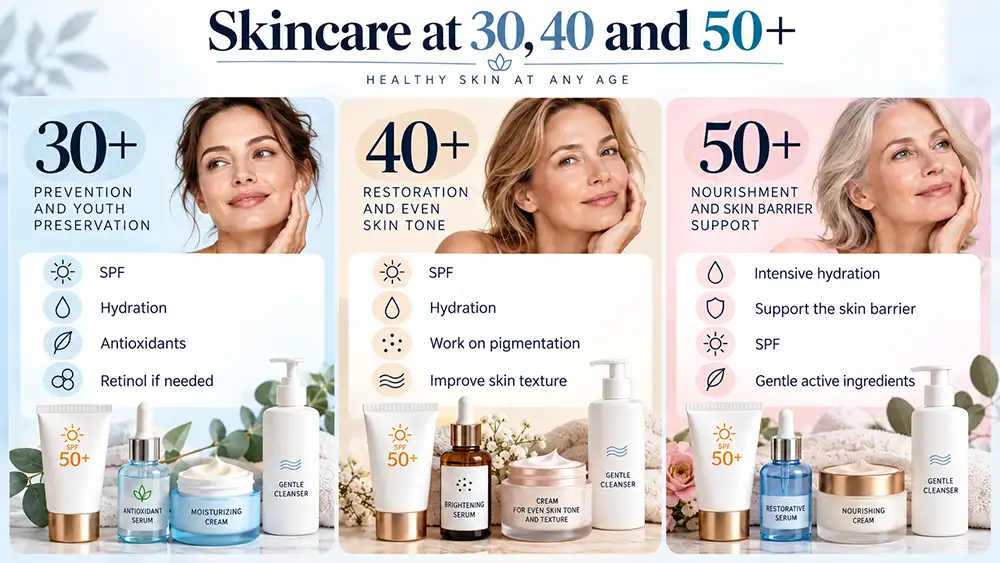
There is no separate “age-specific SPF.” For adult skin, dermatologists recommend a broad-spectrum sunscreen with SPF no lower than 30.
Ultraviolet radiation has a cumulative effect. It is photo damage that is associated with the appearance of wrinkles, spots, uneven tone, and actinic keratoses, as well as increasing the risk of skin cancer. Therefore, sun protection matters not only for appearance.
Labels like “30+”, “40+” or “50+” on packaging by themselves say almost nothing about whether the product is suitable for a specific person.
When choosing products, it is more important to assess:
For example, oily skin after 50 might require a completely different cream texture than very dry skin after 30.
Cosmetics can support the skin barrier, improve hydration, and reduce some visible signs of photoaging. But they should not replace diagnosis.
You should see a dermatologist if you notice:
A pigmented spot should also not automatically be treated as a cosmetic problem. Some pathological formations can look like ordinary age-related pigmentation on the surface, so suspicious changes require a dermatologist’s examination.
