What Is Tokenization of Real Assets Tokenization is the creation of a digital representation of a right to an asset or a related property right on a blockchain or another distributed ledger ...

22Sep


DeFi stands for decentralized finance, where lending, asset exchange, liquidity management, and other operations are executed through blockchain and smart contracts. By 2026, the market is no longer limited to simple token swaps and yield farming. The main development focuses on credit markets, stablecoins, tokenized real-world assets, DEXs, and risk management.
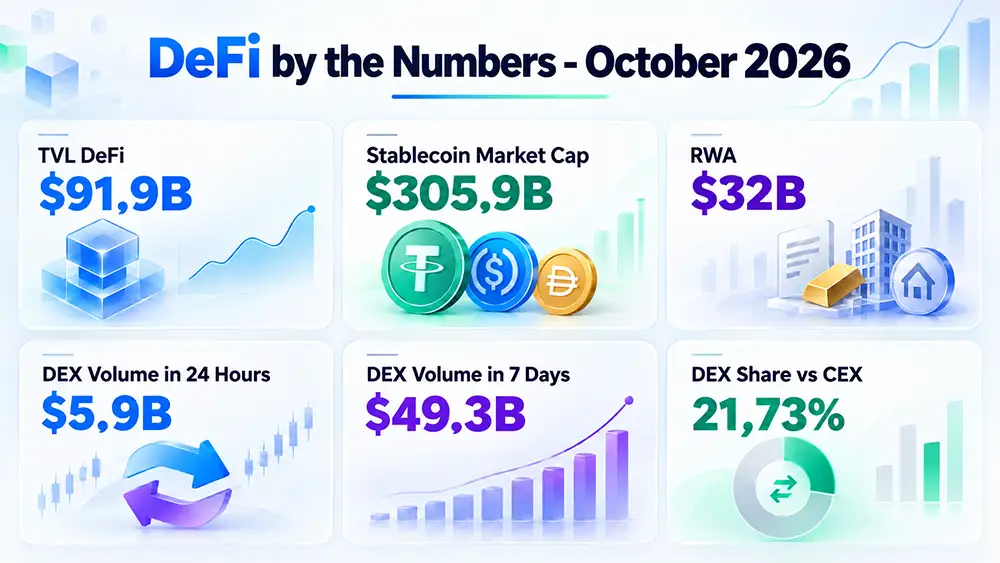
As of October 10, 2026, DefiLlama estimates the total TVL in DeFi at approximately $91.9 billion. The capitalization of stablecoins is about $305.9 billion, assets in the RWA category stand at $32 billion, and the daily trading volume on decentralized exchanges is around $5.9 billion. Over seven days, nearly $49.3 billion passed through DEXs, with the DEX to CEX volume ratio at 21.73%.
These figures are important not on their own. They show that DeFi is increasingly integrating with stablecoins, tokenized securities, and other assets that previously existed mainly outside the blockchain.
One of the main trends in DeFi lending in 2026 is the fight against liquidity fragmentation. Previously, each credit market effectively formed its own capital pool. This reduced the efficiency of fund use and created different rates even for assets close in risk.
Aave V4, launched on Ethereum on March 30, 2026, uses a Hub and Spoke architecture. The central Liquidity Hub accumulates liquidity, and individual markets operate with their own collateral, risk, and liquidation rules. According to Aave Labs, the protocol has processed over $1 trillion in loans and holds more than half of the decentralized lending market.
On the current DefiLlama TVL snapshot, Aave holds about $18.4 billion, and Morpho $11.2 billion. This shows how much of DeFi lending has become.
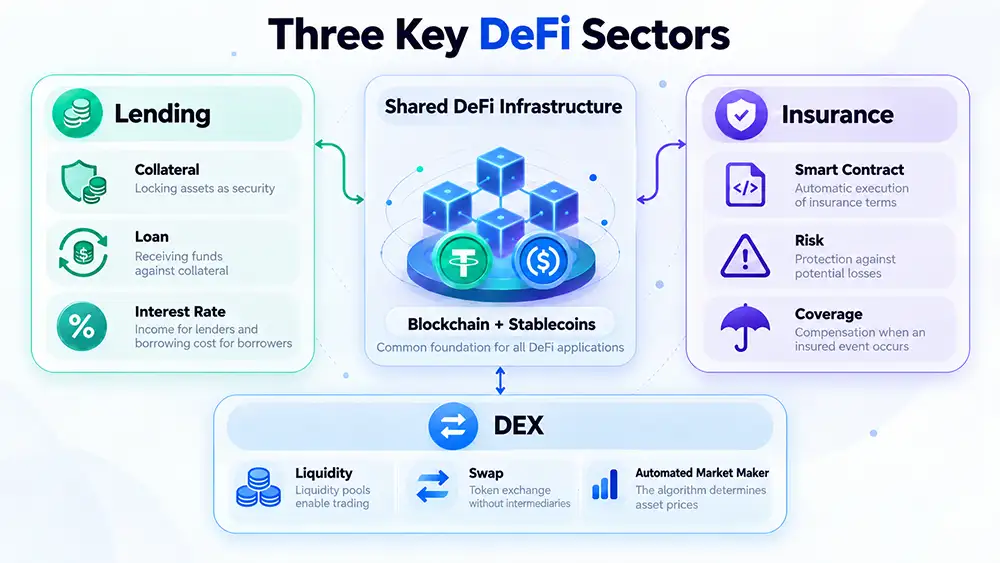
Modern DeFi loans depend more on collateral quality. Protocols separate assets by risk, applying different collateral factors, limits, and interest rate models.
Before opening a position, it is important to evaluate not only the APY. Technical parameters are also crucial:
A high rate alone does not mean a more profitable position. Often it signals high demand for loans, liquidity shortage, or increased risk of a particular asset.
Another change in 2026 is the convergence of DeFi and RWA. In September, Aave V4 on Base allowed using seven tokenized American tech stocks as collateral to obtain USDC. These include tokenized AAPL, Amazon, Alphabet, Meta, Microsoft, Nvidia, and Tesla.
This changes the very model of DeFi lending. Collateral can now be not only ETH, BTC, or crypto-native tokens but also digital representations of traditional financial assets.
Alongside this, the role of stablecoins grows. Their reserves, regulatory rules, and risks are discussed separately in the material “Stablecoins in 2026: Rules, Market, and Forecast”.
The term “DeFi insurance” is conditional. Some services are not legally classic insurers but sell onchain cover – protection against predefined events.
For example, Single Protocol Cover in Nexus Mutual may include risks of smart contract hacks, oracle issues, liquidation mechanism errors, and governance takeover. At the same time, such products may not cover asset price drops, phishing, private key compromise, or certain depeg cases.
A typical DeFi cover thus needs to be read as carefully as a traditional insurance contract. Before purchase, check:
For example, for certain Nexus Mutual products, the standard deductible is 5%, and claim submission is possible only after a specified waiting period. Therefore, a “DeFi deposit insured” should not be equated with a bank deposit with state guarantee.
Decentralized exchanges in 2026 are moving from the standard AMM formula to programmable trading infrastructure. Uniswap v4 uses hooks – external smart contracts that can modify pool behavior before or after a swap, liquidity addition, or other operations.
Hooks allow for dynamic fees, custom order logic, automatic liquidity management, and special oracles. Uniswap also develops permissioned pools for tokenized regulated assets.
In June 2026, Spark moved $150 million of stablecoin liquidity into Uniswap v4. The DualPool model allows keeping part of inactive liquidity in yield-bearing vaults and returning it to the trading pool when needed for transactions.
Even a large TVL and a multi-year protocol history do not eliminate technological risk. A smart contract can contain an error, an oracle can provide incorrect prices, a stablecoin can lose its peg, and poorly chosen collateral parameters can cause cascading liquidations.
For working with DeFi, it is useful to apply a consistent verification process:
This check is especially important for new protocols and pools with abnormally high yields. The material is informational and not an individual investment recommendation.
Decentralized technology does not automatically mean the absence of legal regulation. If a company accepts client funds, organizes lending, exchange, custodial operations, or other financial services, the legal status must be determined by the actual business model, not only by blockchain usage.
For Ukrainian businesses, this is especially important due to the gradual formation of virtual asset market rules. If a project simultaneously performs financial institution functions, it is advisable to separately check the requirements for financial services licensing.
DeFi is financial services based on blockchain, where the rules of operations are embedded in smart contracts. A user can exchange assets, provide liquidity, take a loan, or earn income without classic banking infrastructure.
On a classic DEX, operations are performed through smart contracts, and the user typically retains control over their wallet. A centralized exchange accepts assets into its own accounts and maintains internal balance accounting.
There is no absolute safety. Risks include smart contract bugs, collateral liquidation, oracle problems, stablecoin depeg, infrastructure attacks, and user errors. TVL size and audits reduce some risks but do not eliminate them completely.
The most noticeable change is the shift from isolated crypto products to a broader onchain financial infrastructure. Lending protocols unify liquidity, DEXs gain programmable trading mechanisms, RWAs are used as collateral, and risk management and cover become separate DeFi layers.