The boundary between classic search engines and AI is gradually disappearing. Previously, a user would enter a query, receive a list of links, and find the answer across several websites ...

16Oct



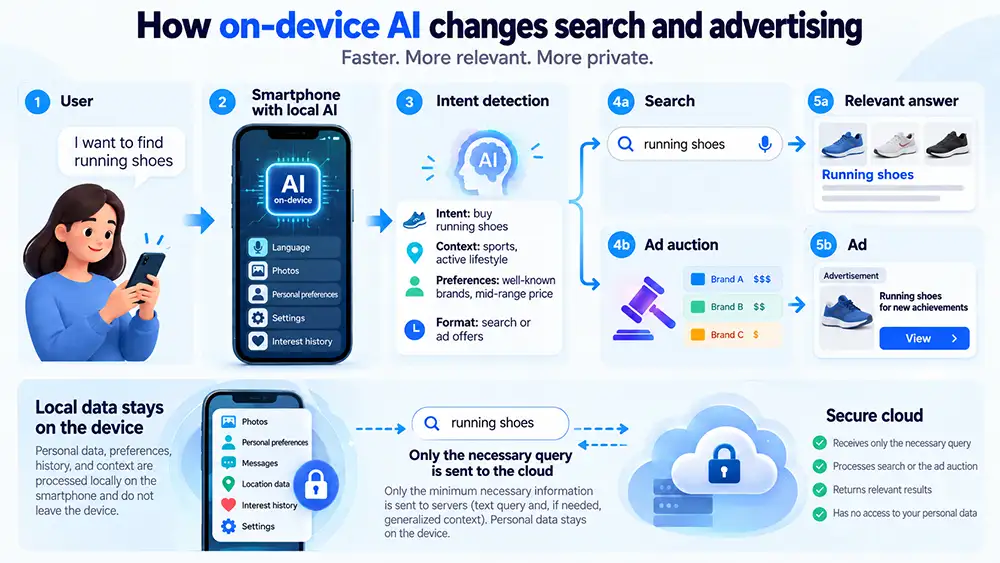
On-device AI is artificial intelligence that performs part or all of the data processing directly on a smartphone, laptop, tablet, or other user device. The request does not necessarily need to be sent to a remote server.
Google uses this approach in Gemini Nano. The model works through the Android AICore system component and can perform generative AI tasks offline without sending the corresponding data to the cloud. In Chrome, Google is also developing built-in AI APIs based on Gemini Nano, and from Chrome 140 has expanded local model execution with GPU support to supported CPUs.
For the user, local processing brings several practical changes:
This does not mean the cloud disappears. Apple, for example, uses a hybrid scheme: some Apple Intelligence models operate locally, while more complex requests can be routed to Private Cloud Compute. In September 2026, Apple confirmed that the new generation of Apple Foundation Models runs both on devices and on server infrastructure.
Search is already moving away from the “short keyword query – ten links” model. A person can describe a problem in natural language, add a photo, continue a previous query, or ask the system to consider context.
Google reported in May 2026 that AI Mode exceeded 1 billion monthly users worldwide, and query volumes more than doubled each quarter since launch. The company also noted that users increasingly ask complex and conversational queries instead of traditional keyword sets.
On-device AI adds another level to search — local understanding of context. A typical scenario might look like this:
Thus, on-device AI does not mean “Google Search without servers.” Web indexes, current news, prices, and billions of pages still require server infrastructure. The local model becomes an additional layer between the person and the search engine.
For SEO, this is a significant change. A page must correspond not only to the query “on-device AI” but also related intents: “what is on-device AI,” “local artificial intelligence,” “AI without internet,” “AI on a smartphone,” “how AI changes search,” “AI and contextual advertising,” “the future of search advertising.”
Google AI Mode already allows asking complex questions in natural language and continuing searches with clarifying queries. Therefore, for a site, thematic completeness, clear structure, accurate facts, own expertise, and pages that can be used as a reliable source for specific answers become more important.
More context about practical model usage can be found in the Poshuk.info article “AI for business in 2026 – what really worth comparing”.
Advertising is also gradually moving from simple keyword-to-ad matching to understanding intent, context, and choice stage.
In Google Search, this process is already noticeable in cloud AI products. In 2026, Google began testing new ad formats within AI Mode, including ads integrated into the process of comparing products and services, as well as Business Agent for Leads.
On-device AI can complement this model with local signal analysis without constantly sending all raw user data to the advertising platform.
There is already a close example in advertising infrastructure. Google Protected Audience API allows the browser to conduct ad auctions directly on the user’s device for remarketing and special audience scenarios.
Protected Audience itself is not generative on-device AI. But its architecture shows the principle: part of ad selection can be moved closer to the user, reducing the need for cross-site transmission of behavioral information.
For advertisers, this means an increased role of such components:
In other words, the algorithm needs not just many signals but quality signals.
More about the connection between AI, customer data, and sales is discussed in the Poshuk.info article “AI in CRM systems: how artificial intelligence is changing the sales department’s work”.
Completely — no. But their role is changing.
Google is actively moving Search campaigns to AI-driven query matching. AI Max for Search uses AI to expand matching of search terms and optimize ad creatives. In September 2026, Google also began automatically transferring part of broad match and Automatically Created Assets functions to AI Max, while the automatic transition of Dynamic Search Ads was postponed to February 2027.
A user may write not “buy orthopedic chair,” but “need a comfortable chair for working 10 hours a day to avoid back pain.” For the advertising system, it is important to understand the commercial intent of such a query even if the advertiser did not add this exact phrase to the keyword list.
Therefore, contextual advertising remains relevant, but the matching mechanism becomes more complex. You can read about the basic logic of capturing search demand in the Poshuk.info article “Why a site loses orders without contextual advertising”.
There is no need to rebuild a site solely “for AI.” It is worth adapting those elements that help algorithms accurately understand the business, page, and offer.
The second point is especially important. In 2026, Google directly links new AI ad formats with the quality of information about businesses, products, and landing pages. For Shopping AI Max, for example, the system uses Merchant Center data about material, landing, product characteristics, and other attributes to match offers with the conversational query of the buyer.
The local model does not have unlimited resources. Its capabilities depend on memory, processor, NPU, battery charge, and software support of the specific device.
Because of this, the market is moving toward a hybrid model:
That is why on-device AI should be seen not as a replacement for search engines or advertising platforms but as a new computational layer between the user, their device, and cloud services.
