Skin care after 30, 40, and 50 years should not be based solely on the number in your passport. The condition of the skin depends on genetics, ultraviolet exposure, smoking, hormonal changes, ...

26Sep



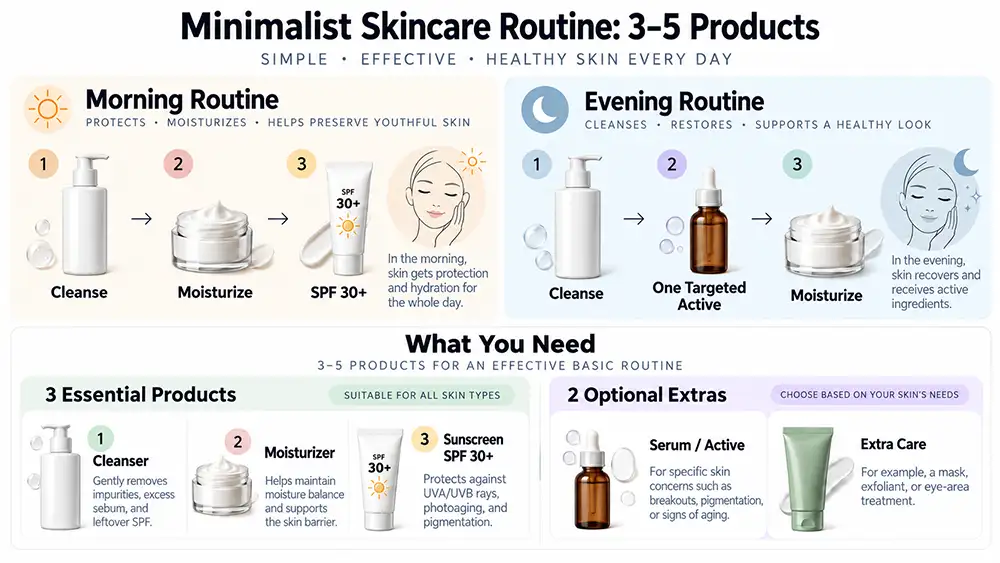
Minimalist facial care is not about giving up cosmetics, but about reducing the routine to products with a clear purpose. For most people, the basic scheme consists of cleansing, moisturizing, and sun protection. A fourth or fifth product is added only when there is a specific need: acne, pigmentation, excessive oiliness, dryness, or age-related changes.
The American Academy of Dermatology notes that an excessive number of products, especially several active agents used simultaneously, can irritate the skin. The order also matters: first cleansing, then a treatment or targeted product, followed by moisturizing and sun protection. recommendations from the American Academy of Dermatology
Three products can cover the main needs of healthy skin. It is not necessary to buy a separate toner, essence, multiple serums, mask, and cream for each area of the face.
The minimal routine looks like this:
This scheme is simple, making it easier to follow daily. And consistency in basic care is more important than the number of jars.
The cleansing product’s task is to remove skin oils, sweat, dust, makeup residues, and sunscreen without a feeling of tightness.
The American Academy of Dermatology recommends using a gentle, non-abrasive cleanser and not rubbing the skin with a washcloth or scrub. For most people, cleansing up to twice a day and after intense sweating is enough. Dry or sensitive skin sometimes only needs thorough cleansing in the evening.
When choosing, it is worth paying attention to several characteristics:
The skin should not “squeak” after cleansing. This feeling does not mean the face became cleaner.
Moisturizing is needed not only for dry skin. Cream helps reduce water loss through the stratum corneum and supports the skin barrier.
For oily or acne-prone skin, lightweight gels and fluids labeled “non-comedogenic” are often convenient. For dry skin — richer creams with ceramides, glycerin, or other moisturizing ingredients.
The American Academy of Dermatology specifically recommends people prone to acne to look for products labeled “oil-free,” “non-comedogenic,” or “won’t clog pores.”
Those who notice changes in dryness, sensitivity, or skin texture over the years should consider not only age but also its actual condition. This is detailed in the Poshuk.info article about skin care after 30, 40, and 50 years.
SPF is a basic part of daytime care, not a seasonal product for the beach.
AAD dermatologists recommend a broad-spectrum sunscreen with SPF 30 or higher. The FDA reminds that protection should be renewed at least every two hours while in the sun, and more often after swimming or heavy sweating. FDA recommendations for sunscreen use
The daily product should be chosen based on the following criteria:
Even good SPF does not replace shade, a hat, and clothing during prolonged exposure to active sun.
More products make sense only when the basic scheme already works but there remains a specific issue. Adding three new active ingredients at once is not advisable — in case of irritation, it will be difficult to identify its cause.
A targeted product is selected not by ingredient popularity, but by skin condition. For example, niacinamide is often used in formulas for oily or combination skin, and salicylic acid in products for skin prone to pore clogging.
The rule is simple:
If persistent redness, itching, swelling, strong burning, or rash appears, use of the new cosmetic product should be discontinued. For severe or prolonged symptoms, a dermatologist consultation is necessary.
The fifth product can be a makeup remover, a separate treatment prescribed by a doctor, or an additional moisturizer for very dry skin.
Double cleansing is not needed for everyone. It makes practical sense when stubborn makeup or waterproof sunscreen needs to be removed in the evening.
The morning routine should be short. Its main task is to prepare the skin for the day and protect it from ultraviolet rays.
For oily skin, a comfortable SPF with adequate hydration sometimes allows combining the second and third steps.
It is especially important in the evening not to try to use all available acids, serums, and masks at once.
Skin type primarily affects the texture of products rather than the number of steps. The three basic steps remain relevant for most people.
Skin condition is influenced not only by cosmetics. Sleep, stress, habits, and general health also can change its reactivity. You can read more about the mechanisms of this connection in the article “How Stress Affects Skin, Hair, and Weight”.
A complicated routine is not automatically more effective. This is especially noticeable when a person simultaneously introduces acids, retinoids, scrubs, and several concentrated serums.
Signals to review your care may be:
In this situation, it is advisable to return to the basic scheme of “cleansing – moisturizing – SPF,” and introduce additional products gradually.
Even a product labeled “for sensitive skin” can cause an individual reaction. AAD recommends testing a new product on a small patch of skin twice a day for 7-10 days before regular use.
To build a stable routine, it is worth acting sequentially:
Moderate to severe acne, rosacea, dermatitis, pronounced pigmentation, and other skin diseases require not an extension of the cosmetic shelf but proper diagnosis. In such cases, it is better to coordinate the care and treatment scheme with a dermatologist.
