Ferritin is a protein that stores iron and reflects its reserves in the body. That’s why the ferritin test helps detect iron store depletion earlier than a decrease in hemoglobin would show ...
21Oct


Non-hallucinogenic psychedelics are experimental compounds developed based on the mechanisms of action of classical psychedelics but without pronounced changes in perception, hallucinations, or dissociation. In scientific literature, more precise terms “psychoplastogens” and “neuroplastogens” are used for some of these substances.
They are primarily studied for their potential impact on neuroplasticity—the brain’s ability to change the structure and functional connections between neurons. This is one of the promising directions in the search for new treatments for major depressive disorder.
The need for new therapeutic approaches is significant. According to current data from the World Health Organization, approximately 322 million people worldwide suffered from depression in 2023. Among adults, its prevalence was estimated at 5.2%, with 6.2% among women and 4.1% among men.
Classical psychedelics, including psilocybin and DMT, interact with serotonin receptors. Researchers pay particular attention to the 5-HT2A receptor.
Activation of this receptor can trigger a cascade of intracellular processes related to the remodeling of neural connections. The problem is that this same pharmacological pathway is traditionally associated with perceptual changes.
Developers of new molecules strive to separate these effects. A potential model is as follows:
This concept appears biologically plausible, but neuroplasticity alone does not prove a clinical antidepressant effect. The drug must demonstrate benefits for people in controlled clinical studies.
One of the most studied experimental psychoplastogens is tabernanthalog, or TBG. It is a non-hallucinogenic analogue of ibogaine, currently mainly researched at the preclinical level.
In a study published in Nature Neuroscience in 2025, researchers demonstrated that TBG stimulated cortical neuroplasticity in rodents through mechanisms involving 5-HT2A, TrkB, mTOR, and AMPA receptors. At the same time, it did not cause the immediate glutamate release and activation of certain early response genes characteristic of classical psychedelics. The study is available in Nature Neuroscience.
The authors also linked the formation of new dendritic spines to a prolonged antidepressant-like effect in an animal model. However, there is a fundamental limitation: antidepressant-like behavior in rodents is not the same as treating clinical depression in humans.
Another experimental candidate is 5-Br-DMT. This is a modified analog of DMT, structurally incorporating a bromine atom.
A study published in Molecular Psychiatry showed that 5-Br-DMT activates serotonin receptors and stimulates dendrite growth in cortical neuron cultures. In mice, the substance did not induce a significant head-twitch response—a behavioral reaction often used as an indirect preclinical marker of hallucinogenic potential.
After a single administration of 10 mg/kg in a stress-induced depressive-like behavior model, researchers observed a reduction in depressive-like behavior within 24 hours. This cannot be interpreted as an established dose for humans or proof of efficacy in clinical depression. The research was conducted on animals.
Several stages separate a preclinical discovery from the emergence of a medicinal drug. Even a strong result in cells or rodents may not be replicated in clinical trials.
For a new antidepressant, it is necessary to:
Only after these steps can regulators evaluate the benefit-risk ratio of the drug. Therefore, preclinical psychoplastogens are currently better regarded as a research direction rather than an available treatment method.
The closest to practical psychiatry is zalsupindole—DLX-001, formerly known as AAZ-A-154. It is an oral experimental neuroplastogen structurally related to psychedelic tryptamines.
Phase I involved 106 healthy volunteers. The study tested single doses from 2 to 360 mg, as well as multiple doses up to 350 mg per day for seven days. No serious adverse events were reported. The most common side effects were nausea, headache, and dizziness.
An important result is that at the exposure levels studied, no psychotomimetic, hallucinogenic, or dissociative effects were observed. The substance was also detected in cerebrospinal fluid, and EEG showed dose-dependent changes in brain activity.
In the subsequent Phase Ib, only 18 adults with recurrent major depressive disorder participated. Nine participants received the drug daily for seven days, and nine received it on the first and fourth days. All completed the treatment period.
Preliminary data showed that by day eight, the average score on the MADRS scale decreased by approximately 12 points, corresponding to about a 50% reduction from baseline. Improvement was maintained up to day 36 of observation. Among treatment-related adverse reactions, short-term nausea and headache were most commonly reported.
These results cannot be equated with proof of efficacy. The study had a very small sample size, and its design did not include a full placebo-controlled comparison of antidepressant effect. Thus, the result should be considered a preliminary signal requiring verification in Phase II and subsequent studies.
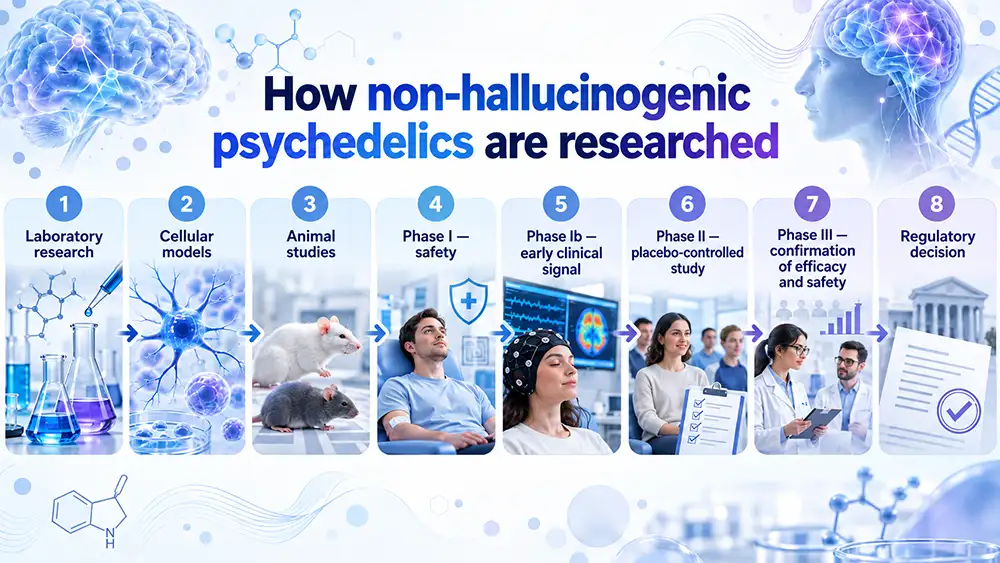
As of October 2026, non-hallucinogenic psychedelics are not a standard approved treatment for depression. Zalsupindole remains an investigational drug, while TBG and 5-Br-DMT are at earlier stages of clinical development.
In July 2026, the FDA published final recommendations regarding clinical trials of psychedelic drugs. The document regulates development and testing requirements but does not itself signify approval of any specific psychedelic or psychoplastogenic therapy.
Using DMT, psilocybin, ibogaine, or experimental analogs independently instead of prescribed treatment is unsafe. It is also inadvisable to stop taking antidepressants based on news about promising research. In cases of depressive symptoms, treatment strategy should be determined with a doctor, considering severity, comorbidities, prior therapy, and risk of suicidal behavior.
