The court fee calculator is not meant to determine the total cost of the court process, but to calculate the mandatory payment for submitting a specific application, claim, appeal, or cassation ...

23Oct



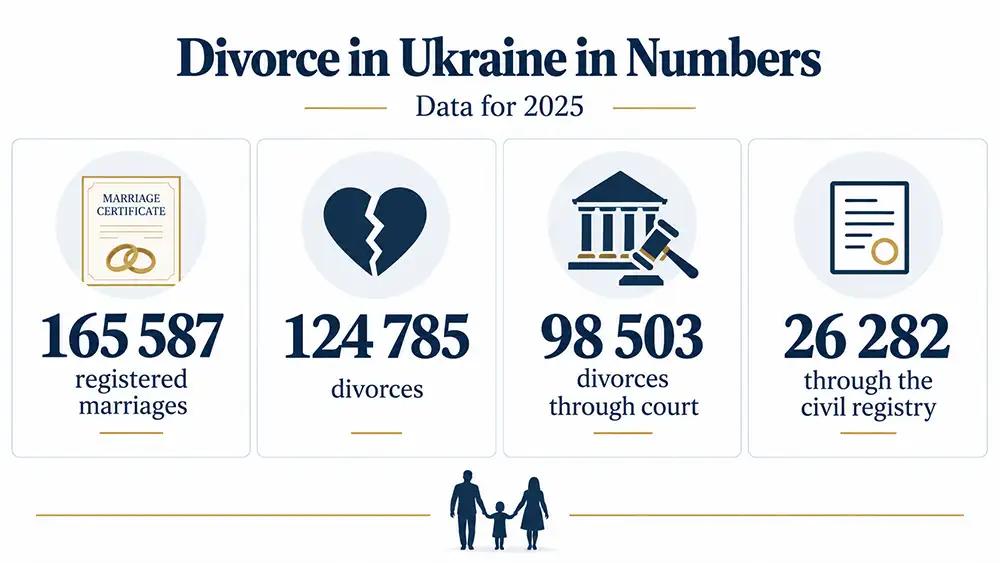
In 2025, Ukraine registered 165,587 marriages and 124,785 divorces. Of these, 98,503 marriages were dissolved through court, and 26,282 through the Civil Registry Office (DRACS). Thus, most divorce procedures still take place in court.
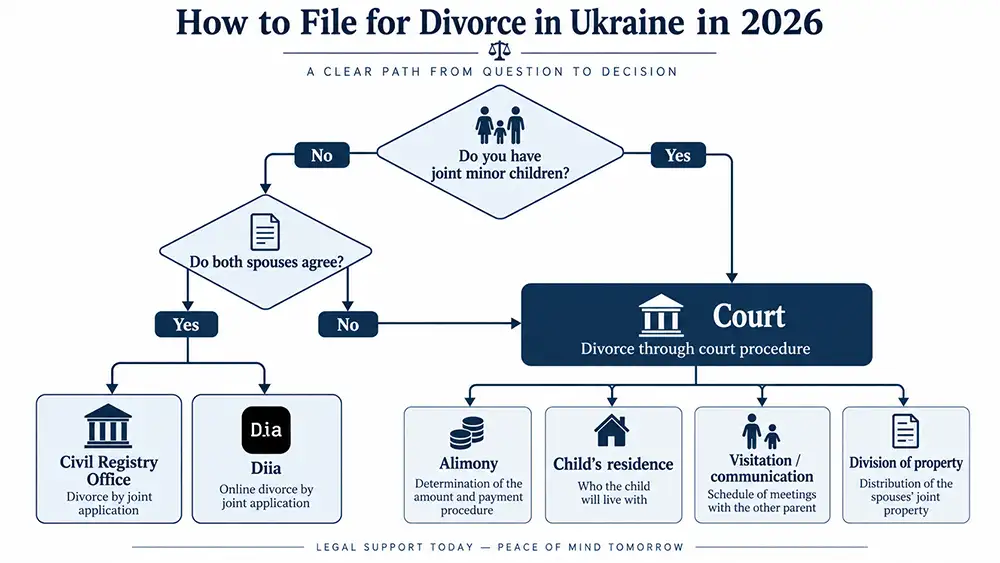
The first question is which procedure suits a particular couple. If there are no joint minor children and both agree to divorce, the marriage can be dissolved through the Civil Registry Office (DRACS).
From September 3, 2026, such a joint application can also be submitted via Diia. One spouse creates the application, the other confirms it. The marriage is dissolved after one month has passed, if the application has not been withdrawn.
The query “divorce if there are children” almost always means a court procedure. Such marriage cannot be dissolved via Diia or the regular DRACS procedure.
The spouses may apply to the court with a joint petition and an agreement that determines the children’s residence, the involvement of the other parent in their support and upbringing. The alimony payment agreement requires proper legal formalization.
Yes. Article 110 of the Family Code of Ukraine allows one spouse to independently file a divorce suit. The refusal of the other spouse does not create an indefinite prohibition on divorce.
An important change: the current edition of Article 110 no longer contains the former restrictions on filing a suit during the wife’s pregnancy and within the first year of the child’s life—the corresponding parts were excluded in 2024.
There is no fixed term for each case. Duration depends on the court’s workload, delivery of documents to the respondent, parties’ positions, disputes regarding children, property, and the need to collect evidence.
Therefore, the question “how long does a court divorce take” can be assessed by a lawyer only after analyzing the specific situation.
The exact package depends on the type of proceedings and the claims combined with the divorce.
Most often, a lawyer will ask to prepare:
The sooner a lawyer receives the documents, the more accurately they can determine the procedural strategy.
The general rule is to apply in the court at the respondent’s registered place of residence, but the law contains exceptions. In particular, the residence with the claimant of minor or underage children or other circumstances provided by procedural law may matter.
That is why it is better to determine jurisdiction before submitting the petition, rather than after documents are returned by the court.
Yes, issues of divorce and child support can be considered in court. At the same time, a lawyer may recommend separating claims if this allows faster resolution regarding alimony.
Divorce itself does not terminate the obligation of parents to support the child. Alimony can be collected even without prior divorce.
Article 182 of the Family Code stipulates: the guaranteed minimum alimony per child cannot be lower than 50% of the subsistence minimum for a child of the corresponding age.
The court also considers the financial situation of the parties, health condition, presence of other property, children, and even proven significant expenses of the payer.
There is no universal option. If the payer has a stable official salary, a share of income may be convenient. With irregular income, work abroad, or complex earning structures, a lawyer may recommend a fixed amount.
The financial situation of the parties should determine the method of collection.
Divorce does not automatically determine the child’s place of residence. If parents do not agree, the dispute can be solved by guardianship authorities or a court.
The court assesses fulfillment of parental duties, child’s attachment, age, health, and other important circumstances.
Yes. The parent living separately does not lose the right to participate in upbringing and communicate with the child.
If agreement is not possible, the order of visits, duration, location, holidays, and other conditions can be legally determined.
The fact of divorce alone does not grant one parent unlimited right to decide all child-related matters alone. The travel procedure depends on the child’s age, trip circumstances, place of residence, and current border crossing rules at the time of travel.
Thus, the query “child traveling abroad after divorce” should be checked directly before the trip.
Generally, the shares of the wife and husband in joint property are equal unless otherwise agreed or stipulated in a marriage contract. However, the court may deviate from equality in cases provided by law.
Practical nuances and a list of evidences are discussed in detail in the Poshuk.info article “Division of spouses’ property: which documents are needed for a peaceful agreement or court”.
Not all spouses’ property automatically becomes joint. A lawyer first establishes the date and basis of acquiring the apartment, car, land, funds, or other assets.
Particularly important are documents about inheritance, gifts, pre-marriage acquisition, and use of personal funds.
The fact of marriage does not mean that any credit is automatically split in half. The purpose of the funds receipt and whether they were used for family needs matter.
The Family Code allows enforcement on joint property if the court finds the contract was concluded in the family’s interest and the funds were used for its needs.
LLC shares, corporate rights, dividends, capital contributions, and entrepreneur’s assets require separate analysis. Formal registration of business on one spouse does not always fully answer the property rights of the other.
In such disputes, the lawyer analyzes the time of business creation, source of funds, asset structure, and corporate documents.
Before court, it is important to determine which assets existed and when they were acquired. Do not rely solely on oral statements.
To prove this, the following may be needed:
A lawyer can use procedural mechanisms to obtain evidence and secure claims if there are legal grounds.
Yes. After divorce, a three-year statute of limitations applies to claims about division of joint property.
But an important detail: three years are counted not automatically from the date of divorce, but from the day the co-owner learned or could have learned about the violation of their right. While the marriage is not dissolved, this statute does not apply.
The presence of the other spouse outside Ukraine does not in itself block the possibility of divorce. However, the lawyer needs to check the respondent’s address, notification procedure, jurisdiction, and the possibility of remote participation in the process.
Here, a prior lawyer consultation is especially useful, as an error in jurisdiction or notification may delay the case.
Such cases require a different approach. Since 2024, Article 111 of the Family Code directly provides: if one spouse committed domestic violence, the court does not apply reconciliation measures regardless of the status of criminal, civil, or administrative proceedings regarding such violence.
Issues of safety, evidence, children, housing, and possible restrictive measures need comprehensive analysis.
To avoid the consultation turning into a general talk, it’s better to immediately get answers regarding the procedure, risks, and budget of the case.
For complex cases regarding alimony, children, or asset division, it is advisable to consult specifically a family law lawyer, since such disputes often go far beyond the mere fact of divorce. On Poshuk.info you can submit a request and compare offers from specialized legal firms.