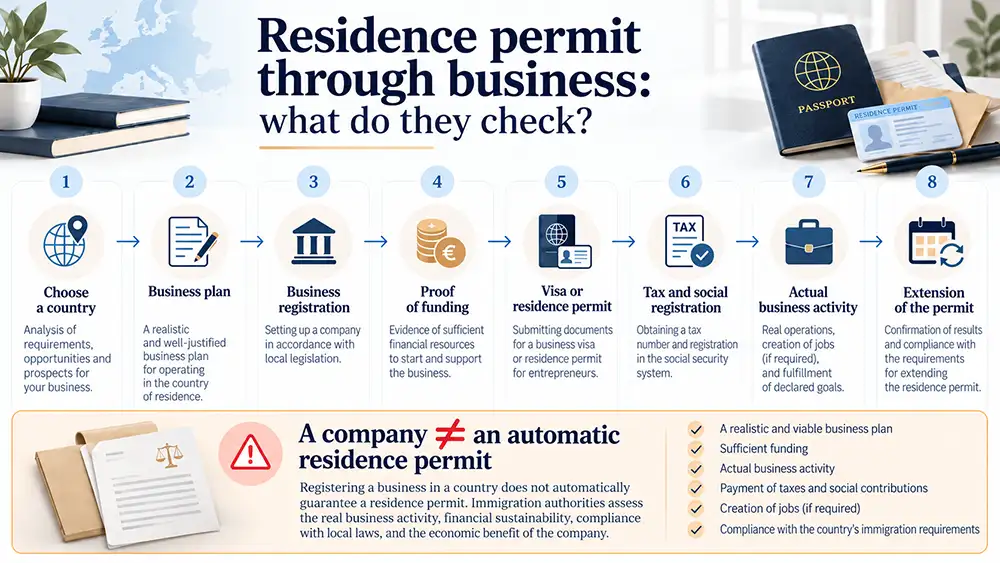
Business registration in the EU is not a single universal procedure for all 27 member states of the European Union. A company is established according to the legislation of a specific country: ...

02Oct



A residence permit through business in Europe is not automatically granted after registering a company. In most countries, it is necessary to separately prove the migration basis: genuine entrepreneurial activity, financing, the economic feasibility of the project, professional experience, availability of housing, and sufficient funds for living. Simply owning a share in a company can be only one of the evidences.
There is no single pan-European permit for entrepreneurs either. This article primarily concerns EU countries, where the rules for third-country nationals are established by national legislation.
Before choosing a jurisdiction, it is useful to separately study the conditions for company registration in Europe, and for specific directions – company registration in Germany and company registration in Czechia. Corporate registration and the migration procedure remain two different processes.
Each state independently determines who can obtain a residence permit through business, for what term it is issued, and what needs to be confirmed. Even the logic of evaluating an applicant varies.
In Germany, a third-country national can obtain a residence permit for self-employment according to §21 of the Residence Act. For commercial business, authorities assess the economic or regional interest, the expected positive impact of the project on the economy, and the availability of financing through own capital or credit. For applicants over 45 years old, proper pension provision is also checked. Detailed requirements are published on the official portal Make it in Germany.
An initial permit for entrepreneurial self-employment can be issued for a maximum of three years. If the business operates successfully and the entrepreneur can support themselves and their family, owners of the permit under §21 may obtain a permanent settlement permit after three years.
In Czechia, a third-country national usually needs the appropriate right to conduct business and a long-term visa for entrepreneurship. After staying on such a visa, one can apply for a long-term residence permit for business.
According to the EU Immigration Portal for Czechia, a long-term business visa is generally issued for a maximum of one year, while the permit for entrepreneurship is granted for up to two years with the possibility of extension. For the permit, besides confirming the purpose of stay, housing, and financial means, confirmation of no debt to tax, customs, insurance, and social authorities may be required.
Portugal has a separate basis for independent professional and entrepreneurial activity. AIMA requires a valid visa for independent activity, proof of registration in the tax system and social security, as well as evidence of actual activity — for example, a service contract or a document of company establishment.
The temporary permit under this basis is valid for two years and can be renewed for subsequent three-year periods. That is, the established company can be part of the evidence package, but by itself does not replace the migration procedure.
For self-employment in Spain, a residence and work permit and an appropriate visa are required. The applicant must submit a viable business plan, confirm sufficient financing, qualifications or experience, and, if necessary, obtain licenses. Authorities also assess the potential of the project to create jobs. An initial permit for such activity is issued for one year.
The exact package depends on the country, citizenship, type of entrepreneurial activity, and chosen legal form. However, the main set of documents in most entrepreneurial routes is similar.
A bank statement by itself does not replace a business plan. Conversely, a well-prepared business concept does not compensate for the absence of necessary financing, license, or legal right to conduct the declared activity.
In the migration procedure, the business plan does not work as an advertising presentation for investors. It should explain where the customers will come from, how much the launch will cost, what expenses the company will have, and how the entrepreneur will finance their living.
Particular attention should be paid to figures. An unrealistic profit forecast without contracts, experience, or confirmed financing can raise more questions than a restrained and well-founded plan.
The fewest legal problems arise when corporate and migration parts are planned simultaneously. The typical sequence looks like this:
The order of actions is crucial. If you first buy or register a company, then check migration rules, you might get a full legal entity but fail to gain the right to live long-term in the country.
The document package is only part of the case. Authorities may assess whether there is real economic substance of the declared business and whether the actual situation corresponds to the business plan.
These factors are especially important during the renewal of the permit, when it is possible to review what has happened since relocation.
At the stage of the first application, the forecast plays a significant role. At renewal, actual figures appear: contracts, turnover, tax declarations, contributions, accounting reports, and activity history.
Therefore, a company created only “for documents” poses an obvious risk. Real entrepreneurial activity is important not only for the first permit but also for maintaining the status.
Ukrainians who already benefit from temporary protection in an EU state do not always need to switch to an entrepreneurial permit just to start their own business. Temporary protection provides the right to reside and access to the labor market, including self-employment. By the decision of the EU Council, protection for those displaced from Ukraine has been extended until March 4, 2028.
A business permit may be relevant as a long-term migration strategy. Before changing status, it is necessary to check whether the specific country allows switching the legal basis without leaving, how the previous period of residence will be counted, and what rules will apply to family members.
Denial is often not related to the absence of one paper, but to a mismatch between the declared purpose and the evidence. Some problems can be seen even before submitting documents.
Therefore, comparing countries only by the price of company registration is incorrect. Requirements for financing, personal presence, housing, insurance, taxation, status renewal, and further obtaining permanent residence rights are equally important.