DeFi Market in 2026: Numbers and Structure DeFi stands for decentralized finance, where lending, asset exchange, liquidity management, and other operations are executed through blockchain and ...

10Oct



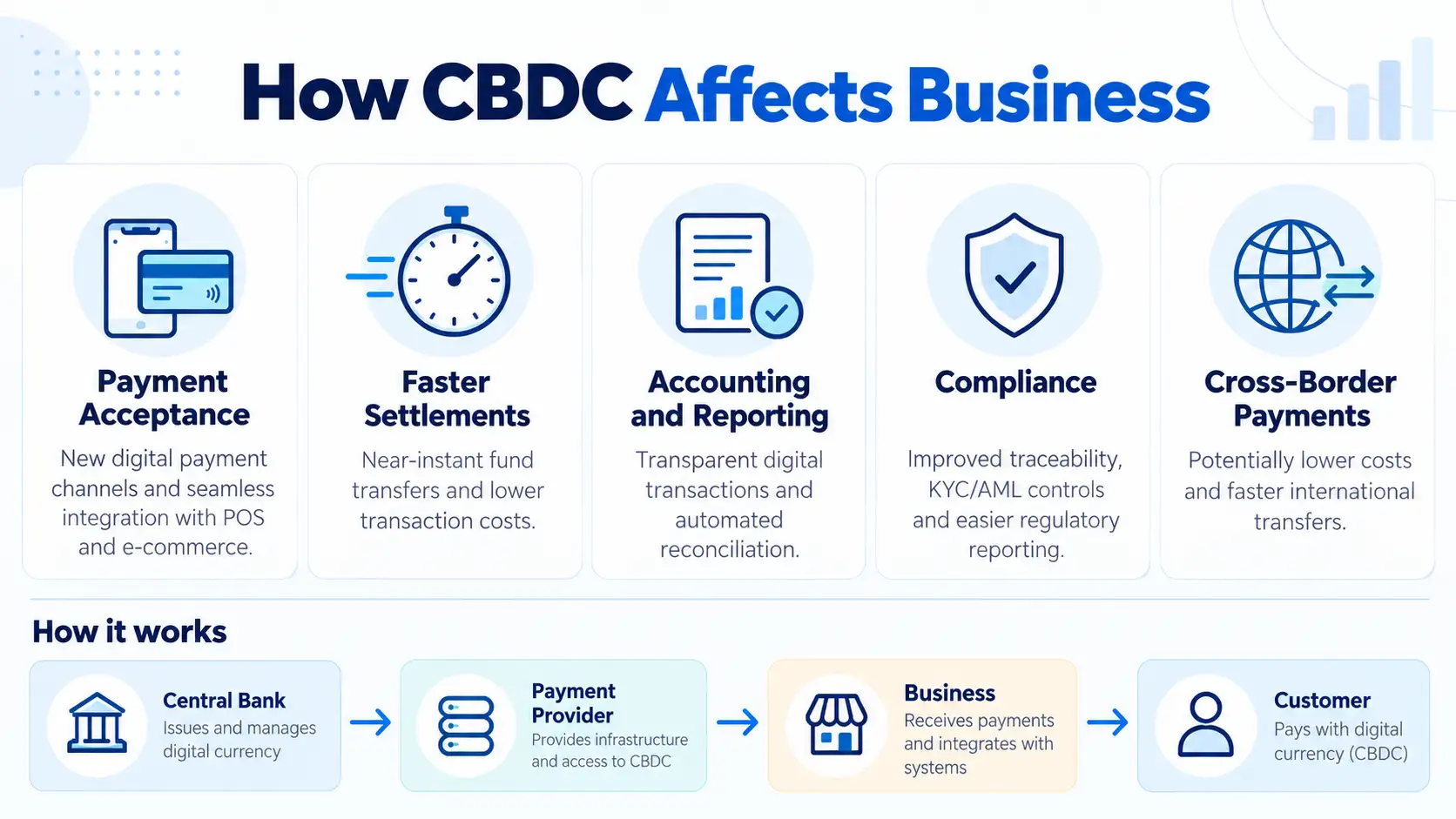
Central bank digital currencies (CBDCs) can change the ways of paying for goods and services, accelerate financial settlements, and reduce costs for certain payment operations. For businesses, their implementation will mean the emergence of new payment instruments, the need to adapt accounting practices, and additional cybersecurity requirements.
CBDC (Central Bank Digital Currency) is a digital form of the national currency issued by a country’s central bank. Unlike money in a regular bank account, CBDC is a direct liability of the central bank, not a commercial financial institution.
A digital currency can be used for payment of goods, transfers between individuals, enterprise settlements, and transactions between financial institutions. Specific capabilities depend on the technical architecture and the country’s legislation.
According to the Bank for International Settlements (BIS) study published on August 22, 2025, 85 out of 93 surveyed central banks, or 91%, were researching retail or wholesale CBDCs during 2024. Over a third of jurisdictions sped up the work due to the spread of stablecoins and other crypto assets.
Central bank digital currencies are often compared with cryptocurrencies. However, there are fundamental legal and economic differences between these instruments.
| Characteristic | CBDC | Bank Money | Bitcoin | Stablecoins |
|---|---|---|---|---|
| Issuer | Central Bank | Commercial Bank | No centralized issuer | Typically a private organization |
| Backing | Central bank liability | Commercial bank liability | No traditional backing | Depends on stabilization mechanism |
| Value | Nominal national currency | Account currency nominal | Market determined | Usually pegged to another asset |
| Regulation | Central bank and national legislation | Banking legislation | Depends on jurisdiction | Depends on jurisdiction |
| Main use | Payments and settlements | Payments, deposits, loans | Transfers and investments | Transfers, trading, settlements |
CBDCs do not necessarily use blockchain. Central banks may choose a centralized database, distributed ledger technology, or a combined architecture.
The key difference lies in the nature of the obligation. If a commercial bank holds client funds in an account, it is responsible for fulfilling depositor requirements. In the case of CBDC, the issuer of digital money is the central bank.
Central banks develop two main categories of digital currencies. They differ in user base, functionality, and purpose.
Retail digital currency is intended for everyday payments by the population and businesses. Potentially, it allows paying for purchases via smartphone, digital wallet, or compatible payment terminal.
Main usage scenarios:
For entrepreneurs, the most significant aspect will be the ability to integrate CBDC into existing payment acceptance systems without substantially complicating cash register operations.
Wholesale CBDCs are primarily intended for financial institutions and settlements between professional market participants.
They are researched for interbank transfers, securities settlements, tokenized asset transactions, and international payments.
For an ordinary enterprise, such changes might go unnoticed. A company will continue working through its bank, but financial institutions may potentially settle between themselves faster.
One potential advantage of CBDCs is reducing the time between payment initiation and final settlement.
Today, transfer speed depends on banks, payment systems, their operation modes, and international settlement rules. CBDCs can provide rapid final execution if such capabilities are built into their architecture.
However, instant payments already exist without CBDCs. Therefore, speed alone is not a unique advantage of central bank digital currency.
CBDCs can potentially reduce costs for certain transaction processing stages. However, this does not automatically mean fees for entrepreneurs will be eliminated.
The overall payment cost will depend on the following components:
Companies should compare not only transaction fees but also integration costs, payment reconciliation, refund processing, and system maintenance expenses.
For businesses with a large daily number of transactions, the speed of incoming funds directly impacts working capital.
For example, a company receives 500 payments daily with an average amount of 800 UAH. The total incoming volume is 400,000 UAH.
If funds become available faster, the company can use them earlier for purchases, supplier settlements, or other current needs.
This is a hypothetical example, not a forecast of savings from CBDCs. The actual result will depend on the rules of the specific payment system.

International payments remain an area of CBDC research. Enterprises working with foreign counterparties may gain new ways to conduct cross-border operations.
Technically, this is possible if central banks and payment operators ensure system compatibility.
However, the existence of a digital hryvnia and digital euro does not automatically mean direct transfers between them are possible.
Coordinated rules will be needed for international operations:
Legal and technological compatibility will determine the practical benefit of CBDCs for exporters and importers.
The European Central Bank continues preparations for the digital euro. It is one of the most significant CBDC projects for Ukrainian enterprises cooperating with European Union companies.
According to official information from the ECB about the digital euro pilot, 36 payment providers from eurozone countries were selected for participation. The regulator received over 50 applications in total.
The pilot is planned for the second half of 2027 and will last 12 months. Participants will test payments between individuals, payments in stores, and e-commerce.
ECB Executive Board member Piero Cipollone noted that the high interest in the pilot demonstrates the private sector’s readiness to contribute to the development of the digital euro and strengthening the European payment system.
The ECB aims for possible technical readiness for the first issuance during 2029, provided the necessary EU legislation is adopted in 2026.
As of October 30, 2026, there is no final decision on the issuance of the digital euro.
For Ukrainian enterprises, forthcoming rules on non-resident access, international settlements, and use of the digital euro through payment providers remain particularly important.
E-hryvnia is a digital form of the hryvnia, which should be issued by the National Bank of Ukraine. Its nominal value will correspond to the regular hryvnia at a 1:1 ratio.
The NBU has been researching the possibility of creating its own digital currency since 2016. In 2018, the regulator conducted a closed pilot project to test distributed ledger technology, issuance mechanisms, and payment execution.
In the concept of the e-hryvnia implementation by the National Bank of Ukraine, various usage scenarios are considered, including retail payments, transfers between users, and programmable operations. The document describes a preliminary vision, not a finalized model.
As of October 2026, a large-scale release of e-hryvnia for everyday use by the population and businesses has not occurred.
Potential application areas depend on the final model approved by the National Bank.
Possible scenarios include:
The last option implies the use of programmable payments. For example, the system could make a transfer after confirming contractual conditions are met.
At the same time, the ability to program payments does not necessarily mean the central bank will control the purpose of every unit of digital currency. Such mechanisms depend on architecture and legal restrictions.
Despite potential advantages, central bank digital currencies introduce additional technological and organizational requirements.
| Risk | Possible impact on business | Mitigation method |
|---|---|---|
| Cyberattacks | Unauthorized operations or loss of access | Multifactor authentication, access control |
| Technical failures | Temporary inability to accept payments | Backup payment channels |
| Regulatory changes | Additional reporting and inspection requirements | Regular legal audit |
| Compatibility issues | Complicated integration with ERP and POS | Use of standardized APIs |
| Usage restrictions | Limits on balances or transactions | Diversification of payment instruments |
| Personal data protection | Risk of unauthorized information access | Encryption and privacy policies |
For fintech companies, the legal status of services they plan to provide will be especially important.
Businesses developing their own payment products should assess in advance registration requirements as a financial institution and possibilities of obtaining the appropriate license. Poshuk.info provides information about registration of financial companies in Ukraine.
Meanwhile, merely accepting digital currency as payment does not necessarily require a separate financial license. Requirements will depend on the company’s role and legislation.
Using central bank digital currency does not exempt from maintaining accounting, documenting business transactions, and fulfilling tax obligations.
After CBDCs are introduced, companies will need to establish procedures for:
Specific accounting entries will depend on national standards, regulator rules, and the legal status of the CBDC.
For companies with a large number of payments, it is important to ensure automatic data transfer between payment platforms and accounting systems.
The mere fact of using CBDCs does not imply a new tax. Tax consequences will be determined by the nature of the business transaction and relevant legislation.
For example, if a company sells goods for digital hryvnia, it does not change the economic essence of the sale. However, there may be additional requirements for documentary payment confirmation and its accounting reflection.
For cross-border operations, currency regulation, international income tax rules, and financial monitoring requirements must also be considered.
Businesses do not need to immediately change payment infrastructure. It is more reasonable to evaluate system readiness and monitor regulator decisions.
Practical preparation includes several stages.
It is advisable to plan integration expenses after official technical specifications and access rules are issued.
Current projects do not envisage automatic abandonment of bank accounts, cards, and cash. For example, the European Central Bank considers the digital euro as a complement to existing forms of money.
The further role of CBDCs will depend on user demand, legislation, technology availability, and economic feasibility.
For businesses, the main question is not which form of money will completely replace another, but how to ensure convenient payment acceptance, expense control, and compatibility of various payment channels.