Which NACE Codes Are Needed for IT and Online Business For operating as an individual entrepreneur (FOP) or company in the IT sector, it is not enough to just indicate “programming” ...

18Sep



Registering an IT company abroad means creating a separate legal entity under the legislation of another country. This can be a company in the EU, the United Kingdom, the USA, or another jurisdiction that signs contracts with clients, receives payments, hires employees, and owns intellectual property.
The mere fact of foreign registration does not automatically transfer the entire business and taxes outside Ukraine. For a Ukrainian founder, the important factors are their tax residency, the place of actual management of the company, ownership structure, CFC (Controlled Foreign Company) rules, and international double taxation avoidance agreements.
For an IT company, a foreign legal entity is often needed not because of lower taxes. More often, the reason is client requirements, payment infrastructure, attracting investments, or entering a specific market.
Main advantages of such a structure:
These advantages make sense only when the structure corresponds to the real business model. A “paper” company without a clear economic purpose can create more tax and banking problems than benefits.
There is no universal “best country for an IT company.” The jurisdiction should be chosen according to clients, founders, staff, payments, investments, and future business sale.
| Option | What Attracts IT Business | What to Check |
|---|---|---|
| EU countries | access to the single European market, clear B2B rules, developed banking system | corporate tax, VAT, payroll contributions, GDPR, substance requirements |
| United Kingdom | English law, clear corporate model, international business environment | tax residency, banking compliance, no EU membership |
| USA | access to a large market, investors, and technology ecosystem | federal and state taxes, LLC or Corporation form, rules for non-residents |
| other jurisdictions | specific tax or administrative advantages | country reputation, banking restrictions, substance, international information exchange |
For example, on Poshuk you can separately review conditions for registering a company in the Czech Republic and registering a company in Cyprus. For entrepreneurs comparing working through Ukrainian and European structures, materials about entrepreneur taxation in Poland and Ukraine are also useful.

A foreign company of a Ukrainian entrepreneur can fall under controlled foreign company (CFC) rules. According to the State Tax Service of Ukraine, a controlling person may be a tax resident of Ukraine owning more than 50% of a foreign company. The rules also cover ownership greater than 10% if Ukrainian residents together control 50% or more, as well as cases of actual control.
When creating a structure, three issues need to be checked separately:
The controlling person must notify the tax service within 60 calendar days of acquiring a share or beginning actual control. In 2026, individuals submitted CFC reports for 2025 alongside annual declarations by May 1, 2026.
At the same time, the €2 million threshold is often misinterpreted. If the total income of all CFCs of one controlling person does not exceed the equivalent of €2 million for the reporting period, the adjusted income of the CFCs under certain conditions may not be included in taxable income. This does not mean automatic exemption from all reporting obligations.
Relocating servers, opening accounts, or registering a company in another country by itself does not make its owner a non-resident of Ukraine.
The Tax Code considers place of residence, permanent home, center of vital interests, and, under certain conditions, presence in Ukraine for 183 days. The center of vital interests can include family and economic ties.
Therefore, the scheme “register a company abroad and no longer pay taxes in Ukraine” does not work automatically.
This point is especially important for IT business. A founder can register a company abroad but continue to manage accounts, the team, contracts, and key business decisions from Ukraine.
The Ukrainian Tax Code explicitly considers the place of effective management of a foreign company. Criteria include regularly holding executive body meetings in Ukraine, making managerial decisions, and conducting ongoing operational activities primarily from Ukraine.
International rules also consider the real presence of the business. The OECD explains that employees working or managing activities from another state under certain conditions can create a “permanent establishment,” to which the relevant country can attribute part of the profit for taxation. More on this is covered by the OECD.
Opening a company is often easier than opening a full corporate account. Banks and payment systems check beneficiaries, source of funds, clients, countries of payment, and reasons for choosing a particular jurisdiction.
Usually, to pass compliance, you will need to prepare:
A legal address without actual activity is not always sufficient. For some tax regimes and international structures, substance—the actual economic presence of the company—matters.
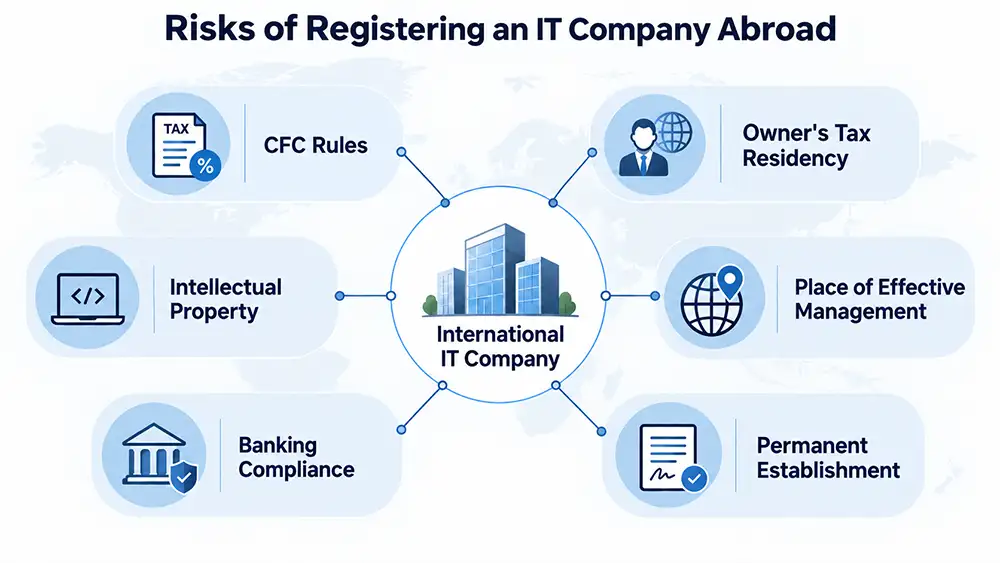
For SaaS, mobile apps, marketplaces, or other digital products, it is important not only to register a company but also legally assign to it the rights to the results of the founders’, full-time developers’, and contractors’ work.
If this is not done, during investment rounds or business sales, it may turn out that the company formally does not own part of the software code, design, trademark, or other assets.
Contracts with the team should clearly regulate the transfer of property rights, confidentiality, payment, use of third-party software, and termination procedures.
It’s better to start decisions not with the question “where is it cheaper to open a company” but with a map of all tax and operational connections of the business.
The practical sequence looks like this:
After such analysis, it becomes clear whether a separate foreign company is needed at all. For a small team working mainly from Ukraine, a complex international structure sometimes only increases costs for accountants, lawyers, banks, and reporting.
Yes. Ukrainian law does not provide a general prohibition for a Ukrainian resident to be a founder of a foreign company.
At the same time, it’s necessary to comply with Ukrainian tax and reporting requirements if they apply to a specific structure. It is especially important to check CFC rules, owner residency, and taxation rules for received dividends or other income.
Not necessarily. A low nominal corporate tax rate does not automatically mean a lower overall tax burden.
You need to account for corporate tax, taxes on dividend payments, payroll contributions, VAT, accounting, audit, legal address, banking expenses, and tax consequences for the owner in Ukraine.
Such structures are used in practice, but transactions between related parties require separate analysis. It’s not recommended to artificially split one business between a sole proprietor and a foreign company just for tax results.
Contracts, prices, actual functions of the parties, and cash flows should correspond to real economic operations.
A foreign legal entity is most logical when the business already has an international component.
Typical situations:
Before registration, it is advisable to obtain a separate opinion on corporate, tax, and currency legislation of Ukraine and the registration country. Rules depend on ownership structure, founder’s residence, and the actual company operation model.
