How to Confirm a Person’s Death in a Temporarily Occupied Territory If a person died in a temporarily occupied territory of Ukraine, having a death document issued by the occupying ...

19Sep



Contents of the article
For private housing, the legally correct term is a lease agreement for residential premises, although colloquially the term “apartment rental agreement” is more often used. According to Article 810 of the Civil Code of Ukraine, the owner transfers the residential premises to the tenant for living for a specified term in exchange for payment.
Article 811 of the Civil Code of Ukraine directly requires the lease agreement of residential premises to be in written form. A typical apartment lease agreement between individuals does not require mandatory notarization. The exception is lease with purchase option agreements.
Even when renting an apartment without intermediaries, it is not advisable to rely solely on a receipt for payment or correspondence in a messenger. A full agreement records who uses the housing and under what conditions, how much is paid, who is responsible for repairs, and when the security deposit is returned.
The agreement should allow unambiguous identification of the apartment, parties, term of use, and financial conditions. The fewer phrases like “as agreed by the parties,” the less room for conflict.
The basic terms to include are:
It is also necessary to specify bank details or another agreed method of payment. When paying non-cash, a payment purpose such as “payment of apartment lease for October” simplifies confirming payments in case of a dispute.
The term must be specified exactly: for example, from October 15, 2026, to October 14, 2027. If the term is not defined at all, Article 821 of the Civil Code of Ukraine provides that the agreement is considered concluded for five years.
It is also advisable to specify the renewal procedure. For example, parties may agree to notify each other in writing about extending or terminating the lease 30 days before the end date.
The amount is set by the parties. Article 820 of the Civil Code also stipulates that unilateral changes in rent are not allowed unless the agreement or law explicitly provides so. If payment date is not specified, payment is made monthly.
It is better to define in the agreement:
This protects both parties. The tenant understands financial obligations, and the owner has a clear payment control mechanism.
The security deposit is one of the most common causes of disputes after eviction. Often, parties call “deposit” the amount equal to one month’s rent, but the term itself explains nothing.
It’s safer to clearly state in the agreement that the money is a security payment, why it is given, and in which situations the owner can use it to cover debt.
It is necessary to record:
For example, parties can set the deposit return within 3-7 business days after signing the handover act and finalizing utility payments.
The owner should have contractual rights to use part of the security payment to cover overdue rent, unpaid utilities, or documented damages.
At the same time, normal wear and tear should not be equated with damage. For example, worn floors after prolonged residency and broken glass are different situations. Therefore, the apartment’s condition should be documented before handing over the keys.
The agreement alone is not enough. It is advisable to attach a handover act with detailed apartment description.
The act should specify:
Photos can be attached to the act. If there is already a stain on the sofa, a scratch on the door, or a crack on the tile, it is better to fix this before moving in than to argue about their origin a year later.
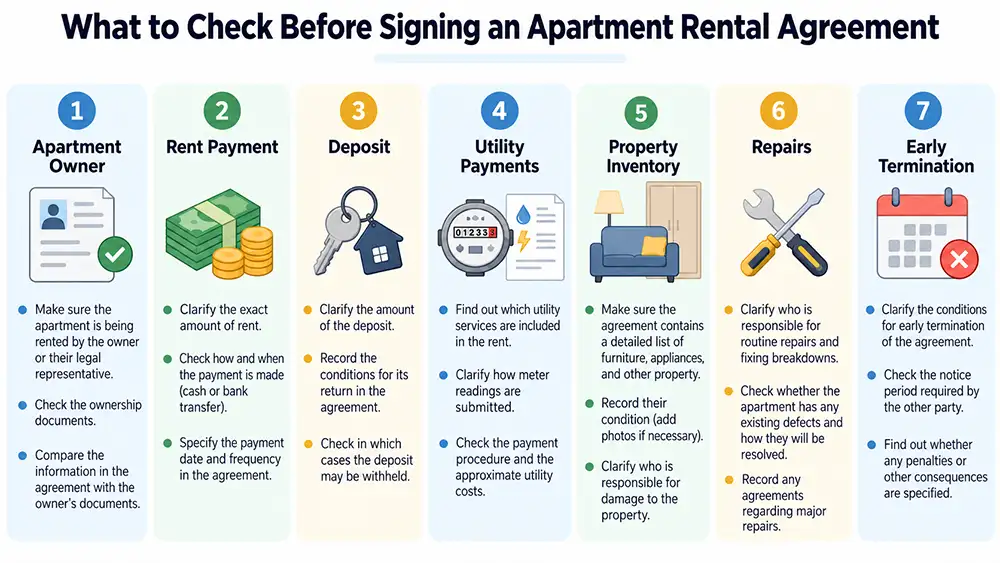
According to Article 815 of the Civil Code of Ukraine, the tenant independently pays utilities unless the parties establish a different arrangement in the agreement.
However, phrases like “tenant pays utilities” are insufficient. Specific payments should be detailed.
Parties must determine who pays for:
Meter readings should be recorded on the move-in date. It should also be specified that debts incurred before the apartment handover do not transfer to the tenant.
The law sets a basic rule: the tenant carries out current repairs, and the landlord is responsible for capital repairs unless the parties agreed otherwise. This is provided by Article 819 of the Civil Code of Ukraine.
However, in practice, the boundary between current and capital repairs is not always obvious. Therefore, it is better to detail in the agreement.
For example, you can specify:
Emergency situations should be outlined separately. If a pipe bursts or there is a short circuit, the tenant should be allowed to promptly call emergency services, and the parties should have a clear payment procedure for such work.
Leasing an apartment does not mean the owner can come without notice at any time. It is better to set the access procedure directly in the agreement.
A practical option is requiring notice at least 24 hours prior and visits at agreed times. For emergencies such as fire, flooding, or real property threats, a separate urgent access procedure can be stipulated.
This protects the tenant’s right to peacefully use the housing while allowing the owner to inspect their property without conflicts.
Rules for early move-out should be agreed upon before moving in, especially important for long-term leases.
Article 825 of the Civil Code grants the tenant the right to refuse the agreement by giving the landlord written notice three months in advance. If the tenant leaves without notice, the owner may demand rent for three months under legal conditions if they prove they could not lease the property to another person under the same terms.
It is advisable to establish a clear procedure in the agreement:
Early termination can also be provided for due to systematic late payments, significant property damage, misuse of the housing, or other specific breaches.
Renting an apartment without intermediaries allows direct agreements between parties, but document verification becomes especially important.
Before handing over money to the tenant, it’s worth:
If ownership is divided between multiple persons or a representative signs the agreement, it is better to verify before handing over money. For complex cases, Poshuk offers legal consultations on housing and contract issues, covering disputes between tenants and landlords.
For standard lease agreements between individuals, the Civil Code requires written form but does not mandate notarization. Notarization is mandatory only for leases with a purchase option.
However, parties can voluntarily seek a notary if they want additional document verification or have complex arrangements. Suitable specialists can be found in Poshuk’s “Notary Services” section.
The most dangerous agreement is a short document that records only the rent price. It hardly answers questions arising from actual apartment use.
It is especially important to avoid mistakes such as:
Each of these points can be regulated with one or two sentences in the agreement. This is much simpler than after eviction proving who owes utility bills, who damaged the furniture, or why the owner withheld the entire deposit.
