Victoria Ishchenko is the director and founder of “Consulting-Top”, a company specializing in accounting and tax support for businesses. The company works with sole proprietors and ...

14Oct



Tax accounting for a sole proprietor of Group 3 is primarily built around the correct determination of income. It is from the revenue received that the single tax and military levy are calculated.
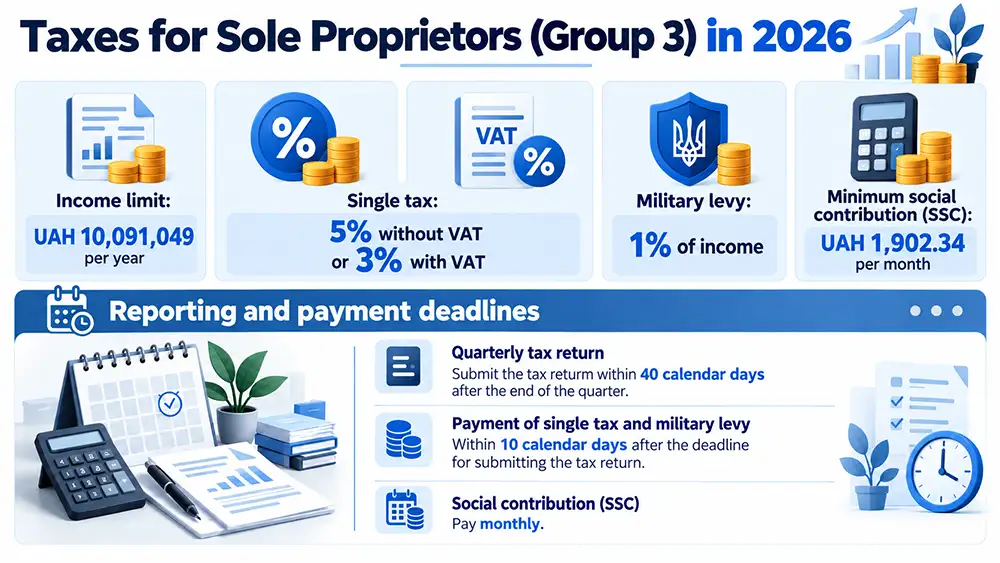
In 2026, the annual income limit for the third group is 10,091,049 UAH, which is equivalent to 1,167 minimum wages. The relevant figures are confirmed by the State Tax Service of Ukraine.
The sole proprietor applies one of two single tax rates:
Thus, for a typical Group 3 sole proprietor without VAT, the current tax burden is 6% of received income plus USC.
The single tax operates on a cash basis in practice. The date of income receipt, according to the general rule, is the day when the money actually arrives to the entrepreneur in cash or non-cash form. This is explicitly stated in Article 292 of the Tax Code.
Therefore, it is not enough to just consider the date of the invoice, act, or contract conclusion.
For example, if a service was provided on September 28, and the client transferred 40,000 UAH on October 3, according to the general rule, this amount is accounted for as income in the 4th quarter.
It is especially important to monitor carefully:
For foreign currency revenue, the income amount is converted to hryvnias at the official NBU exchange rate on the date the funds are received.
A separate mistake arises with card payments. If a buyer pays 10,000 UAH, but the bank transfers only 9,850 UAH to the entrepreneur after deducting its commission, the income cannot automatically be considered only as 9,850 UAH.
According to the State Tax Service’s explanation regarding acquiring, when payments are made with the issuance of a fiscal receipt, the full revenue amount including the bank commission is included in income. The date of income in such cases is the date indicated on the fiscal receipt.
A Group 3 sole proprietor without VAT is not required to keep the old registered income record book. The Tax Code allows keeping records in any form with monthly reflection of received income. Records can be organized electronically.
In practice, it is advisable to record more information than just a monthly total:
Such a register greatly simplifies declaration preparation. If the volume of operations is large or there are employees, foreign currency receipts or VAT, professional accounting services for sole proprietors at Poshuk.info can be used. The page presents companies engaged in record keeping, reporting, and tax calculation.
For an entrepreneur of the third group with a 3% rate, the rules are more complex. Such a sole proprietor keeps records of income and expenses according to the standard form established by the Ministry of Finance and also complies with tax legislation requirements concerning VAT.
Therefore, the model “calculate card inflow and multiply by 3%” does not replace full tax accounting.
The reporting period for Group 3 sole proprietors is a calendar quarter. The declaration must be submitted within 40 calendar days after the last day of the quarter.
The procedure is as follows:
The military levy for Group 3 sole proprietors is directly reflected in the single taxpayer’s declaration.
Suppose a sole proprietor without VAT received income of 300,000 UAH for the quarter and has no exemption from USC.
The calculation looks like this:
The total burden for the quarter in this example is 23,707.02 UAH. The actual calculation should consider the specific entrepreneur’s status, VAT, employees, and possible legal USC exemptions.
Any form of accounting does not mean that a sole proprietor can operate without documentary confirmation of transactions. Tax accounting must be based on documents and information that confirm received income and business transactions.
The working archive should include:
For most other primary documents, the Tax Code establishes a minimum retention period of 1,095 days, but longer periods apply for certain transactions. The State Tax Service also notes that under certain conditions documents must be kept longer, particularly if a documentary audit has not been conducted.
Before a possible audit, it is useful to cross-check declarations, bank receipts, primary documents, and cash registers. A detailed algorithm is available in the Poshuk.info material “How to Prepare for a Tax Audit – Step-by-Step Guide for Sole Proprietors and LLCs”.
Most problems arise not from the complexity of the tax rate itself, but from incorrect income determination.
Particular attention should be paid to:
Exceeding the limit has tax consequences. The excess amount for a Group 3 sole proprietor is taxed at a single tax rate of 15%, after which there is an obligation to switch to another taxation system in the manner prescribed by the Tax Code.
Entrepreneurs who want to keep records independently will also find useful the material “Tips and Resources for Sole Proprietors: Keeping Accounting Independently or Outsourcing”. To check current rates and changes, you can use the review “New Tax Legislation for 2026 – Taxes for Sole Proprietors and LLCs”.
