How Financial Services Licensing Works in 2026 In 2026, the basic principle remained unchanged: financial services can be provided by institutions and other persons who have the right to conduct ...

05Oct



A license in Ukraine is gradually ceasing to be associated with a paper application, a personal visit, and separate correspondence with a governmental body. The state is transferring some procedures to a digital format, with the key infrastructure for this becoming the “ePermit” system.
The legal foundations of licensing are defined by the Law of Ukraine “On Licensing Types of Economic Activities”. It establishes which types of activities require a license, what powers licensing authorities have, and under what conditions a business gains the right to operate.
An important detail: a license is not required for every business. Only those types of activities explicitly defined by legislation are subject to licensing. Therefore, before launching a company, it is worth clarifying not only the NACE code but also whether a separate permit, license, declaration, or other document is necessary.
In July 2026, the Cabinet of Ministers moved the “ePermit” from experimental mode to permanent operation. The system effectively became the sole digital infrastructure through which various permitting procedures are being gradually connected.
According to the Ministry of Economy, during the experimental phase:
These figures do not reflect the entire Ukrainian license market but rather the results of the digital system. However, they demonstrate the direction of changes well: businesses are increasingly interacting with regulators remotely, and some information verification occurs through state registers.
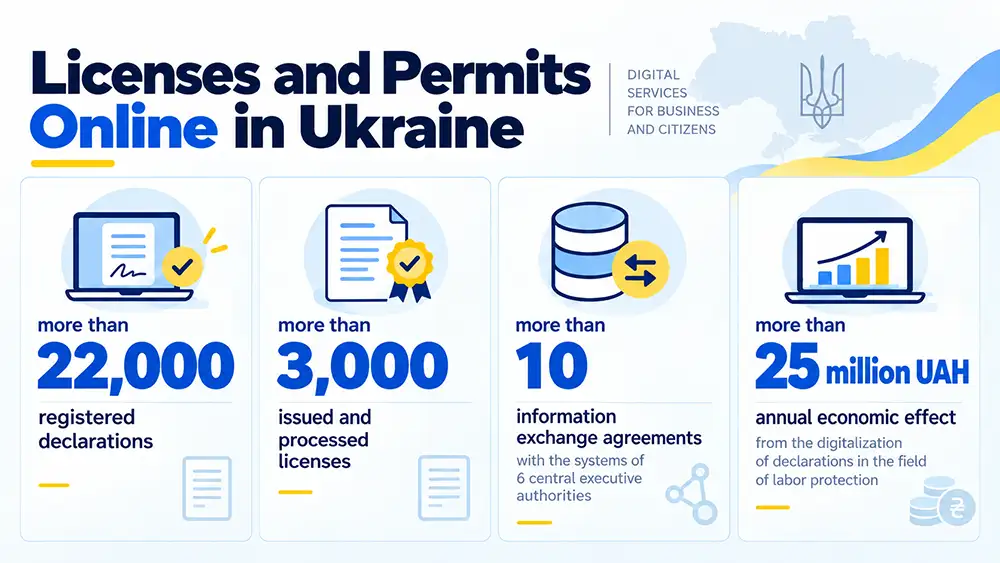
One universal procedure for all spheres does not yet exist. The order depends on the type of economic activity, the relevant authority, and whether a particular service is connected to the digital system.
The basic algorithm looks like this:
According to Law No. 222-VIII, an economic entity may engage in activities subject to licensing from the day the licensing register contains information about the decision to issue a license. The mere fact of submitting an application does not create this right.
The official portal “ePermit” unites electronic permitting and licensing procedures. The system interacts with the “Diia” portal and state registers.
Among the implemented or prepared directions, the Ministry of Economy named declarations related to labor protection, veterinary practice, licensing activities involving the circulation of narcotic drugs, psychotropic substances and precursors, as well as tour operator activities.
This does not mean that all permits can now be issued the same way. Some services operate online, some are in the implementation stage, and some spheres have their own electronic systems and special rules.
The license market is heterogeneous. For some entrepreneurs, a permit is required before the actual business launch; for others, licensing requirements define personnel, transport, equipment, premises, or internal control systems.
On Poshuk.info, a dedicated section business licensing covers medical practice, transport, security activities, work with hazardous waste, fuel, precursors, and other directions.
For example, a license for medical practice is associated not only with submitting an application. The specialties of medical staff, material and technical base, and compliance with specific licensing conditions matter.
A different model applies to licenses for international transport, where the procedure is influenced by the type of transport, vehicles, and transportation law requirements.
Therefore, the search query “how to get a license online” does not have a single correct answer without specifying the type of activity.
Digitalization changes the way documents are submitted but not the criteria for market admission. If the law requires qualified personnel, specified equipment, or certain organizational conditions, the electronic form does not allow bypassing these.
This is where entrepreneurs most often confuse two different stages: submitting an application and compliance with licensing conditions.
Common reasons for problems may be:
Automatic verification of state data reduces the amount of paper documents but simultaneously makes errors in registers more noticeable. Before submitting an application, it is advisable to check the EDR (Unified State Register), addresses, NACE codes, and other company information.
The key change is not just transferring the application from paper to screen. The system forms an electronic licensing or permitting case and can obtain some information directly from state registers.
The “one-time information submission” approach means that a business does not have to repeatedly provide a document if the required data already exists in the state information system and technical interaction allows obtaining it.

For an entrepreneur, this changes the practical approach to the question “how to get a permit online.” First, it is necessary to determine the legal requirement, then find the official electronic service, check the licensing conditions, and only after that submit an application. If a specific license is not yet integrated into “ePermit” or “Diia,” one should use the procedure of the relevant authority established for the respective activity type.