Registering an IT company abroad means creating a separate legal entity under the legislation of another country. This can be a company in the EU, the United Kingdom, the USA, or another ...

07Oct



Ukrainian startup “Nexora Labs” developed a B2B SaaS platform to automate processing of customer requests in e-commerce. At the time of inquiry, the team had an MVP, initial pilot contracts, two potential investors, and a problem blocking scaling — foreign clients were unwilling to sign contracts with individuals or a local entity without a clear jurisdiction, tax model, and banking history.
The key requirement was to register a company in Europe with the ability to receive payments from clients in the EU, USA, and UK, manage intellectual property rights, work with contractors, handle accounting, and pass KYC procedures with banks and payment services.
To start, the team created a list of business requirements that influenced the choice of country, company form, and future management structure.
After analysis, the team rejected the chaotic “register where cheapest” approach and moved to a model where jurisdiction is selected based on the product, clients, banking, taxes, and investment strategy.
Get accounting advice here.
For “Nexora Labs,” it was important not just to open a company in Europe, but to create a legal shell that would not hinder sales. In the B2B segment, clients check the company registry, VAT status, legal address, beneficiaries, privacy policies, data processing agreements, and GDPR compliance.
![[Diagram: 'Criteria for choosing a country for IT company' – 35% banking and payment infrastructure, 25% taxes, 20% client trust, 10% registration speed, 10% cost of maintenance.]](https://poshuk.info/wp-content/uploads/2026/06/kryterii-vyboru-krainy-dlya-it-kompanii-en.webp)
During comparison, Estonia, Poland, Czech Republic, Ireland, and Cyprus were considered. Estonia proved practical for a remote model, as the e-Residency program allows foreign entrepreneurs to manage a company online, and the OÜ format suits small IT teams, SaaS projects, consulting, digital services, and international service trade.
The comparative selection logic was as follows:
This phase took 12 working days but saved the team several months of possible re-registrations, bank rejections, and tax errors.
The team chose the OÜ model in Estonia. For the startup, this meant remote corporate management, electronic document flow, access to the European company register, and a clear structure for clients from the EU.

Before submitting documents, the founders agreed on the cap table. Two co-founders received 40% each, CTO got 15%, and 5% was reserved for a future option pool for key employees. This decision was included immediately in corporate documentation to avoid conflicts after revenue generation.
The registration package included these elements:
After registration, the company received a registration number, corporate profile, legal address, and a base for opening an account. Separately, the team prepared an English-language document package for the bank: pitch deck, product description, website, sample contracts, cash flow forecast, and founders’ source of funds explanation.
Order a legal consultation on company registration in Estonia on this page.
The most challenging stage was not the business registration in Europe itself, but the financial infrastructure. The payment provider checked not only passport details, but also the website, income sources, client countries, subscription model, refund policies, and actual economic activity.
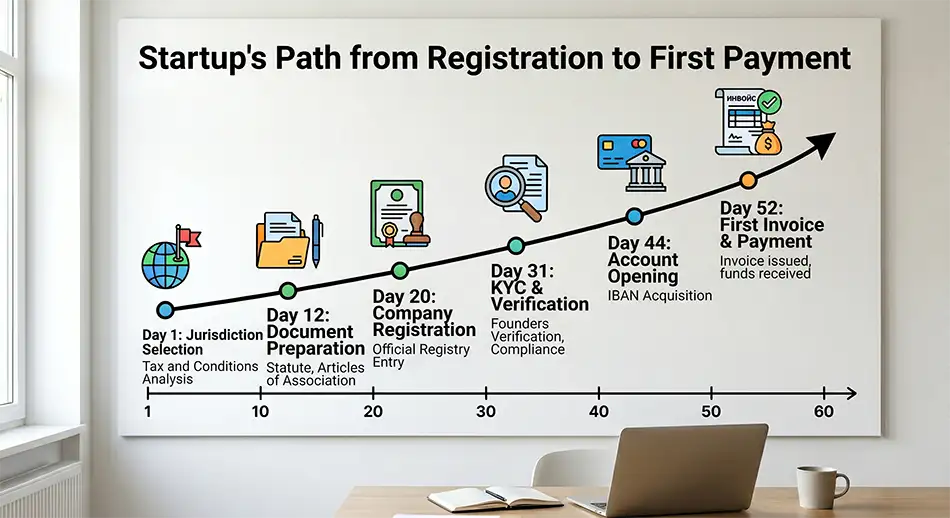
To pass compliance without delays, the team acted step-by-step:
Fifty-two days after project start, the company issued its first invoice to a European client for 8,400 euros. By the end of the first quarter after launch, turnover reached 37,600 euros, with repeat subscription payments accounting for 68%.
For an IT company, registering a legal entity abroad makes no sense without properly arranging intellectual property. Code, design, database architecture, brand, documentation, technical specifications, and domains must be linked to the company, not scattered between founders and contractors.
The team conducted legal consolidation of assets so future investors would see not only the product but also control over rights.
After this, the startup was able to pass due diligence without chaotic document collection. The legal structure became part of sales, not just a formality for accounting.
Six months after launch, the company had 14 paying B2B clients, 3 partner integrations, a stable monthly recurring revenue (MRR) of 18,900 euros, and a prepared data room for investor negotiations. Registering the company in Europe provided the startup not only with a foreign legal entity but also a working system for contracts, payments, taxes, banking, and scaling.
![[Statistical chart: 'Key metrics dynamics over 6 months' – MRR: 0, 3,200, 7,800, 11,600, 15,400, 18,900 euros; clients count: 0, 3, 6, 8, 11, 14.]](https://poshuk.info/wp-content/uploads/2026/06/dynamika-klyuchovykh-pokaznykiv.webp)
The final case result can be described by specific metrics:
The case demonstrated that registering an IT company abroad works only when connected to the commercial model. The startup not only opened a company in the EU but also created infrastructure for sales, finances, contracts, tax reporting, rights protection, and capital attraction.
For teams planning to open an IT company in Europe, it’s important not to copy another’s jurisdiction blindly but to verify their own scenario. SaaS, mobile app, marketplace, outsourcing, AI platform, fintech solution, or e-commerce service all have different requirements for banking, licensing, taxes, contracts, and compliance.
The optimal roadmap looks like this:
This sequence reduces risks of bank rejections, tax claims, founder conflicts, and loss of product rights. For IT business, a foreign company should be not just a business card but a legal platform for growth.