A residence permit through business in Europe is not automatically granted after registering a company. In most countries, it is necessary to separately prove the migration basis: genuine ...

22Oct



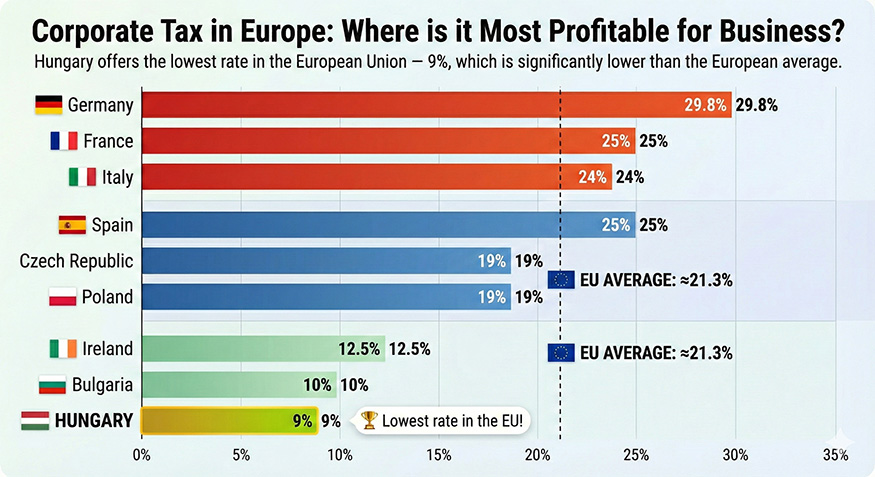
Registering a company in Hungary – a popular choice for entrepreneurs from Ukraine and businesses from the European Union that are looking for a predictable legal system, access to the single market, and a clear taxation model. In addition to reputational advantages, setting up a company in Hungary is often chosen because of a competitive corporate tax rate and the possibility to complete a significant part of the process remotely through electronic procedures with the involvement of a lawyer.
Below is a practical guide to help you register a company in Hungary correctly – from basic requirements and filing documents to taxes, reporting, and choosing between a branch and a subsidiary.
For company registration in Hungary to proceed without delays, it is important to build the right legal structure from the start: the company form, ownership structure, address, and management. Hungary’s registration system operates through registration courts, and the data is available in an official online company register.
Before moving on to documents, pay attention to the key requirements that are most often checked at the initial stage.
These criteria form the baseline that a Hungarian company typically meets when it is established for real operations rather than formal presence.
It is also important to note that corporate procedures are filed electronically, and in most cases mandatory legal representation by a lawyer is required when interacting with the registration court.
The choice of form affects the amount of capital, governance, reporting obligations, and the ease of bank compliance. Most foreign founders choose a «Kft» as the equivalent of a limited liability company, with a minimum share capital of 3,000,000 Hungarian forints.
Below is a quick overview of the company types most commonly used by business clients.
After choosing the form, you can move on to preparing the document package and planning the tax model.
The set of documents depends on the company form, the residency of the founders, and whether online company registration in Hungary is planned remotely. However, the core logic is almost always the same: identification of the participants, incorporation documents, address, management, and then filing documents through a lawyer.
Below is a standard list prepared for most registrations.
Once the document package is finalized, the lawyer prepares the filing to the registration court, and then steps for tax registration and bank interaction are launched in parallel.
In practice, the process looks like a managed project with clear stages: preparation, signing, electronic filing, assignment of registration data, tax setup, opening an account, and launching reporting. Official information about the company is available in the state online register, which is convenient for banks and counterparties.
Below is the typical sequence of actions.
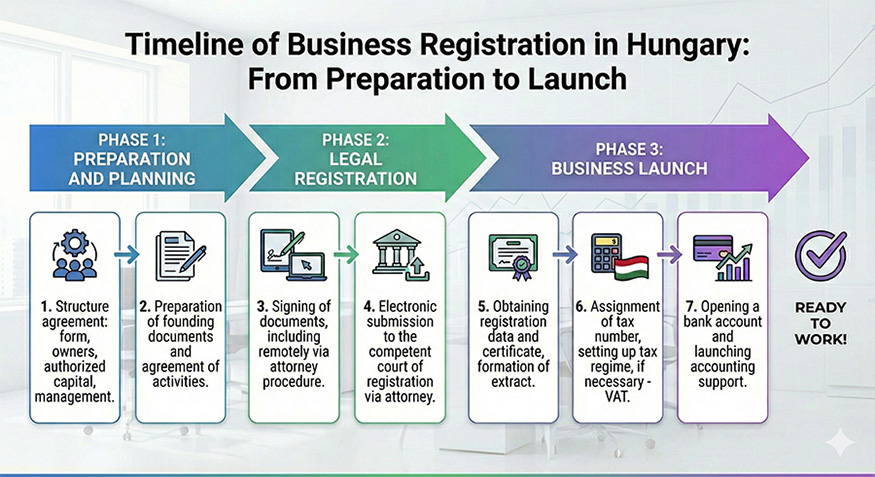
In real practice, the longest part is often not the court stage but bank compliance and preparing a correct ownership structure to avoid additional requests.
Businesses expect predictability – therefore it is correct to separate state fees from the cost of professional services. Pricing also depends on whether urgent registration is needed, whether a registered address is required, whether accounting is included, whether bank support is needed, and whether the option of buying a ready-made company in Hungary is being considered.
Below is what typically forms the project budget.
As a general guideline, part of the fees may be fixed, but the total cost always depends on the scope of tasks and the business risk profile. For example, certain procedures differ in publication-related charges, and this should be considered at the start.
If a client wants the cheapest possible company formation in Hungary, we usually advise not to save on key elements – ownership structure, bank compliance, and accounting – because that is exactly where the most expensive mistakes occur.
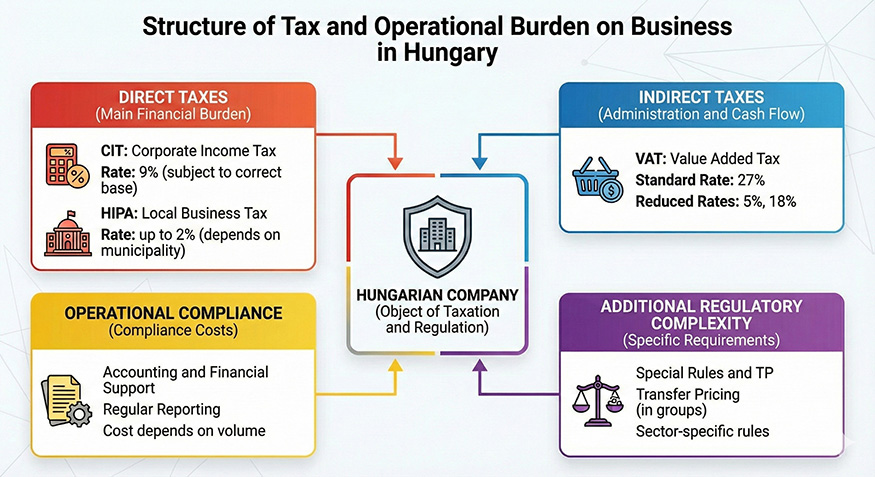
Tax planning is not only about the corporate income tax rate, but also local levies, VAT, special sector-specific charges, and correct reporting. Corporate income tax in Hungary is 9% of taxable profit, and the standard VAT rate is 27%.
Below is a basic map of the tax burden that is useful to have before operational activity begins.
In practice, for most companies it is critical to set up reporting processes from the outset, establish a filing calendar for declarations, and adopt internal policies for data protection and document flow.
This decision depends on whether full legal autonomy is required, or whether presence without creating a separate legal entity is sufficient. A subsidiary usually works better for contracting, opening bank accounts, and attracting investment, while a branch can be suitable for a faster start when the parent company already exists.
Below are comparative criteria we recommend relying on.
After such an analysis, it becomes clear whether it is worth registering a company in Hungary as a separate legal entity or whether a branch is sufficient for specific tasks.
Businesses often ask about ready-made companies, «nominee services, ready-made companies», and the possibility to complete everything remotely. Such tools do exist on the market, but they must always be legally clean, with transparent origin, clear beneficial owners, and no risks for the bank account and tax authorities.
Below are situations when such options may be appropriate and when they should be approached cautiously.
Ultimately, the right tool is chosen not because it is «the fastest» or «the cheapest», but based on your business process, tax profile, and the bank’s requirements.
In registration projects, the greatest value comes not only from filing documents, but from risk management – from ownership structure to the bank, taxes, and further support. That is why many clients choose full legal support with guarantees, clear timelines, and understandable accountability of lawyers.
Below is what professional support typically includes.
After the company is launched, lawyers often continue to support contract matters, intellectual property, data protection procedures, and, upon request, scenarios for how to liquidate a company without unnecessary risks.
If you do not want to spend time searching dozens of websites, the platform allows you to view a list of professional law firms and bar associations that are leaders in company registration across the European Union. The website also allows you to create a consultation request – it will be received by all law firms that meet professional requirements for registering a company in Hungary and are verified in this service category.
This makes it possible to compare terms, timelines, and pricing, and to choose the most advantageous option without unnecessary calls and separate submissions to each firm. The client does not need to visit different law firm websites and submit separate requests – after posting a request on Poshuk.info, it is immediately received by all professional law firms and bar associations that meet the requirements in this category. As a result, the client saves time and receives several consultations about the service at once, after which they can choose the best conditions for their needs.
If you are planning to register a company in Hungary, open a bank account, build a tax model, or clarify residence permit questions based on business – submit a request for a free consultation on Poshuk.info. You will receive several responses from verified teams and will be able to choose the optimal support format for your budget and business goals.
Is there a company register in Hungary and how can I check a counterparty?
Yes, company data is available through the official company register in Hungary, and search and basic information are available online.
Is online company registration in Hungary possible remotely?
Procedures are filed electronically through a lawyer, and the format of signing and identification depends on the specific case.
What is the minimum share capital for a «Kft»?
As a rule, the minimum is 3,000,000 Hungarian forints, and the structure of capital contributions is defined by the incorporation documents.
Which taxes are key for business?
Most often these are corporate income tax, VAT, and the local business tax, as well as obligations for regular reporting.
Is it possible to buy a ready-made company in Hungary?
Such solutions are possible, but they require legal due diligence of the company’s history, its liabilities, and a compliance assessment for the bank and tax authorities.