On-device AI is artificial intelligence that performs part or all of the data processing directly on a smartphone, laptop, tablet, or other user device. The request does not necessarily need to ...

28Sep



Sl8 by Cassator Corp emerges at the intersection of three rapidly converging markets: social networks, crypto payments, and real-world asset tokenization. The platform is positioned not as just another social network for content posting but as a SocialFi ecosystem where a user profile, audience, reputation, digital wallet, and financial interactions operate within a single environment.
Sl8 is a social crypto platform developed by Cassator Corp, a technology company focused on blockchain infrastructure for social and financial interaction. According to the project press release, it is described as a next-generation SocialFi platform with a native Financial Layer — an integrated financial layer that allows users to make payments, transfers, donations, or monetize content without leaving the social network.
The key distinction of Sl8 lies in its attempt to unify functions typically separated across different services. Users don’t just publish content, build an audience, or follow other creators; they also access financial tools within the same platform.
Within Sl8’s structure, several core components define it as a new type of crypto social network:
This model makes Sl8 part of the broader SocialFi trend, where social activity becomes financially measurable. For users, it means not just consuming content but having the opportunity to participate in the platform’s digital economy.
The Financial Layer is the core around which Cassator Corp builds Sl8’s architecture. It refers to embedded financial functionalities that are not added as external services but are integrated into the platform from the outset.
In traditional social networks, users create content, build audiences, attract attention, and only afterward try to monetize that activity through advertising, affiliate programs, donations, third-party payment services, or subscriptions. Sl8 proposes a different logic: financial interaction should be part of social interaction.
The financial layer can be important for various categories of users:
Cassator Corp publicly states financial accessibility as a goal. Company materials mention the global issue of over 1.4 billion adults without bank accounts, presenting Sl8 as a mobile-first tool accessible with just a smartphone.
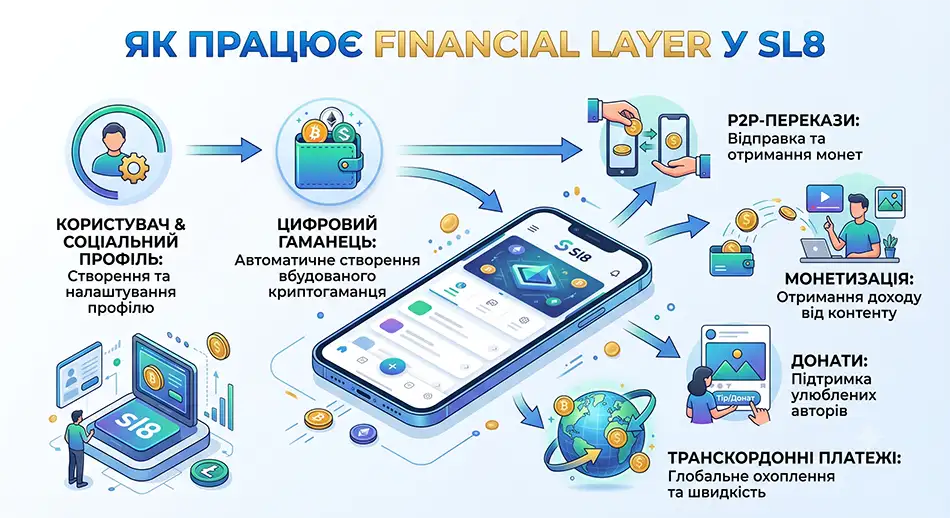
Cassator Corp states that Sl8 operates on distributed ledger technology provided by the Stellar Development Foundation. This is a significant technical choice for a SocialFi platform because Stellar focuses on payments, global transfers, asset tokenization, and low-transaction-cost financial solutions.
In the context of Sl8, Stellar is used not as a decorative blockchain element but as the infrastructure for everyday financial actions. Users are provided access to built-in wallets, peer-to-peer transfers, tipping, creator monetization tools, and cross-border payments.
This sends a clear signal to the market: a social network is no longer limited to likes, comments, and follows. It can become a shell for micropayments, international transfers, digital assets, and direct economic interaction among people.
reNews highlights the shift in the internet model: content ceases to be the sole asset, with human potential — reputation, trust, expertise, audience, influence, and ability to create economic value — coming to the forefront. This is where Sl8 goes beyond a typical SocialFi platform.
Cassator Corp also announces an RWA platform for compliant tokenization of human capital and personal economic potential. This means that in the upcoming model, not only real estate, bonds, goods, or other traditional assets but also future income, intellectual property, personal brand, or professional value of a person can be tokenized.
This concept can be seen as an attempt to create a new market category — human capital tokenization. Potentially, it may interest people seeking financing without traditional debt or institutional barriers.
Examples of possible applications of this model include several professional groups:
Tokenization of human capital raises legal, ethical, and regulatory challenges. Accordingly, Cassator Corp emphasizes “compliant” — indicating the model is intended to operate under transparent and regulated conditions.
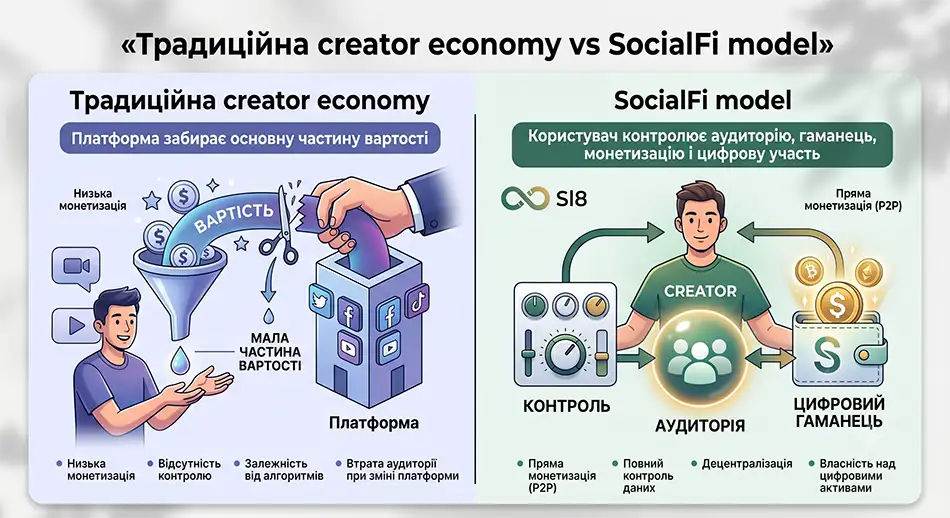
The SocialFi, DeFi, RWA tokenization, and crypto payments markets have matured to where social interactions can have financial infrastructure without traditional banking models. Creators seek independence from algorithms, ad platforms, and intermediaries, while users desire to engage not only as content consumers but as participants in the growth of people, brands, and communities.
According to RWA.xyz, the tokenized real-world assets segment is already measured in tens of billions of distributed asset value dollars, with nearly a million owners of such assets. Though human capital tokenization may not become mass-market immediately, it marks the direction of the market: financial assets are increasingly moving into programmable digital infrastructure.
Cassator Corp has also reported Letters of Intent with global influencers whose combined audience exceeds 400 million followers. For a SocialFi platform, this can be a factor in early user adoption, as influencers can quickly shift audience attention to new digital environments.
On Google Play, the Sl8 – Social Platform app is listed as a social platform by Cassator Corp. The app description emphasizes the “Time Well Spent” concept, “Shadow Following” method, freedom to customize the news feed, content monetization, and a friendly environment.
For a broad audience, key public app metrics are important beyond technological claims:
These numbers do not guarantee the platform’s future success but show Sl8’s current public presence in the mobile market. Mobile access is critical for a SocialFi project, as smartphones remain the main tool for mass entry into digital payments and social services.
Sl8 operates at the crossroads of cryptocurrency, social networks, personal data, financial accessibility, RWA, influencer marketing, and potential human capital tokenization. This combination brings opportunities as well as complex challenges for regulators, users, and potential investors.
The main risks associated with this model involve several areas:
Therefore, Sl8 should be seen not just as a crypto app but as an experiment in programmable finance within a social network. Its significance lies in addressing who should control the economic value of digital reputation — the platform, the advertising market, banks, or the users themselves.