Income indexation is a mechanism for partial compensation for price increases. For an employee, it affects the salary amount, while for a pensioner – the size of the pension payment. ...

20Oct



NBU decisions affect the cost of money, the hryvnia exchange rate, inflation, bank loans, deposits, government bonds, imports, exports, and the financial behavior of businesses. The National Bank of Ukraine, through monetary policy, determines how expensive loans will be, how attractive hryvnia savings remain, and how quickly inflation can return to the target level.
The National Bank is the state’s central bank, responsible for price and financial stability. Its decisions do not work instantly but gradually change conditions for banks, entrepreneurs, investors, and consumers.
It is through these instruments that the National Bank’s influence on the economy is formed. For business, this means changes in financing costs; for the population, changes in deposit and loan rates; for the state, conditions for internal borrowing and support for the stability of the hryvnia.
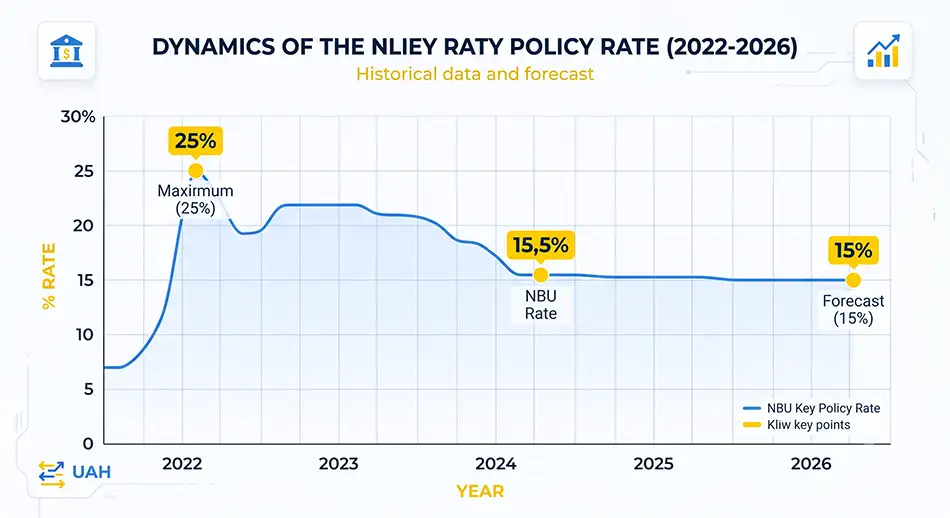
The discount rate indicates what the cost of money in the economy should be. As of June 19, 2026, the National Bank’s rate was 15.0% per annum, according to the official NBU archive on monetary policy decisions.
In June 2026, the NBU Board kept the discount rate at 15%, explaining the need to maintain sufficiently tight monetary conditions, demand for hryvnia instruments, and control over the NBU’s inflation expectations. For search queries like “NBU discount rate,” “NBU rate decisions,” “Ukraine monetary policy,” this is a key indicator from which economic situation analysis begins.
Inflation is one of the main benchmarks for the National Bank of Ukraine’s decisions. According to the NBU, in May 2026, consumer inflation was 8.2% year-on-year, with core inflation at 7.9%.
When the National Bank of Ukraine maintains a high rate, it effectively cools demand and protects the hryvnia’s purchasing power. At the same time, excessively tight policy can limit investments, so the NBU balances between curbing inflation and supporting economic activity.
The NBU’s currency policy affects prices of imported goods, fuel, equipment, medicines, raw materials, and business expectations. If the hryvnia sharply weakens, imports become more expensive, which quickly translates into consumer prices.
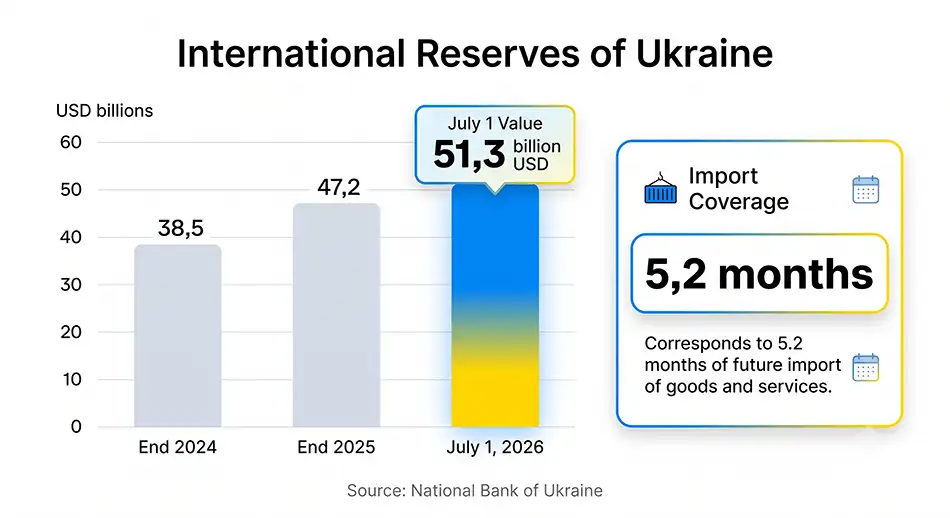
As of July 1, 2026, Ukraine’s international reserves amounted to 51,269.3 million USD, having increased by 12.1% in June thanks to currency inflows from the NBU’s international partners. The current volume of reserves covered financing for 5.2 months of future imports.
In June, the NBU sold 5,147.0 million USD on the foreign exchange market, demonstrating the regulator’s active role in maintaining the NBU’s currency stability. This is important for the economy because the hryvnia exchange rate affects not only exchange offices but also the cost of goods, equipment imports, the fuel market, and budget calculations.
The decisions of the National Bank affect the banking system through the cost of resources, regulations, risk policies, and demand for loans. When the rate is high, banks are more cautious in issuing loans but at the same time have an incentive to attract hryvnia deposits.
According to the NBU, hryvnia loans to businesses have been growing by about a third for more than a year, and a similar increase in loans to the population has been observed for two consecutive years. This means that even under relatively tight policies, the banking sector can support the economy if it has capital, liquidity, and clear rules.
For citizens, NBU decisions are felt through currency rates, deposit rates, store prices, credit card terms, mortgages, car loans, and consumer loans. When the national bank maintains tight monetary conditions, hryvnia savings may seem more attractive, but loans remain more expensive.
For queries like “how NBU decisions affect people,” “hryvnia exchange rate forecast,” “inflation in Ukraine,” “hryvnia deposits,” “business loans,” the main logic is the same: NBU policy sets financial conditions, and the market gradually transfers them into prices, rates, and participant behavior in the economy.
The state depends on the stability of the financial market because it finances expenditures, places government bonds, receives international aid, and services debt. If confidence in the hryvnia weakens, pressure on the budget, reserves, and prices increases.
The National Bank does not replace government economic policy but creates a financial framework in which businesses, banks, the state, and the population can make decisions with a lower level of uncertainty. That’s why the query “National Bank of Ukraine” is related not only to the dollar exchange rate but to the broader topic of economic stability.