Subsidies and benefits help reduce expenses on housing and communal services but operate differently. A housing subsidy is targeted state assistance to a household that, based on its income, ...

30Sep



Managing inheritance after the death of a relative is never easy, but the situation becomes significantly more complicated if the death occurred in a temporarily occupied territory (TOT), a combat zone, or an occupied area. The main challenge is that a notary cannot properly open an inheritance case without official confirmation of the deceased’s death through Ukrainian documents. Therefore, the first practical step is not searching for assets, but legally confirming the fact of death.
According to the Civil Code of Ukraine, inheritance opens due to the death of a person or their declaration as deceased, and the date of inheritance opening is either the day of death or the day the person was declared deceased. This moment establishes the heirs’ right to appeal to a notary, submit an application to accept the inheritance, formalize the inheritance case, and subsequently receive a certificate of the right to inherit.
If a person died in a temporarily occupied territory, in a settlement where government authorities are non-functional, or in an active combat zone, heirs often do not possess a Ukrainian medical death certificate. There may be only documents issued by occupation authorities, photos of burial, certificates, notifications from relatives or witnesses. Such materials can help prove the fact of death but do not replace Ukrainian state registration of death on their own.
To legally arrange inheritance, one usually must follow this sequence of actions:
This procedure formalizes the actual death as a legally recognized fact that notaries, banks, state registrars, local governments, or courts can work with.
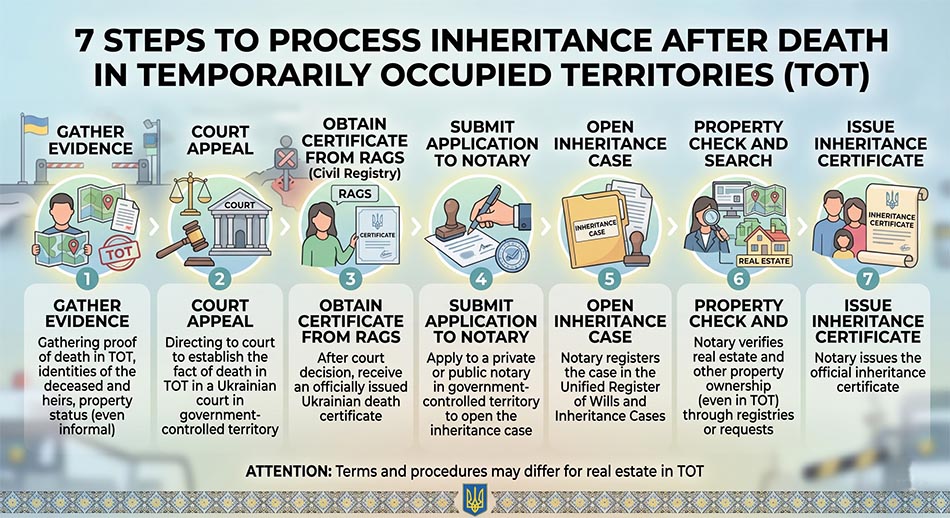
An application to establish the fact of death on territories where martial law, emergency state, or TOT applies may be filed by family members of the deceased, their representatives, or other interested parties if the fact of death affects their rights or legitimate interests. This application is submitted to any local court in Ukraine that exercises justice, regardless of the applicant’s residence. Such cases are considered urgently, and the court decision is subject to immediate execution.
For the court, it is important not only to prove the fact of death but also to clarify why it is established. In inheritance matters, the goal is evident — to open the inheritance, appeal to a notary, and formalize ownership rights of real estate, land, vehicles, bank funds, corporate rights, or other assets of the deceased.
It is advisable to attach the following evidence to the application:
The more independent evidence provided to the court, the lower the risk of refusal. This is especially important when no Ukrainian medical death document exists or when the death occurred a long time ago and heirs apply belatedly.
After the court decision, one must approach the Civil Registry Office (DRACS). The Ministry of Justice explains that a copy of the court decision is issued immediately to the parties or sent to the civil registration authority for registration of death. To obtain the certificate, a person submits a copy of the court ruling and a Ukrainian citizen’s passport. Court fees for such applications related to martial law, armed aggression, armed conflict, or temporary occupation are waived.
After state death registration, the heir receives the key document for the notary — a Ukrainian-style death certificate. Without it, the inheritance processing following death in an occupied territory is usually blocked or substantially complicated.
The general deadline for accepting inheritance is six months. The heir who did not reside permanently with the deceased must personally submit an application to the notary. If missed, the heir is deemed not to have accepted the inheritance, but the court may grant an extension for valid reasons.
At the same time, during martial law, there is an important exception. If the death of the individual is registered later than one month after the death or declaration of death, deadlines under certain inheritance articles of the Civil Code are counted from the date of state death registration. Still, the opening moment of inheritance remains the actual day of death or declaration as deceased.
For an heir, this means not waiting for the war to end, de-occupation, or the return of documents from TOT. One should act immediately after receiving information about the death.
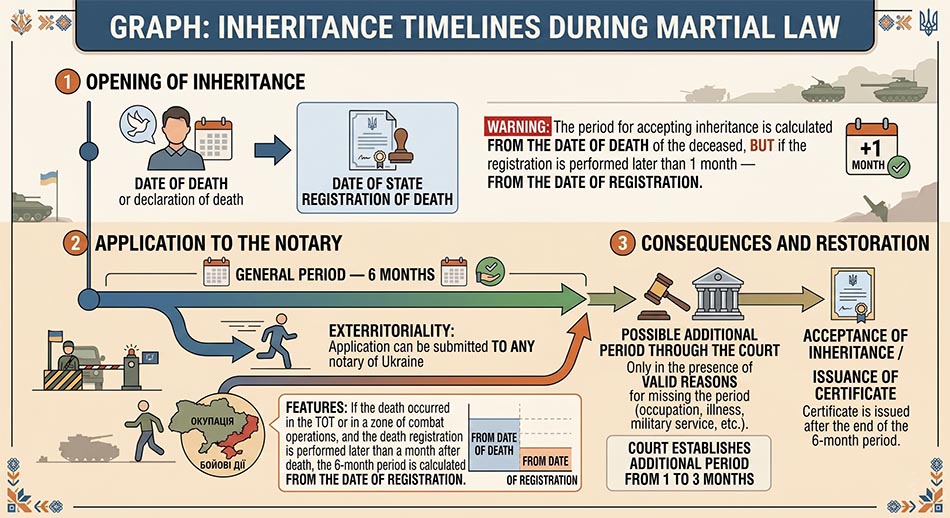
During martial law, the rules for contacting a notary have become more flexible when the inheritance opening place is connected with TOT, active combat, or an area where authorities cannot execute their powers. In such cases, inheritance applications can be submitted to any notary regardless of the inheritance opening location. This is important for internally displaced persons, heirs abroad, relatives of servicemen, and families who lost access to documents.
Before submitting an application, it is advisable to consult a notary. The notary will check the inheritance registry, explain which documents are needed, whether there is a will, if the inheritance case was opened before, which property documents must be restored, and risks of missing deadlines.
Prepare a basic document package for the first consultation:
Even if some documents are missing, do not delay contacting a notary. The notary can open an inheritance case based on a submitted application, and the heir will collect remaining documents additionally.
In practice, inheritance processing after death in a combat zone is often complicated not by a single but multiple factors simultaneously. People search for “how to process inheritance on TOT”, “inheritance in an occupied territory”, “how to confirm death fact via court”, “inheritance without death certificate”, “inheritance during martial law”, “notary inheritance war” — and most face the same legal risks.
The most frequent problems are:
Each of these issues can be resolved legally, but the sooner an heir contacts a court, notary, or lawyer, the better the chances of preserving inheritance rights.
To handle inheritance if death occurred in TOT or a combat zone, a step-by-step approach is essential: confirm death via court, register death with DRACS, obtain a Ukrainian death certificate, contact a notary, and submit an inheritance acceptance application. Martial law does not negate the need to formalize documents but provides special mechanisms for those unable to obtain standard documentation due to occupation, combat, or lack of access to state agencies.
The main rule is not to wait for the situation to “resolve itself.” Inheritance, court, notary, fact of death, TOT, and deadlines are interconnected. Missing one step can cause delays, complicate asset registration, or require additional court applications for deadline extensions.