A residence permit through business in Europe is not automatically granted after registering a company. In most countries, it is necessary to separately prove the migration basis: genuine ...

22Oct



Business registration in the EU is not a single universal procedure for all 27 member states of the European Union. A company is established according to the legislation of a specific country: Czechia, Poland, Germany, Cyprus, Austria, Estonia, or another state.
National law defines the organizational and legal forms, requirements for authorized capital, directors, registered office, documents, and subsequent reporting. At the same time, European rules harmonize some procedures, including the possibility of online registration for certain types of companies. EU Directive 2019/1151 stipulates that member states should ensure fully remote establishment of specified company forms, although the specific mechanisms are set by the countries themselves.
It is advisable to check the practical rules of a particular country via the official Your Europe portal even before preparing the founding documents.
The country should be chosen not only based on the corporate tax rate. For a real business, the banking system, VAT rules, director requirements, accounting reporting, availability of personnel, and the actual place of company management are equally important.
Before registration, it is necessary to analyze:
Only after this should the cost and timing of company formation be compared.
For example, one can separately study the conditions for company registration in Czechia. For small and medium-sized businesses, the s.r.o. form is often used there, but the procedure, documents, and activity requirements depend on the specific company structure.

Each country has its own company forms. Analogues of the Ukrainian LLC may be the Czech s.r.o., German GmbH, Polish sp. z o.o., or Cypriot private company limited by shares.
The choice of form affects owners’ liability, capital, corporate governance, and reporting. For large international structures, there is also the European company SE – Societas Europaea. It requires a minimum subscribed capital of 120,000 euros and specific requirements for cross-border structures.
Companies usually need an official registered address in the country of incorporation. In some jurisdictions, the law also sets requirements for directors, secretaries, local representatives, or the place of actual management.
A formal address alone is insufficient to resolve all tax issues. If a director manages the business from another country, issues regarding tax residency or permanent establishment may arise.
There is no single minimum capital across the entire EU. It depends on the country and company form.
Some companies allow symbolic capital, while others require a significant amount. Separate requirements apply for banks, insurers, financial companies, and other regulated businesses.
The exact package is formed by the registrar, notary, or corporate consultant of the respective country. However, the basic set is similar in many countries.
Most often, the following are prepared:
Foreign documents may require translation, notarization, apostille, or other legalization. Rules must be verified specifically for the country of registration and for the country that issued the document.
The bank may also separately request a business plan, contracts, confirmation of the source of funds, information about clients, and the economic purpose of the structure’s creation. This is bank KYC compliance, not the state registration itself.
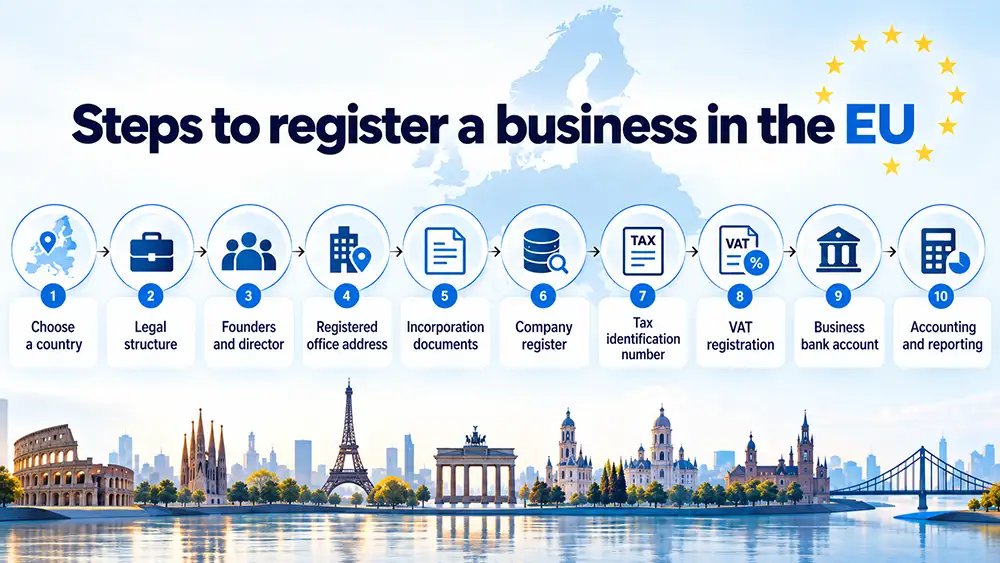
The typical procedure can be divided into several sequential steps. Some of them can already be completed online in many countries.
After entry in the register, the work is not finished. It is necessary to set up accounting, reporting, bank accounts, contracts, and tax calendar.
The EU recommends member states to aim for creating new companies within no more than three working days with administrative costs up to 100 euros, but these are target indicators, not guaranteed prices or deadlines for each country and form of business.
Corporate taxes remain largely a national matter. The company must clarify where it is tax resident, which profits are taxable, and when to submit declarations.
The VAT situation is more complicated, especially for e-commerce and cross-border services.
From 2025, the EU will have a cross-border VAT scheme for small businesses. Under certain conditions, an enterprise with turnover across the entire EU no more than 100,000 euros can use the SME VAT exemption in other member states, provided it does not exceed the national thresholds of the respective countries simultaneously. The maximum national threshold for such an SME scheme is 85,000 euros, but a country may set a lower value.
Detailed current rules should be checked on the official EU page on VAT for small business.
For remote B2C sales within the EU, the general threshold of 10,000 euros is also important. After surpassing it, in cases provided by regulations, the VAT of the purchaser’s country applies, and reporting can be simplified through the OSS system.
For Ukrainian citizens, it is important to distinguish between creating a company and the right to reside and work personally in the respective country. Registering a share or legal entity alone does not automatically grant a residence permit or self-employment rights.
For third-country nationals, migration conditions are established separately. For example, rules for self-employed persons differ in Poland, Czechia, Hungary, and other states.
Therefore, before opening a business, it is necessary to separately check corporate, tax, and migration consequences.
For entrepreneurs considering Cyprus, Poshuk.info has a separate material about company registration in Cyprus describing the procedure and documents. If Poland is among options, it is also useful to compare entrepreneur taxation in Poland and Ukraine in 2026.
Such a possibility is provided by the legislation of many EU countries, but rules for foreign founders vary. Before submitting documents, it is necessary to check the specific country’s requirements for non-residents, directors, address, and rights to actually work in the company.
Not always. European legislation develops online company registration mechanisms, but a particular country may require identification, notarial procedures, or checks for which the remote format has additional conditions.
It depends on jurisdiction and legal form. In some places, an account or proof of capital payment is needed before company registration, while in others, a permanent corporate account is opened after establishing the legal entity.
Not in every case. The obligation depends on the type of activity, turnover, country of registration, and cross-border operations. For B2B, e-commerce, digital services, and sales between EU countries, rules must be analyzed before the first transaction.
No. The tax rate is only one indicator. The company’s place of management, owner’s tax residency, dividend rules, VAT, bank compliance, accounting costs, and treaties on avoiding double taxation are also important.