Taxes for business in Cyprus are formed according to the model of European jurisdiction with corporate taxation, VAT, rules of tax residency, audit, electronic reporting, and economic presence ...

30Jun



Business taxation in Poland depends on the legal-organizational form, residency, type of activity, turnover, and profit distribution method. A limited liability company (Sp. z o.o.) mainly pays CIT, while a sole proprietorship (JDG) chooses the PIT regime.
The main taxes for companies in Poland cover income, consumption, international payments, and certain civil law transactions.
Before starting a business, it is necessary to determine the tax base, the right to expenses, mandatory VAT registration, and rules for international operations.
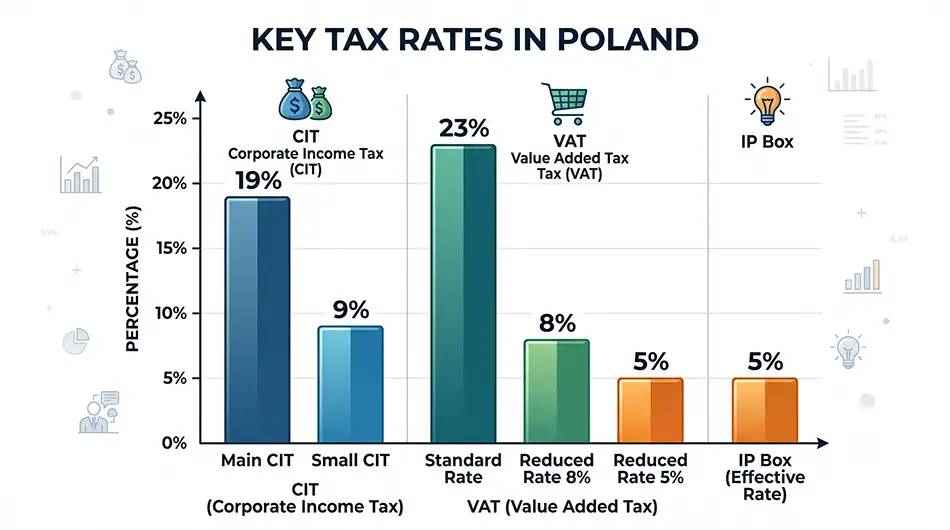
The standard CIT rate is 19%. A reduced rate of 9% may apply to income, excluding capital gains, if the company is a small taxpayer or is starting operations, and its income in the tax year does not exceed the equivalent of 2 million euros. The previous year’s sales limit for small taxpayer status in 2026 is 8,517,000 zlotys.
Tax profit calculation involves the following steps:
For businesses that reinvest profits, the Estonian CIT is available. Its rate is 10% for small taxpayers and new companies and 20% for other taxpayers, but applying the regime requires meeting corporate and accounting conditions.
The basic VAT rate is 23%. Reduced rates of 8% and 5% apply to certain goods and services specified by law, and a 0% rate is possible, including for exports and specific international operations. From January 1, 2026, the VAT exemption threshold is raised to 240,000 zlotys of annual turnover, but an exempt taxpayer cannot deduct input VAT.
VAT registration is required when exceeding the threshold, for activities without exemption rights, or for certain operations within the EU. VAT-UE may be needed for cross-border trade.
The owner of a JDG chooses the regime depending on the structure of expenses, income, and type of services.
Ryczałt often suits businesses with small expenses, while the scale or linear tax may be more appropriate with significant operational costs. The official PIT scale includes rates of 12% and 32%, while the linear regime applies a 19% rate.
The Polish system provides incentives for innovation, investment, and capital accumulation. The IP Box allows qualified income from certain intellectual property rights to be taxed at 5%, if the rights were created, developed, or improved as part of research and development activities.
Main tax planning tools include:
The Polish Investment Zone allows exemption from CIT or PIT for new investments under a support decision. Availability and amount of assistance depend on location, scale, and project parameters.
Domestic WHT rates are 19% for dividends and 20% for certain payments to non-residents, including interest, royalties, and certain intangible services. An international agreement or EU law may reduce the rate or provide exemption with a certificate of residency and appropriate documentation.
Schemes involving offshore companies do not override Polish rules on place of effective management, controlled foreign companies, transfer pricing, and anti-tax avoidance.
Polish companies keep accounts in zlotys and submit most declarations electronically. CIT-8 is submitted by the end of the third month after the tax year, CIT advance payments are mostly due by the 20th of the following month, and JPK_V7 for VAT is submitted by the 25th.
Key enterprise obligations include:
Proper accounting services are necessary from the first transaction, as errors in expenses, VAT rates, or tax liability dates affect payment amounts and audit risks.
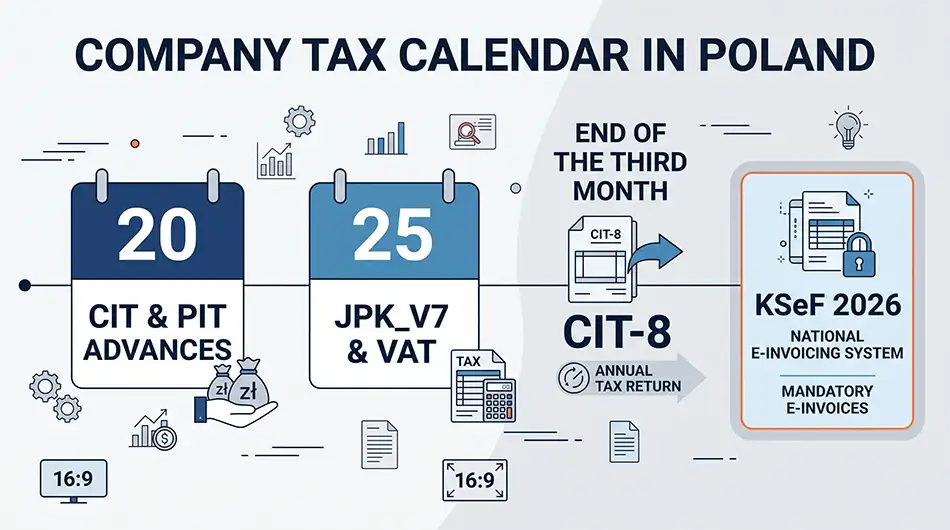
In 2026, mandatory invoicing through KSeF is introduced gradually: from February 1 for taxpayers with sales over 200 million zlotys for 2024, and from April 1 for most other taxpayers. Enterprises with monthly invoice turnover up to 10,000 zlotys gross may not issue invoices via KSeF until the end of 2026, whereas receiving invoices in the system became mandatory from February 1.
Advantages include a 9% CIT rate for small businesses, Estonian CIT, IP Box, B+R relief, VAT-UE, and investment incentives. Disadvantages are detailed reporting, complex WHT, transfer pricing, and KSeF rules.
The Polish tax system can be practical for manufacturing companies, IT businesses, trading, logistics, exporters, and projects focused on the EU. Before deciding to register a company, buy a ready-made company or relocate activities, a consultation on company registration and a full tax burden calculation are needed.
For a foreign owner, nominee services, place of effective management, banking compliance, dividend payment model, and disclosure of ultimate beneficiaries are evaluated separately.


