

Result Found1


Why it is better to buy a ready-made company in Cyprus than register a new one
A ready-made company is a legal entity that has already been entered in the Cyprus Companies Register, has a registration number, constitutional documents, registered office, director, secretary and shareholder. Usually, such a structure is created specifically for further sale and does not conduct business activity before being transferred to the buyer.
The main features of a ready-made Cypriot company are:
- the company is registered in accordance with the Cyprus «Companies Law»;
- the constitutional documents have already been accepted by the Registrar of Companies;
- the share capital has been formed;
- a director and corporate secretary have been appointed;
- a registered office in Cyprus has been determined;
- there is no commercial activity if it is a classic shelf company;
- a set of corporate certificates has been prepared;
- the company can be transferred to a new owner by changing shareholders and officers;
Before concluding the transaction, it is necessary to confirm that the legal entity has no debts, court disputes, banking obligations, tax violations or unfulfilled reporting requirements.

How buying a ready-made company differs from registering a new one
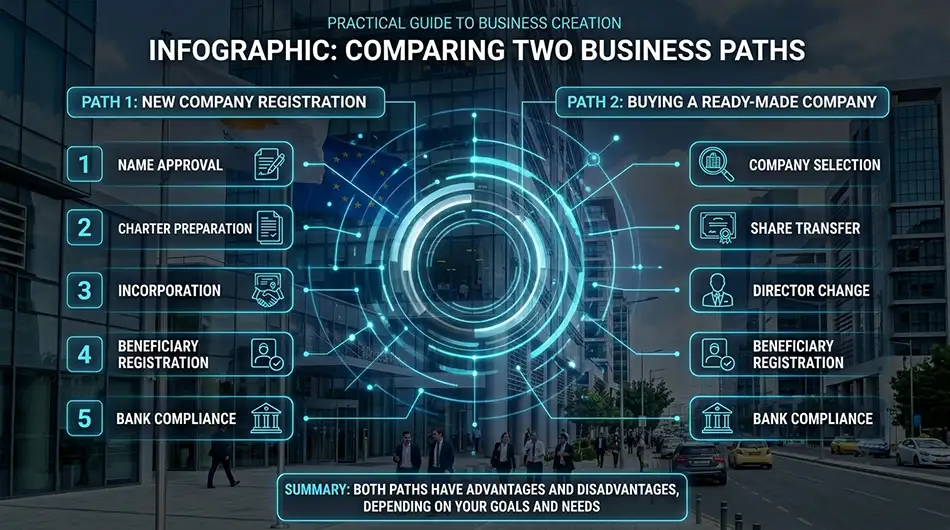
Company registration from scratch involves choosing and approving the name, preparing the memorandum and articles of association, appointing officers, determining the registered office and submitting documents to the Registrar. The memorandum and articles of a Cypriot company must be prepared by a local lawyer who confirms their compliance with legislation in form HE1.
The government fee for standard registration of a private company with share capital is 165 euros. Accelerated processing requires an additional fee of 100 euros, and obtaining a certified set of documents requires separate payment. These amounts do not include the lawyer’s work, registered office, secretarial and corporate services.
A ready-made company has already passed the initial incorporation stage. The buyer needs to conduct due diligence of the legal entity, arrange the transfer of shares, change the director, secretary and address if necessary, and enter information about the ultimate beneficial owner.
| Criterion | New company | Ready-made company |
|---|---|---|
| name approval | mandatory | already completed |
| preparation of articles | required | documents already registered |
| registration number | issued after completion of the procedure | already assigned |
| corporate certificates | issued after registration | available before the transaction |
| start of legal procedures | after company formation | after transfer of corporate control |
| history check | not required | mandatory |
| choice of name | free within the Registrar’s requirements | limited to available offers |
| bank account | opened separately | checked and re-registered separately |
Sale of ready-made companies in Cyprus makes it possible to shorten the corporate launch stage. Opening an account, obtaining a license, tax registration and bank compliance do not occur automatically together with the acquisition of a legal entity.
Advantages of buying a ready-made company in Cyprus
The decision to buy a company in Cyprus is used by entrepreneurs who need an already registered legal entity for signing contracts, participating in negotiations, building a holding structure or launching an international project.
The main advantages of a ready-made structure are:
- no need to wait for approval of a new corporate name;
- availability of a registration number and certificate of incorporation;
- possibility to review constitutional documents in advance;
- reduction in the number of initial registration procedures;
- possibility to choose a company with the required incorporation date;
- ready corporate structure with director, secretary and registered office;
- predictable document package for changing the owner;
- possibility to start preparing contracts and a banking file immediately;
- access to the legal environment of the European Union;
- use of the company for trading, consulting, IT, investment or asset holding;
These advantages have practical value only if proper legal and financial due diligence is carried out. The age of the company by itself does not guarantee opening a bank account, obtaining financing or passing compliance.
Why a ready-made company may be more convenient for international business
Cyprus is a member state of the European Union and uses the euro. A Cypriot Private Company Limited by Shares can work with counterparties in the EU and third countries, own corporate rights, intellectual property, real estate and other assets.
A ready-made company can be used for the following areas:
- international trade in goods and services;
- IT development and software sales;
- consulting and marketing services;
- management of intellectual property;
- creation of a holding structure;
- ownership of shares in foreign enterprises;
- investment activity within the framework of legislation;
- work with European counterparties;
- e-commerce;
- management of international projects;
A license from CySEC or another competent authority may be required for regulated activities. Acquisition of a ready-made legal entity does not replace licensing for financial, investment, payment, insurance or other regulated services.
Is it possible to buy offshore in Cyprus
The search query «buy offshore in Cyprus» is often used to find a company suitable for international operations. In legal terms, Cyprus is not a classic offshore jurisdiction – it is an EU state with corporate taxation, financial reporting, audit, anti-money laundering rules and a register of ultimate beneficial owners.
The phrases «ready-made offshore companies in Cyprus» and «sale of offshore companies in Cyprus» usually refer to the sale of Cypriot companies intended for use in an international structure. Such companies are not automatically exempt from taxes and do not provide anonymity to the owner.
The buyer must take into account the following requirements:
- disclosure of the ultimate beneficial owner in the relevant register;
- customer identification by the lawyer, bank and corporate provider;
- documentary confirmation of the source of funds;
- maintenance of accounting records;
- preparation of annual financial statements;
- filing of tax returns;
- confirmation of the economic substance of transactions;
- compliance with transfer pricing rules for controlled transactions;
- fulfillment of licensing requirements for certain types of activity;
Therefore, to buy a ready-made firm in Cyprus means to acquire a corporate structure in a regulated European jurisdiction, not an anonymous tax-free shell.
Taxes for companies in Cyprus in 2026
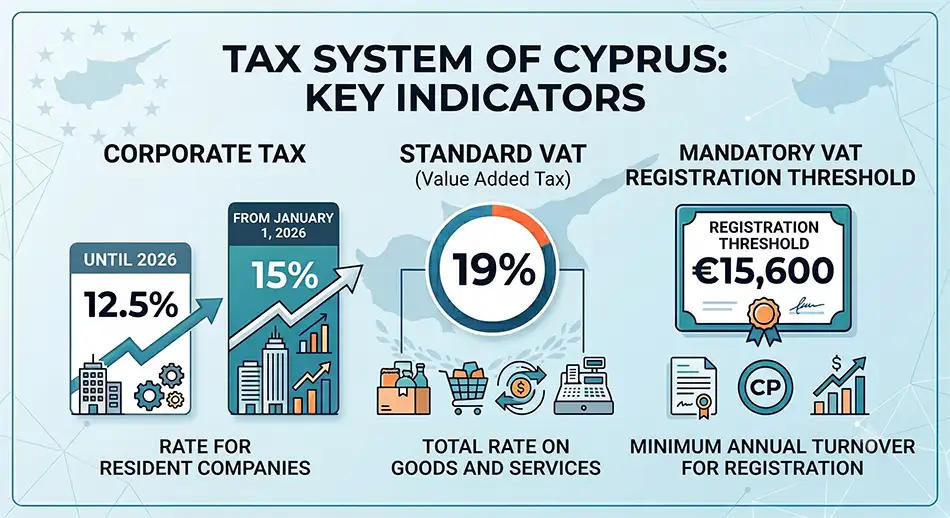
From January 1, 2026, the corporate tax rate for tax residents of Cyprus is 15%. Before that date, the general rate was 12.5%. Profit calculated in accordance with Cypriot tax legislation is subject to taxation.
The main tax parameters are:
- corporate tax – 15%;
- standard VAT rate – 19%;
- reduced VAT rates apply to goods and services defined by law;
- mandatory VAT registration arises when taxable turnover exceeds 15,600 euros during the previous 12 months or is expected to exceed this threshold within the next 30 days;
- the threshold for acquisitions of goods from other EU member states is 10,251.61 euros for the period established by law;
- a tax number is obtained through the Tax For All system;
- VIES registration may be required for transactions within the EU;
- the tax result depends on the nature of income, expenses, residency and transaction structure;
Cyprus has a network of double taxation treaties with more than 65 states. The possibility of applying a specific treaty is determined by tax residency, factual circumstances of activity, the status of the income recipient and the presence of sufficient economic substance.
Procedure for buying a company
The procedure for buying a company begins not with payment, but with determining the requirements for the structure. It is necessary to establish the acceptable age of the company, type of activity, composition of officers, share capital parameters and the need for tax or VAT registration.
The transfer of a ready-made company usually takes place in the following sequence:
- Determining the purpose of acquiring the company and the future business model.
- Selecting a legal entity by name, registration date, articles and corporate structure.
- Obtaining an extract and corporate certificates from the Companies Register.
- Conducting legal, tax and accounting due diligence.
- Identifying the buyer and ultimate beneficial owner in accordance with AML and KYC rules.
- Signing the share purchase agreement.
- Preparing documents for the transfer of shares to the new owner.
- Accepting resignation letters from previous officers.
- Appointing a new director, secretary and other authorized persons.
- Updating the internal register of company members.
- Filing form HE57 regarding the transfer of shares within 14 days.
- Filing form HE4 in case of change of director or secretary within 14 days.
- Updating information about the ultimate beneficial owner.
- Obtaining updated certificates and the corporate kit.
- Arranging tax registration, VAT and VIES if there are grounds.
- Passing banking or payment compliance.
- Organizing accounting services and reporting.
A change of shareholder acquires corporate significance after proper execution of the share transfer and entry of the buyer into the register of members. Updating the state register and obtaining new certificates provide documentary confirmation of the changes for banks and counterparties.
What documents the buyer needs
The list of documents depends on citizenship, place of residence, source of funds, field of activity and requirements of the corporate provider. Legal entities submit an extended package with documents covering the entire ownership structure.
For an individual, the following are usually required:
- copy of passport;
- document confirming residential address;
- tax number;
- CV or description of professional experience;
- information about the future activity of the company;
- confirmation of the source of funds;
- confirmation of the source of wealth;
- information about countries of operation and main counterparties;
- projected turnover and types of payments;
- information about the ultimate beneficial owner;
Documents may require notarization, apostille and translation. Requirements are determined separately for the corporate transaction, the Beneficial Owners Register, the bank and the licensing authority.
What to check before purchase
Sale of ready-made firms in Cyprus must be accompanied by due diligence. Even if the seller states that the company has not operated, this must be confirmed by documents and registry data.
The check should include:
- current certificate of incorporation;
- memorandum and articles of association;
- certificate of registered office;
- certificate of directors and secretary;
- certificate of shareholders;
- register of members and register of directors;
- information about filed annual returns;
- financial statements for all completed periods;
- tax status and presence of debts;
- VAT and VIES registration;
- information about court proceedings;
- presence of pledges, encumbrances, loans and guarantees;
- bank accounts and transactions performed;
- concluded agreements;
- issued powers of attorney;
- rights to trademarks, domains and other assets;
- information about previous beneficial owners;
- compliance with deadlines for submitting information to the Beneficial Owners Register;
If the company has an operating history, the check must cover primary documents, accounts receivable and payable, employees, tax risks and contracts with counterparties.

Nominee director and corporate service
A nominee director is a professional person appointed to the management bodies of a company under a corporate services agreement. Such a director does not cancel the rights of the beneficial owner but has real statutory duties and liability.
Corporate service may include:
- provision of a director;
- corporate secretary services;
- registered office in Cyprus;
- storage of corporate documents;
- preparation of minutes and resolutions;
- assistance with filing forms with the Registrar;
- receipt of official correspondence;
- interaction with the accountant and auditor;
- maintenance of proper corporate status;
A nominee director does not ensure anonymity of the ultimate owner. Information about the beneficial owner is submitted to the relevant register, while banks, auditors, lawyers and licensed providers carry out identification.
Accounting services and annual reporting
A Cypriot company must maintain accounting records and keep them for at least seven years. Companies prepare annual financial statements and engage an approved auditor in accordance with applicable requirements.
Accounting services include:
- recording income and expenses;
- systematization of invoices, contracts and bank statements;
- calculation of corporate tax;
- preparation of VAT returns;
- VIES reporting;
- payroll calculation;
- preparation of annual financial statements;
- audit support;
- filing of tax returns;
- control of payment and reporting deadlines;
The annual return HE32 is filed through the Registrar’s electronic system. The basic filing fee is 20 euros. Late filing results in 50 euros on the first day and 1 euro for each subsequent day, but the total penalty for such delay is capped at 150 euros.
Disadvantages and risks of a ready-made company
Acquiring a ready-made structure is not always the best option. Disadvantages depend on the age of the company, its previous use and the quality of documents provided by the seller.
The main risks are:
- inability to choose any desired name;
- higher total price compared with the government fee for new registration;
- need for comprehensive due diligence of corporate history;
- risk of hidden debts or unfulfilled obligations;
- need to amend the articles for certain types of activity;
- absence of automatic transfer of a bank account;
- repeated bank compliance after change of owner;
- possible overdue reports in older companies;
- no guarantee of obtaining a license;
- need to explain the economic purpose of acquiring the company;
Shelf companies without operating history, accounts, contracts and employees carry the lowest risks. Acquisition of a business that has already operated requires separate financial, tax and legal audit.
Who benefits from buying a ready-made firm in Cyprus
Buying a ready-made legal entity is not suitable for every entrepreneur. It is justified when the speed of obtaining corporate control has practical value for the project.
This format is used by:
- entrepreneurs who need a registered company for an international contract;
- investors creating a holding structure;
- IT companies and software developers;
- export and import businesses;
- owners of intellectual property;
- consultants, marketing agencies and service companies;
- groups of companies that need a legal entity in the EU;
- founders for whom the incorporation date is important;
- buyers ready to pass full KYC and AML control;
If the buyer needs a unique name, special articles or a complex capital structure, registration of a new company may be more appropriate.
How to choose a ready-made company
The correct choice depends not only on cost. The company must correspond to future operations, bank requirements, the tax model and the ownership structure.
When choosing, it is necessary to assess:
- Age of the company and date of registration.
- Presence or absence of operating history.
- Relevance of annual and tax reporting.
- Composition of shareholders, directors and secretary.
- Provisions of the memorandum and articles of association.
- Amount and structure of share capital.
- Availability of tax number, VAT and VIES.
- Banking history and account status.
- Availability of licenses, agreements or assets.
- Cost of annual corporate support.
- Ability to ensure economic presence in Cyprus.
- Reputation of the seller and corporate provider.
Legal consultation before signing the agreement helps determine the scope of due diligence, secure the seller’s warranties and provide liability for hidden obligations.

Does Starting a Company Grant Residency Rights in Europe
A residence permit through business in Europe is not automatically granted after registering a company. In most countries, it is necessary to separately prove the migration basis: genuine entrepreneurial activity,

Company Registration in Europe
Business registration in the EU is not a single universal procedure for all 27 member states of the European Union. A company is established according to the legislation of a

How to Check an Employer in Poland or the Czech Republic Before Signing a Contract
The advertisement promises 4,500 zlotys net, free accommodation, and an official contract. A person arrives, and it turns out—the accommodation costs 800 zlotys per month, the contract is signed only

Entrepreneur Taxation in Poland and Ukraine: A Comparison
Taxes for Entrepreneurs in Ukraine in 2026 Ukraine maintains a relatively simple simplified system model for small businesses. Most entrepreneurs operate under the 2nd or 3rd group of the single

How to Open an IK in Latvia?
Individual Merchant (Individuālais komersants) in Latvia is a natural person who conducts entrepreneurial or economic activity on their own behalf. The official IK status is granted after registration in the

Taxes for Business in Poland in 2026
How the Polish Tax System Works Business taxation in Poland depends on the legal-organizational form, residency, type of activity, turnover, and profit distribution method. A limited liability company (Sp. z

Case of a Foreign Entrepreneur: How Legalization Began in Ukraine
Let us consider a model practical case built on the rules in force in 2026. A foreigner plans to move to Ukraine, establish a LLC, manage the company, and legally

How the Market for Licenses and Permits in Ukraine Has Changed
A license in Ukraine is gradually ceasing to be associated with a paper application, a personal visit, and separate correspondence with a governmental body. The state is transferring some procedures

What Determines the Court Fee
The court fee calculator is not meant to determine the total cost of the court process, but to calculate the mandatory payment for submitting a specific application, claim, appeal, or
Does Starting a Company Grant Residency Rights in Europe
A residence permit through business in Europe is not automatically granted after registering a company. In most countries, it is necessary to separately prove the migration basis: genuine entrepreneurial activity,

Low Ferritin: What the Test Result Means and When to See a Doctor
Ferritin is a protein that stores iron and reflects its reserves in the body. That’s why the ferritin test helps detect iron store depletion earlier than a decrease in hemoglobin

Article 631 of the Civil Code of Ukraine Explained Simply: What the Article Regulates
Article 631 of the Civil Code of Ukraine (CCU) regulates the term of the contract—that is, the period during which the parties may exercise their rights and must fulfill the