

Result Found1


Why Buying a Ready-Made Company in Poland Can Be Better Than Registering a New One
An entrepreneur planning to operate in Poland can either register a new company or acquire an existing legal entity. In the second case, the buyer receives a company already entered in the National Court Register – KRS – with assigned NIP and REGON identification numbers, share capital and an established corporate structure.
According to Statistics Poland, 89,004 businesses were registered in the first quarter of 2026. Limited liability companies – Sp. z o.o. – accounted for 16.6% of all registrations, while their number increased by 9.7% compared with the first quarter of 2025. These figures indicate continuing demand for the Sp. z o.o. structure as one of the principal forms of doing business in Poland.

What Is a Ready-Made Company in Poland
Ready-made companies are legal entities that have already completed state registration but have either never conducted business or were previously used by their owners. Newly incorporated companies without an operating history are also commonly referred to as shelf companies.
Most ready-made companies for sale in Poland are limited liability companies – Sp. z o.o. The minimum share capital for this legal form is PLN 5,000. The company has separate legal personality, while the liability of its shareholders is generally limited to their contributions to the share capital.
Depending on the particular offer, a ready-made company may include:
- registration in KRS – the legal entity is already entered in the National Court Register;
- NIP and REGON numbers – the main tax and statistical identification numbers;
- paid or declared share capital – not lower than the statutory minimum;
- a registered office address – an official address within Poland;
- corporate documents – articles of association, shareholder records, resolutions and registry extracts;
- VAT registration – if the company has separately completed the VAT registration process;
- a bank account – subject to the bank approving the change of ownership and management;
- licences or permits – provided that they remain valid after the transfer of ownership;
The scope of the offer depends on the individual company. Registration in KRS does not automatically mean that the company has active VAT status, a transferable bank account, licences, a credit facility or an established business reputation.
How Buying a Company Differs from Registering a New One
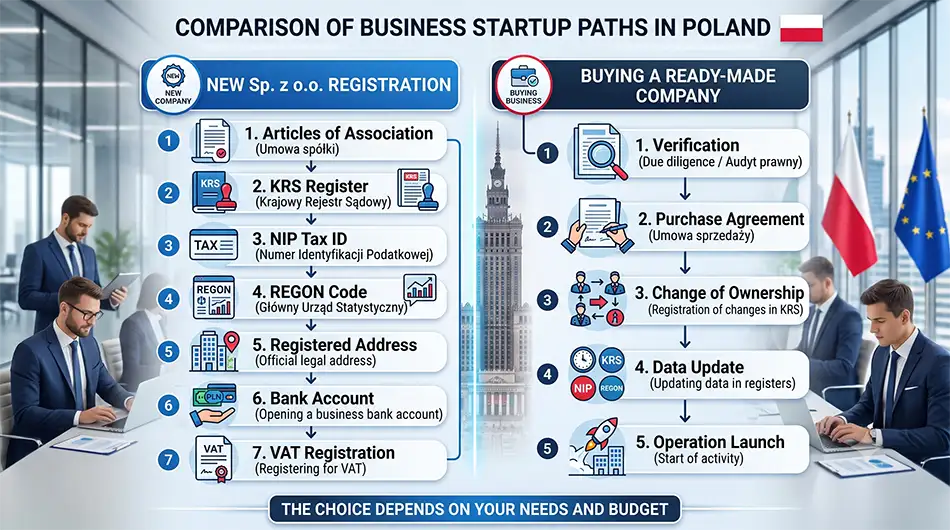
The registration of a new company requires the preparation of articles of association, appointment of shareholders and management board members, selection of a registered office, PKD business activity codes, representation rules and a tax model. The documents are then submitted to KRS through the S24 system or the Court Registers Portal.
Since 1 January 2025, the PKD 2025 classification has applied when registering a company or changing its business activities. New businesses must also provide information required to create an electronic delivery address or disclose an existing address. Documents submitted through S24 are signed using a qualified electronic signature or a trusted profile.
When an entrepreneur decides to buy a company in Poland, the legal entity already exists. Instead of incorporating a new business, the transaction involves transferring shares, changing the management board, updating registry information and handing over the corporate documentation.
Main Advantages of a Ready-Made Company
The decision to buy a ready-made company in Poland may be practical when a business needs to reduce initial formalities and proceed more quickly to contracts and operations. The actual benefit depends on the company’s documentation, tax status, corporate history and the requirements of banks and counterparties.
The main advantages include:
- time savings – the buyer does not create a legal entity from the beginning but takes control of an already registered company;
- existing registration numbers – the company already has KRS, NIP and REGON identifiers;
- a choice of configurations – the buyer can search for a company with VAT, a bank account, specific business activities or an operating history;
- an established legal structure – the articles of association, share capital, registered office and management bodies are already in place;
- faster access to negotiations – the company can use its details in agreements, commercial proposals and applications;
- the possibility of acquiring an older company – the incorporation date may be relevant for tenders, marketplaces, leasing arrangements or particular counterparties;
- fewer initial organisational procedures – the buyer does not need to coordinate each stage of primary registration separately;
- access to different offers – ready-made companies for sale in Poland may include both newly established shelf companies and businesses with an operating history;
The purchase does not eliminate the need to verify the documents and does not guarantee that all operations can begin immediately. Changes may still be required in KRS, CRBR, banking systems, tax registers, accounting records and agreements with service providers.
When a Ready-Made Company Is More Suitable Than a New One
An existing legal entity can be particularly useful when delays may result in the loss of a contract, supplier, client or tender opportunity. The company should be selected according to a defined commercial objective rather than solely on the basis of price.
Buying an existing company may be appropriate in the following situations:
- A contract with a Polish or European counterparty must be signed quickly.
- An application requires a company that already has KRS, NIP or REGON numbers.
- The business needs a company with active VAT or VAT EU status.
- A legal entity with a particular incorporation date is required.
- The founders cannot coordinate the registration procedure themselves.
- A company with an existing bank account or payment infrastructure is needed.
- The business intends to participate in a tender, leasing arrangement, partnership programme or marketplace.
- Employees, office premises or equipment must be contracted in the name of a Polish company.
- The buyer requires legal advice and wants to compare several professionally verified options.
Registering a new company may be more appropriate where the shareholders require a customised governance structure, detailed shareholder rights or individually drafted articles of association. A ready-made Sp. z o.o. is usually more suitable when a standard company structure meets the business requirements.
Comparison Between a Ready-Made Company and a New Company
The choice between purchasing and incorporating should take into account more than the initial cost. The expected launch date, tax position, bank requirements, ownership structure and risks connected with previous operations should also be assessed.
The two options can be compared using the following criteria:
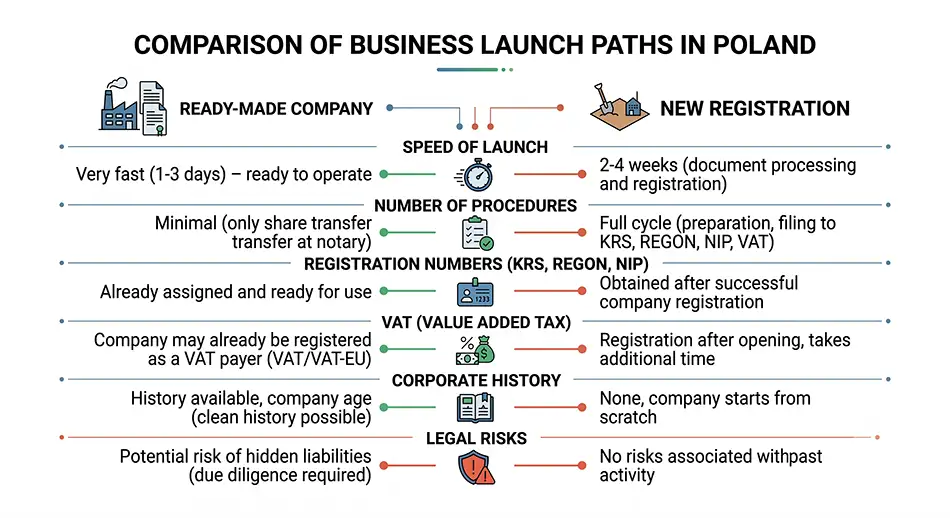
- legal existence – a new company must be incorporated, while a ready-made company already exists;
- registration numbers – a newly incorporated company receives them during registration, while an existing company already has KRS, NIP and REGON;
- corporate history – a new company has no history, while an existing company may be dormant or previously active;
- tax status – a new company must complete the relevant tax procedures, while an existing company may already be registered for VAT;
- articles of association – a new company can be structured according to the founders’ requirements, while the existing articles must first be reviewed and amended if necessary;
- launch costs – incorporation involves state fees, legal expenses, address services and administrative costs, while the price of an existing company also reflects its configuration and history;
- previous liabilities – a new company has no earlier obligations, while an existing company requires legal and financial due diligence;
- operational speed – a ready-made company may shorten the preparation period if its registrations and documentation remain valid;
The purchase of shares transfers corporate control rather than creating a new legal entity. Assets, obligations, contracts, tax history and potential disputes continue to belong to the same company after the ownership change.
What Determines the Price of a Ready-Made Company
The price of a ready-made Sp. z o.o. is not limited to its share capital. A seller may also include registration costs, registered office services, accounting expenses, company maintenance, VAT registration, bank account preparation and transaction documentation.
The price may depend on:
- company age – businesses registered several years earlier may cost more than newly incorporated shelf companies;
- VAT and VAT EU status – valid tax registration may increase the value of the offer;
- bank account availability – the price may reflect an existing account and the process required to transfer management access;
- financial history – turnover, reporting, profitability and the absence of overdue liabilities;
- licences or permits – regulatory approvals may have separate value if they remain valid after the ownership transfer;
- registered office services – the package may include payment for the address for a defined period;
- transaction documentation – the price may cover the share purchase agreement, shareholder resolutions and registry filings;
- legal status – a verified company without debts or disputes presents fewer risks for the buyer;
- business infrastructure – a domain, website, contracts, employees, equipment or client portfolio may be valued separately;
The lowest purchase price should not be the main selection criterion. The cost of resolving undisclosed tax liabilities, contractual debts or corporate disputes may significantly exceed the price difference between a verified and an unverified company.
Procedure for Buying a Company in Poland
The procedure for purchasing a company depends on its method of incorporation, articles of association, number of shareholders, buyer’s nationality and asset structure. Before signing the agreement, the buyer should establish whether the articles restrict the transfer of shares or require prior corporate approval.
As a general rule, shares in a Polish Sp. z o.o. are transferred under a written agreement with signatures certified by a notary. The articles of association may restrict the sale or require the company’s consent. For certain companies incorporated through S24, an electronic agreement template may be available where permitted by law.
A typical company acquisition procedure includes the following stages:
- Define the required company profile – age, VAT status, bank account, registered office, business activities, licences and budget.
- Obtain the KRS extract, articles of association, shareholder list, financial statements and tax documents.
- Conduct legal, financial, tax and corporate due diligence.
- Agree on the price, payment procedure, seller warranties and liability for undisclosed obligations.
- Review the articles for restrictions on the transfer of shares and any consent requirements.
- Sign the share purchase agreement in the required legal form.
- Adopt resolutions concerning shareholders, management board members, address, company name or business activities.
- File the relevant changes with KRS and update information concerning ultimate beneficial owners.
- Notify the bank, accountants, tax advisers, counterparties and payment service providers.
- Receive all corporate records, electronic keys, access credentials and accounting databases.
- Arrange ongoing accounting services and internal financial controls.
- Begin operations after confirming the authority of the new management board and obtaining access to company accounts.
You can get advice from an accountant here.
The payment schedule should be linked to the completion of specific transaction conditions. Part of the price may be paid after the shares are transferred, with the final amount released after documents, access credentials or registry confirmations are received.
How to Verify a Ready-Made Company Before Purchase
Due diligence is necessary even if the seller states that the company has never traded. Zero turnover does not exclude missing reports, corporate irregularities, bank accounts, signed contracts or administrative obligations.
Public registers and internal company records should be used during the verification process:
- KRS – current and historical information about the company, management board, shareholders, capital and representation rules;
- VAT White List – VAT status and registered business bank accounts;
- KRZ – information concerning insolvency, restructuring and certain enforcement proceedings;
- CRBR – information about ultimate beneficial owners;
- financial statements – balance sheets, profit and loss accounts, notes and filing dates;
- tax records – declarations, correspondence with tax authorities and certificates concerning tax liabilities;
- bank statements – account activity, loans, restrictions, security interests and outstanding obligations;
- contract register – leases, supply contracts, loans, guarantees, employment agreements and subscriptions;
- litigation records – current and potential disputes with counterparties, employees or public authorities;
- corporate resolutions – shareholder minutes, management board decisions, powers of attorney and previous share transfers;
- electronic access – online banking, tax systems, electronic delivery accounts, accounting software, domains and corporate email;
The Polish VAT register includes information about registered, unregistered, removed and reinstated taxpayers. The public KRZ system can be used to check information concerning bankruptcy, restructuring and other proceedings covered by Polish law.

Warranties That Should Be Included in the Agreement
The purchase agreement should address more than the number and price of the shares. It should allocate responsibility for circumstances that arose before the ownership change but are discovered after completion.
The agreement should normally include:
- confirmation of ownership – the seller warrants that the shares are legally owned and may be transferred;
- absence of encumbrances – the shares are not pledged and are not subject to a dispute;
- absence of undisclosed debts – the company has no hidden tax, banking or contractual liabilities;
- completeness of reporting – all required declarations and financial statements have been filed;
- accuracy of banking information – all accounts, loans, guarantees and restrictions have been disclosed;
- indemnification provisions – the seller compensates the buyer for losses resulting from breaches relating to the period before completion;
- access transfer arrangements – deadlines are established for transferring online banking, electronic signatures, email and accounting systems;
- final payment conditions – part of the purchase price may be retained until agreed obligations are completed;
- dispute resolution provisions – the applicable law, court jurisdiction or arbitration mechanism is specified;
A legal consultation before signing the agreement helps ensure that the warranties reflect the actual structure and risks of the transaction. A short standard-form agreement without detailed disclosure may provide insufficient protection for the buyer.
Is a Nominee Director Required
A nominee director is a person formally appointed to the management board who acts within powers agreed with the beneficial owner. This arrangement may be offered to foreign entrepreneurs as part of corporate administration services.
The appointment of a local director does not release the company, shareholders or actual controllers from compliance with Polish law. Banks, tax authorities and professional advisers may require disclosure of the ultimate beneficial owner, the source of funds and the genuine commercial purpose of transactions.
Before appointing a nominee director, the parties should define:
- scope of authority – which agreements, payments and documents the director may sign;
- transaction limits – which decisions require the owner’s written approval;
- bank account access – who controls online banking and authorises payments;
- allocation of liability – the consequences of exceeding authority or failing to follow lawful instructions;
- reporting requirements – deadlines for transferring documents and notifying the owner about correspondence;
- confidentiality obligations – rules governing commercial and personal information;
- replacement procedure – the process for terminating the appointment and appointing a new board member;
A nominee service must not be used to conceal beneficial ownership, avoid banking controls or submit inaccurate corporate information. An operating company requires genuine oversight, documented decision-making and continuous access to financial records.
Taxes Applicable to a Ready-Made Company in Poland
A change of shareholders does not create a new legal entity or erase the company’s tax history. The buyer acquires the company together with its existing rights, obligations, previous filings and potential tax risks.
The standard corporate income tax – CIT – rate in Poland is 19%. A reduced rate of 9% may apply to operating income, excluding capital gains, if the company qualifies as a small taxpayer or has recently started its activity and its annual revenue does not exceed the equivalent of EUR 2 million. Statutory exclusions may prevent some companies from applying the reduced rate.
The standard VAT rate is 23%, while reduced rates of 8%, 5% and 0% apply to specified goods and services. The applicable tax treatment depends on the type of activity, turnover, place of supply, status of counterparties and the nature of cross-border transactions.
Before operations begin, the buyer should confirm:
- Whether the company has active VAT and VAT EU status.
- Whether all tax returns and JPK files have been submitted.
- Whether there are outstanding liabilities to the tax authorities.
- Whether the company qualifies for the 9% CIT rate.
- Whether transactions with related parties have taken place.
- Whether WHT, PCC or transfer pricing obligations have arisen.
- Whether carried-forward tax losses may be used.
- Whether the bank accounts match the VAT White List records.
- Whether registration in additional tax or sector-specific systems is required.
After the acquisition, ongoing accounting services should be arranged without delay. The accountant should receive source documents, historical reports, system access, bank statements and information about all existing agreements.
More information about taxes: Taxes for business in Poland.
Disadvantages and Risks of Buying a Ready-Made Company
The advantages of an existing company should be considered together with its potential risks. The main difference from a new company is that the buyer cannot rely solely on a current KRS extract.
The principal disadvantages include:
- undisclosed liabilities – debts or disputes may not appear in public registers;
- historical tax risks – errors made by the previous owner remain associated with the company;
- inactive registrations – VAT, bank accounts or licences may be suspended or require confirmation;
- banking review – the bank may repeat its KYC procedure after changes to shareholders and management;
- restrictive articles of association – the existing document may not suit the intended governance model;
- due diligence costs – legal and financial reviews increase the initial budget;
- dependence on the seller – completion requires the transfer of documents, keys and access credentials;
- reputational risks – negative reviews or disputes may be associated with the company’s name or prior operations;
- additional amendments – the name, address, PKD codes, management board and articles may need to be updated;
Most of these risks can be reduced through due diligence, detailed seller warranties and a controlled payment structure. A company should not be purchased solely on the basis of a brief advertisement or a copy of its KRS extract.
How to Find a Ready-Made Company Through Poshuk.info
Poshuk.info allows users to review a list of ready-made companies available for sale, examine the main details of each offer and contact the company owner. The platform makes it possible to compare companies by incorporation date, legal form, tax status, included services and price.
When the required company is not available in the published list, the user can submit a consultation request. The request is distributed to owners of companies for sale and to legal and law firms that have been verified on the platform and meet professional criteria in the relevant service category.
The search process includes:
- Review the available ready-made companies for sale in Poland.
- Define the required company age, VAT status, bank account and budget.
- Contact the owner of a suitable company through the details published on the website.
- Submit a consultation request if no suitable option appears in the public list.
- Receive proposals from several verified legal and law firms.
- Compare the price, company configuration, transfer period and legal support.
- Select the conditions that correspond to the business plan and budget.
The entrepreneur does not need to visit the websites of multiple legal providers, contact each adviser separately or submit the same request several times. A consultation request published on Poshuk.info is received by verified legal and law firms that meet the professional criteria for the selected service category.
This process saves time, provides access to several consultations and allows the buyer to compare different commercial and legal options before making a decision.

How to Choose the Right Company
The appropriate company depends on the intended operations, counterparty requirements, budget and acceptable risk level. For standard trading or service activities, a newly incorporated Sp. z o.o. without an operating history may be sufficient.
The following factors should be reviewed:
- no previous activity – appropriate where the buyer does not require turnover or contractual history;
- filed zero-activity reports – confirmation that basic reporting obligations have been met;
- current KRS information – registry data should correspond with the corporate records;
- transparent ownership structure – the seller should confirm lawful ownership of the shares;
- absence of liabilities – taxes, loans, contracts and litigation must be checked;
- required VAT status – where the planned activity requires VAT registration;
- suitable PKD codes – these may be changed after the acquisition where necessary;
- bank account usability – the bank must approve the new shareholders and management board;
- complete documentation – articles of association, resolutions, registers, reports and evidence of capital contributions;
A company with turnover, assets or licences requires more extensive due diligence. It may cost more, while its previous history may not necessarily create a practical advantage for the new owner.

Taxes for Business in Poland in 2026
How the Polish Tax System Works Business taxation in Poland depends on the legal-organizational form, residency, type of activity, turnover, and profit distribution method. A limited liability company (Sp. z

Taxes for Business in Cyprus: System, Rates, Benefits, Reporting, Advantages, and Risks
Taxes for business in Cyprus are formed according to the model of European jurisdiction with corporate taxation, VAT, rules of tax residency, audit, electronic reporting, and economic presence requirements. Cyprus

Advantages and Disadvantages of Doing Business in Austria
Austria is one of the most stable and respected business jurisdictions in Europe. Located in the centre of the European Union, it offers access to developed markets, reliable infrastructure, transparent

Taxes for Business in Serbia: A Comprehensive Overview of the Tax System, Rates, Reporting, Benefits, and Risks
Serbia is gradually becoming one of the most attractive jurisdictions in Southeast Europe for real business, foreign investors, IT companies, manufacturing, trade, logistics, and service centers. Its appeal stems not

Taxes for Business in Ireland: A Complete Overview of the Tax System, Rates, Incentives, Reporting, Advantages and Risks
Ireland has for many years remained one of the most attractive European jurisdictions for international business, IT companies, start-ups, pharmaceutical corporations, financial services, consulting firms and companies working with intellectual

Best Countries for Europeans to Register a Company
ВOpening a company in Europe is one of the most practical ways to enter the international market, work with clients in the EU, receive payments in euros, conclude contracts with


