Sl8 by Cassator Corp emerges at the intersection of three rapidly converging markets: social networks, crypto payments, and real-world asset tokenization. The platform is positioned not as just ...

12Jun


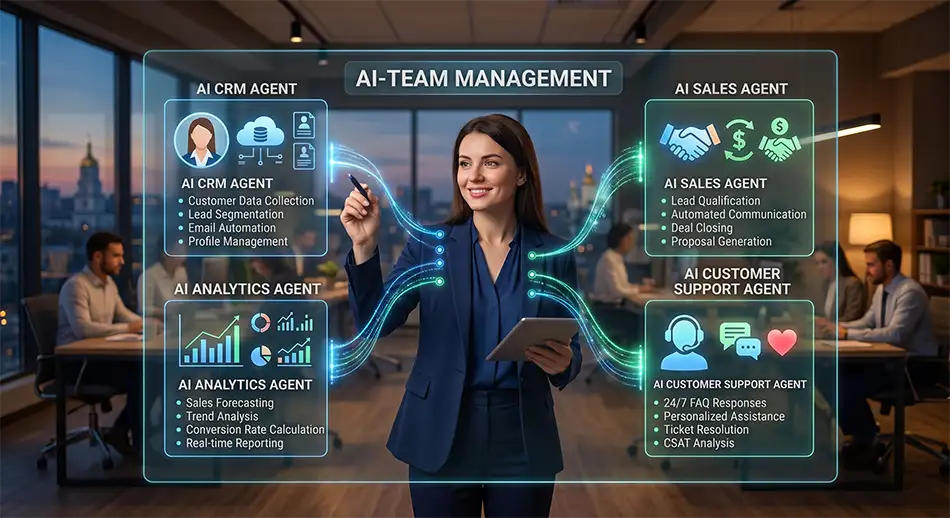
AI agents are autonomous digital systems that can receive tasks, analyze information, plan actions, work with business tools, and perform parts of processes without constant manual control. To explain the query “what are artificial intelligence agents” in simple terms, it is not about an ordinary chatbot, but about a software executor capable of acting towards a given goal.
AI agents operate through a combination of language models, instructions, data access, memory, APIs, and external services. They can analyze emails, calls, requests, spreadsheets, documents, CRM records, financial reports, and task statuses.
The basic principle of the agent system’s operation looks like a cycle of actions where each next step depends on the received result.
This is why the query “how AI agents work” is often related to business automation, process management, sales, customer support, and internal analytics. The agent not only answers questions but helps to get the work done.
AI agents most quickly replace those parts of a manager’s work that are repetitive, have a clear scenario, and rely on structured data. According to Gartner’s estimates, by the end of 2026, up to 40% of enterprise applications may include task-specific AI agents, whereas in 2025 such solutions were less than 5%.
In management, operational and informational tasks have the greatest automation potential.
Such scenarios do not require deep managerial intuition, so they are well suited for automation. In this case, the manager moves from manual execution to quality control and decision-making.
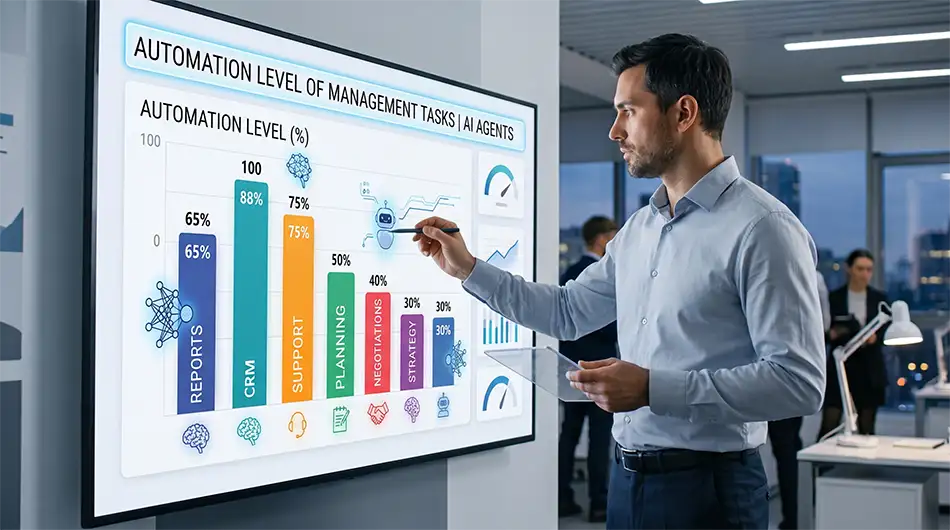
Complete replacement of a manager is possible only in limited processes where decisions are made according to clear rules. In a complex business environment, a manager works not only with information but also with people, risks, conflicts, motivation, negotiations, and responsibility.
AI agents can suggest decisions but do not always understand the hidden company context, informal agreements, and emotional state of process participants.
Therefore, it is more accurate to talk not about a complete disappearance of managers, but about a change in their role. The manager becomes a coordinator of people, processes, and artificial intelligence agents.
In 2025, Gartner reported that only 15% of IT application leaders considered, tested, or implemented fully autonomous AI agents without human supervision. This highlights an important distinction between an agent as an assistant and an agent as a fully independent executor.
For most companies, the closest model is “human plus AI agent,” not “AI agent instead of human.”
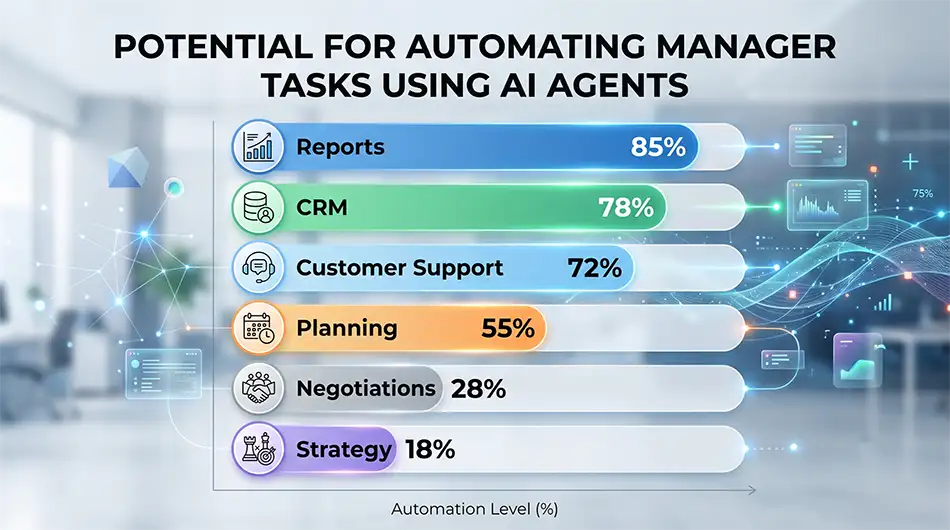
The most automated tasks are reports, CRM operations, and typical communication. The least automated are negotiations, strategic decisions, conflict management, and team development.
AI agents deliver results when implemented not “for the trend” but towards a specific business metric. This can be response speed to the customer, reducing manager workload, report accuracy, increasing conversion, or cutting operational costs.
The most noticeable benefits appear after integrating the agent with real business systems.
In sales, an AI agent can verify new leads, prepare a brief client history, create follow-ups, remind about the next contact, and update CRM. In support, it can classify requests, suggest answers, and transfer complex cases to a human.
The main business mistake is expecting autonomy without prepared data, regulations, and control. If a company has chaotic CRM, outdated documents, and unclear rules, the AI agent will only reproduce this chaos faster.
Before launch, it is necessary to assess not only the capabilities but also the weak points of the technology.
These risks do not negate the benefits of the technology. They mean that AI agents should be implemented as part of a management system, not as a standalone experiment without rules.
The query “AI agents how to create” begins not with choosing a model, but with describing the business process. First, it is necessary to understand which task the agent should perform, what data it needs, which actions are allowed, and which require manager confirmation.
It’s best to start with one narrow process where the result is easy to measure.
After testing the agent, it can be scaled to other departments. But each new scenario requires separate rules, data, access, and a responsible person.

AI agents will most quickly affect managers whose work mainly consists of information transfer, typical responses, manual status control, and mechanical report generation. If the role does not include analytics, responsibility, negotiations, and team development, a significant part of it can be automated.
Those at least risk are specialists who combine people management, business thinking, client work, and strategic decisions.
AI agents do not cancel management but change its content. The value of a manager shifts from manual coordination to goal setting, quality control, risk management, and decision making.
AI agents will partially replace managers in tasks where there is enough data, rules, and repetitive scenarios. They can already perform a significant part of work with CRM, reports, requests, planning, analytics, and typical communication.
A manager who only forwards messages, reminds about deadlines, and collects standard reports can be almost entirely replaced by AI agents. A manager who understands business, people, clients, finance, risks, and strategy will not be replaced—they will be empowered by them.


