Rights and responsibilities of foreigners in Ukraine depend primarily on the legality of their stay. If a foreigner enters Ukraine legally, holds a valid travel document, a visa if required, a ...

14May



Czech citizenship is a legal status that grants a person full connection with the Czech Republic, the right to a Czech passport, political rights, diplomatic protection, and freedom to reside in any European Union country. For foreigners, it often represents the final stage of legalization after long-term residence, permanent residency, work, study, business, or family integration.
It is important to understand that the question “how to obtain Czech citizenship” does not have a universal answer. The law provides various grounds and methods for acquisition, and the decision on granting citizenship is made by the Ministry of the Interior of the Czech Republic. The official portal for foreigners states that citizenship acquisition is regulated by Act No. 186/2013 Coll., and there is no automatic right to a positive decision.
The main ways to acquire Czech citizenship are related to origin, family circumstances, birth, adoption, or long-term integration in the country. The most common path for foreigners is naturalization after lawful residence.
After determining the grounds, it is necessary to assess whether the applicant meets formal and factual criteria. Even with proper documents, authorities may verify actual integration, law compliance, tax discipline, and residence stability.
Naturalization is a procedure in which a foreigner requests the state to grant citizenship after prolonged lawful residence. For most applicants, this is the primary method.
According to gov.cz, an application may be submitted by a foreigner or stateless person who has permanent residence in the Czech Republic: at least 5 years, at least 3 years for EU citizens, or under the condition of continuous lawful residence in the Czech Republic for at least 10 years.
Naturalization is not a formality. Even if a person has lived in the country for the required period, the state evaluates behavior, social connections, economic activity, tax compliance, and genuine intention to link life with the Czech Republic.
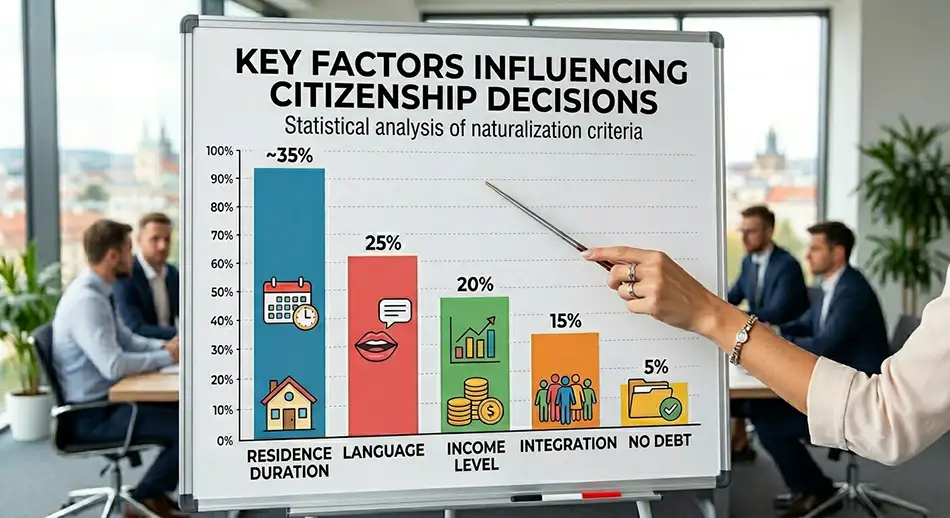
Marriage to a Czech citizen can be an important factor but does not guarantee automatic citizenship. The applicant still must undergo the procedure, confirm lawful residence, language proficiency, legitimacy of family relations, and other requirements.
Marriage alone does not replace naturalization. Therefore, before submitting an application it is advisable to conduct a legal audit of documents and consult a migration lawyer.
Simplified conditions or special rules may apply to certain categories of foreigners. This concerns refugees, stateless persons, children, and minors applying with parents or having separate legal grounds.
These categories require especially careful preparation, as the standard document set may change depending on the applicant’s status.
The document package is a key element of the procedure. The official gov.cz portal states that the application should be submitted in free form, accompanied by documents about civil status, a biography in Czech, proof of no criminal record, exams, residence, absence of debts, income, work, study, and social integration.
After submission, authorities may request additional explanations. Therefore, it is advisable to prepare not only formal certificates but also a coherent history of residence, work, study, business, and family life in the Czech Republic.
Language knowledge is one of the most important criteria of integration. Citizenship usually requires passing an exam in the Czech language and an exam on basic knowledge about the constitutional system, culture, society, geography, and history of the Czech Republic.
The language component should not be left to the last moment. For many applicants, the exam becomes a practical obstacle, even if documents and residence periods are in order.
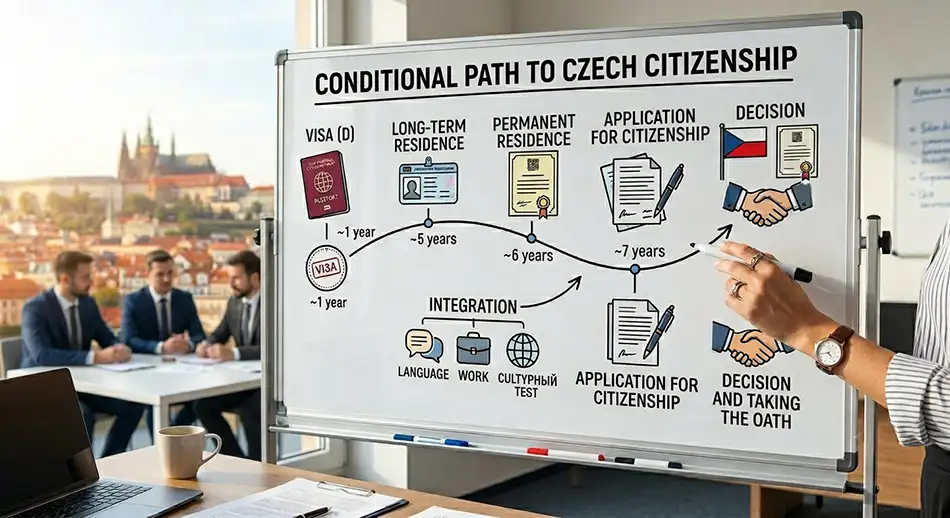
The procedure appears sequential but requires thorough preparation in practice. The application is submitted in person to the regional office or relevant Prague municipal district office at the place of permanent residence, after which materials are forwarded to the Ministry of the Interior of the Czech Republic.
The administrative fee for submitting an application is 2,000 CZK for adult applicants and 500 CZK for children or persons with asylum, although the fee may be reduced in justified cases.
Registering a company in the Czech Republic or buying an existing company does not grant automatic citizenship. However, legal business can help establish grounds for residence, confirm economic activity, income, tax payments, and real ties to the country.
Before choosing a business model, it is worth evaluating not only commercial advantages but also migration consequences. In such cases, consulting a migration lawyer helps avoid mistakes with visas, residence permits, taxes, and future naturalization.
Czech citizenship offers broader opportunities than permanent residence. The official gov.cz portal lists key benefits such as voting rights, protection from deportation, right to a Czech passport, and diplomatic protection.
For many foreigners, Czech citizenship becomes not just a legal status but a tool for long-term security, mobility, and integration in the European Union.
Before applying, it is necessary to check weak spots in the case. Minor mistakes in documents, debts, missing translations, unclear biography, or unconfirmed incomes can complicate the procedure.
Quality preparation is often more important than speed. If the case involves complicated circumstances — marriage, refugee status, minor children, business, residency status changes, or previous refusals — professional support significantly reduces risks.
Most commonly — through naturalization after permanent residence, meeting requirements such as length of stay, language knowledge, income, absence of debts, no criminal record, and integration.
No. Marriage to a Czech citizen can help confirm integration but does not replace the procedure and other requirements.
There is no direct “purchase” of citizenship through business. However, registering a company or buying an existing one in the Czech Republic can be part of a long-term legal residence and integration strategy.
Yes, in most cases, passing tests in Czech language and basic knowledge about the Czech Republic is required. Exceptions apply to certain applicant categories.
Yes. In case of refusal, the applicant may file an appeal within the established deadline. The official portal states that appeals must be submitted within 15 days from the receipt of the decision.
Czech citizenship is a real but legally complex procedure that requires lawful residence, well-prepared documents, language proficiency, financial transparency, and proven integration. Naturalization is the most common path, but in certain cases, grounds exist based on birth, adoption, ancestry, marriage, refugee status, minority age, or special merits.
To increase chances of a positive decision, it is advisable to verify documents, eliminate debts, prepare proof of integration, and consult a migration lawyer in advance. This is especially important if the applicant plans to connect the procedure with business, work, family circumstances, or long-term residence in the Czech Republic.


