
To open a pharmacy you need an official license for the retail sale of medicinal products, approved by Ukrainian legislation. This permit guarantees the safety and quality of pharmaceutical ...

08Apr

A construction license is one of the key permitting instruments for companies planning to perform construction, installation, road, engineering or general contracting works on facilities with an increased level of responsibility. For a developer, it is not a formality, but confirmation that the contractor has the right to work on facilities of the relevant consequence class, has personnel, material and technical resources, experience and an organizational structure for safe performance of works.
At the same time, in 2026 this topic should be considered very carefully. The Law of Ukraine «On Licensing of Types of Economic Activity» classifies construction of facilities with medium «CC2» and significant «CC3» consequences as licensed activities according to the list of works determined by the Cabinet of Ministers of Ukraine. However, during martial law, DIAM separately explains that the right to conduct economic activity may be acquired by submitting a declaration, which currently replaces the construction license.

A construction license is the right of a business entity to perform certain types of construction works on facilities belonging to the relevant consequence class. In practice, this term often refers to three different things: a classic construction license, a previously issued license recorded in the Register of Construction Activity, or a declaration on conducting economic activity under martial law.
For a developer, it is important to distinguish between these documents because they have different legal meanings:
– a license for construction activity confirms the company’s right to perform licensed construction works;
– a declaration during martial law may temporarily replace the license;
– a permit for construction works applies to a specific facility, not to the entire activity of the company;
– a notification on the commencement of construction works is mainly used for CC1 facilities;
– a certificate or declaration of readiness is required after construction is completed;
That is why the search query «construction license documents» should be considered more broadly: the developer must prepare not only documents for licensing construction works, but also documents for the specific facility, contractor, land plot, project documentation and commissioning of the facility.
The key criterion is the consequence class of the facility. The Law of Ukraine «On Regulation of Urban Development Activity» divides facilities into three groups: minor consequences – CC1, medium consequences – CC2, significant consequences – CC3.
In practice, this means that the higher the potential risk to people, property, infrastructure or public interests, the stricter the requirements for the developer, designer, contractor and permitting procedures.
After determining the consequence class, the developer understands whether a notification is sufficient, whether a permit is required, and whether it is necessary to involve a contractor with a valid license, declaration or confirmed right to perform the relevant works.
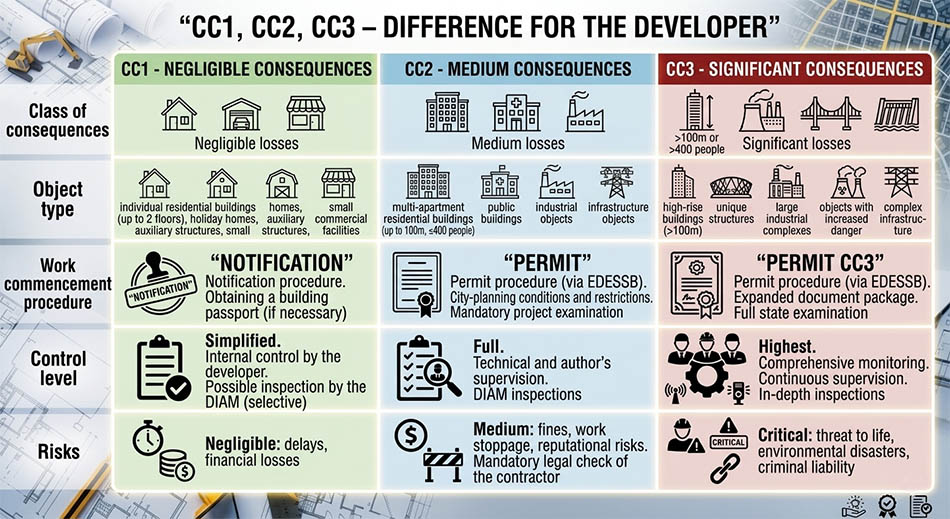
The main mistake developers make is assuming that a construction license automatically gives the right to build any facility. In reality, a license or declaration relates to the business entity, while a construction works permit relates to a specific facility.
The correct logic is as follows:
For CC2 and CC3 facilities, the right to perform preparatory and construction works arises after obtaining a construction works permit. This is directly provided for by Article 37 of the Law of Ukraine «On Regulation of Urban Development Activity».
The first stage is the technical and legal classification of the facility. At this stage, the customer, designer and technical specialists determine whether the future facility belongs to CC1, CC2 or CC3.
To correctly determine the consequence class, several parameters are taken into account:
– the number of people who will permanently or periodically stay at the facility;
– the possible impact of an accident on people outside the facility;
– the amount of potential material damage;
– the social significance of the building or structure;
– the facility’s relation to engineering, transport, industrial or critical infrastructure;
– the complexity of structural, geological and technological solutions;
A mistake at this stage may lead to refusal to issue a permit, cancellation of the right to perform construction works, disputes with supervisory authorities or risks for investors.
A construction license for a sole proprietor can theoretically be considered within the general rule on business entities, since DIAM’s explanations regarding the declaration indicate that the information includes the business entity – a sole proprietor or a legal entity. However, for large-scale works, general contracting, participation in tenders, CC2 and CC3 construction, attracting investors and working with banks, an LLC is more often used.
Before starting activity, the developer or contractor should choose a model:
– sole proprietor – a simpler form for small works, service activities, subcontracting or specialized tasks;
– LLC – a more convenient form for general contracting, road construction, cooperation with large customers and participation in CC2 and CC3 projects;
– ready-made company – an option for quickly entering the market if business history, open bank accounts, personnel or an existing license are needed;
– company with a declaration – a practical scenario during martial law if the declaration is submitted correctly and appears in the relevant lists;
Company registration should precede the submission of documents, filing of a declaration or purchase of corporate rights. It is important that activity codes, management structure, director, founders, contact details, places of business activity and staff resources correspond to the actual construction activity.
At this stage, the legal basis for further registration of the right to construction activity is formed. If a company is created from scratch, it is necessary to complete state registration, choose a taxation system, appoint a director, prepare the charter and determine the types of activity.
The basic package of corporate documents usually includes:
– an extract from the Unified State Register;
– the charter of the legal entity;
– a decision on company establishment or minutes of the general meeting;
– an order appointing the director;
– information about ultimate beneficial owners;
– tax data and taxation system;
– electronic signature of the director or authorized person;
– contact details and address of the place of business activity;
If a nominee director is used in the structure, powers, corporate control, agreements, banking services and liability must be formalized especially carefully. A formal director without real management may create risks for the license, declaration, tenders, banking compliance and inspections.
A license for construction activity or a declaration should not be detached from the real condition of the company. The contractor must confirm that it is capable of performing works safely, professionally and in accordance with construction standards.
For this purpose, it is advisable to prepare an internal evidence base:
– employment agreements or civil law contracts with specialists;
– documents confirming education, qualifications and experience of responsible employees;
– orders appointing responsible persons;
– lease agreements or ownership documents for machinery, equipment and tools;
– occupational safety and industrial safety documents;
– internal regulations on quality control of works;
– insurance agreements, if required for a specific project;
– a portfolio of completed works or confirmation of experience;
This section is especially important for companies planning to perform road construction, installation of engineering networks, works with load-bearing structures, industrial construction or works on CC3 facilities.
During martial law, a declaration on conducting economic activity is a practical tool for many business entities. DIAM states that such a declaration currently replaces the construction license and is submitted free of charge through Diia or in paper form through an Administrative Services Center. The Diia guide also confirms that the declaration may be submitted through the Diia portal or through an Administrative Services Center with subsequent transfer through the portal.
The sequence of actions for submitting a declaration is as follows:
After submitting the declaration, the company must actually comply with legislative requirements, construction standards, occupational safety rules and conditions for performing works. The declaration does not exempt from liability for false information, poor-quality construction or performance of works without a permit for a specific facility.
Before concluding an agreement with a contractor, the developer must verify the license. This applies not only to new partners, but also to companies claiming to have an old indefinite construction license or a submitted declaration.
Verification is carried out through official digital registers:
– in the Register of Construction Activity, the section «Construction Participants» should be checked;
– in the «Licensees» tab, information can be searched by the company identification code;
– the «indefinite» mark should be displayed in the «Licenses» block;
– the registers should also be used to check permit documents, project documentation, expert reviews, readiness acts and technical inventory;
DIAM directly explains that to verify the indefinite status of a license, one must go to the Unified State Electronic System in the Construction Sector portal, select the «Construction Participants» section, choose «Licensees», enter the company identification code and check the «Licenses» block. The Register of Construction Activity also contains separate sections for declarative and permit documents, project documentation, expert reviews, readiness acts, licensees and other construction participants.
Even if the contractor has a license, declaration or licensee status, the developer cannot start construction of a CC2 or CC3 facility without a construction works permit. This is a separate administrative stage that applies to a specific facility.
Through Diia, it is possible to submit an application for a permit for facilities with medium and significant consequences. The service page states that submitting the application takes approximately 20 minutes, registration takes 10 days, and the service is free of charge.
The following data and documents are required to obtain a permit:
– registration number of project documentation in the Unified State Electronic System in the Construction Sector;
– documents confirming ownership or use of the land plot, if the relevant data are absent from the State Register of Property Rights;
– information about the construction customer;
– information about the general contractor or contractor;
– data on architectural supervision and technical supervision;
– expert review of project documentation, if mandatory;
– information about the consequence class of the facility;
After the permit is issued, a record of it appears in the Register of Construction Activity, and the applicant receives an electronic copy of the permit or a refusal. The registration of the permit can be checked through the Unified State Electronic System in the Construction Sector portal in the «Registers» section.
After obtaining the permit, an equally important stage begins – the actual performance of works. The developer must ensure that the contractor works strictly within the permitted types of works, project documentation, construction standards and approved technical solutions.
The construction site must ensure:
– availability of persons responsible for performing works;
– keeping work logs and as-built documentation;
– compliance with occupational safety requirements;
– compliance of materials with project solutions;
– proper architectural and technical supervision;
– recording project changes and timely entering information into the register;
– control of subcontractors and their powers;
The law requires information about the document granting the right to perform construction works, consequence class, facility identifier, customer and contractors to be displayed on a stand at the construction site, except for certain private and utility facilities. This is an important element of transparency for supervision, investors, buyers and neighbors.
Changes often occur during construction: replacement of the general contractor, change of technical supervision, project adjustment, change of customer, update of company data, reorganization or change of director. Such changes must not be ignored.
The most common cases when information must be updated are:
– the general contractor or contractor has changed;
– the person responsible for technical supervision has changed;
– the person responsible for architectural supervision has changed;
– project documentation has been adjusted;
– the construction customer has changed;
– the company name or organizational form has changed;
– the director or authorized representative has changed;
For the developer, this is not only a matter of formal procedure, but also investment security. If the old contractor remains in the register while another company actually performs the works, risks arise during inspections, sale of future real estate units, commissioning and court disputes.
Obtaining a license or declaration is only the beginning of the process. The final stage for the developer is acceptance of the facility into operation. For CC2 and CC3 facilities, this is carried out on the basis of a readiness act by issuing a certificate through the state architectural and construction control authorities.
The following should be prepared for the final stage:
– act of readiness of the facility for operation;
– as-built documentation;
– technical passport or technical inventory materials;
– results of control geodetic surveying;
– documents confirming compliance with project solutions;
– data on contractors, technical and architectural supervision;
– documents on connection to engineering networks;
After the facility is put into operation, the developer obtains the legal possibility to register ownership rights, transfer facilities to investors or buyers, and start operating the building or structure.
The query «buy a company with a construction license» is popular among developers who want to quickly enter the market, participate in a tender or perform works without a long preparatory stage. This option may be useful, but only after a full legal, tax and register-based check.
Before purchase, it is necessary to check:
– whether the company is actually a licensee in the Register of Construction Activity;
– whether there is a mark confirming the indefinite status of the license;
– which specific types of works are covered by the license or declaration;
– whether the company has tax debts;
– whether the company is involved in court disputes;
– whether the director, founders or address have changed suspiciously often;
– whether there is a real staff and technical base;
– whether a nominee director was used to conceal actual control;
Buying a ready-made company may be a faster solution than registering a company from scratch, but it should not replace compliance. The greatest risks are not hidden in the license itself, but in the company’s history, debts, old contracts, tax issues and the reality of its construction experience.
You can choose and buy a ready-made company with a construction license in this section.
A road construction license is not required as a separate universal document under this exact name, but as the right to perform the relevant construction works within licensed or declared activity. If the road facility belongs to CC2 or CC3, it is especially important to check the consequence class, project documentation, construction works permit, contractor qualification and compliance of the type of works.
For road and infrastructure projects, the following are especially important:
– experience in performing similar works;
– availability of road machinery or lease agreements;
– specialists in engineering networks, geodesy and technical control;
– quality of materials and laboratory control;
– compliance with state or municipal procurement requirements;
– correct registration of subcontractors;
If a company plans to participate in tenders for roads, bridges, junctions or engineering and transport infrastructure, the phrase «we have a license» is not enough. It is necessary to confirm specific types of works, experience, resource base and legal status in the registers.
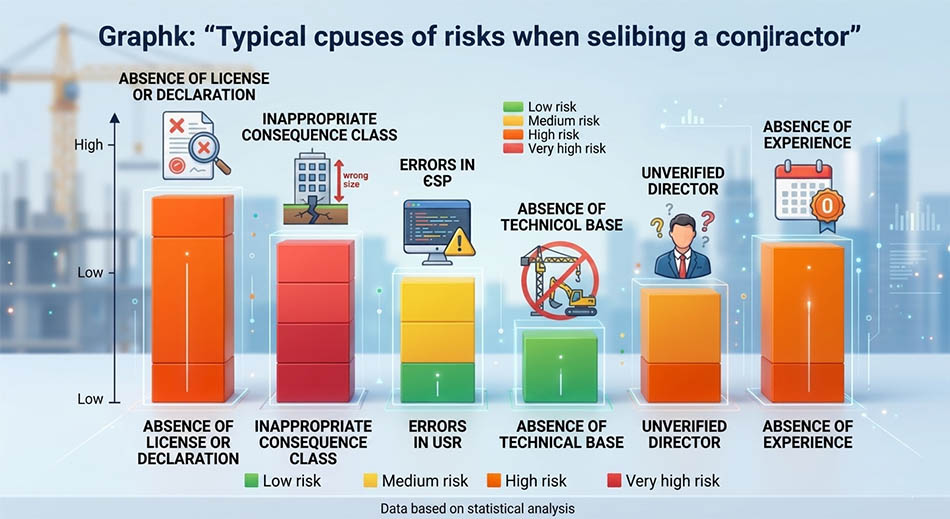
Most often, problems arise not because of the complexity of the procedure, but because of haste. The developer wants to start works quickly, signs an agreement with an unverified contractor, does not check the Unified State Electronic System in the Construction Sector, confuses a license with a permit or believes that a declaration automatically covers all types of works.
The following mistakes are dangerous:
– starting works without a permit or notification;
– incorrect determination of the consequence class;
– using a contractor without confirmed right to perform works;
– formal declaration without a real staff base;
– buying a company without checking debts and court cases;
– absence of technical or architectural supervision;
– failure to make changes after replacing the contractor;
– performing works not according to the project;
– absence of documents for commissioning the facility;
To avoid these risks, it is necessary to check not one document, but the entire chain: company – license or declaration – project – expert review – permit – performance of works – commissioning.
Before starting construction, it is advisable to conduct an internal check. It will help determine whether the project is ready to start, whether documents need to be improved, whether the contractor should be replaced or whether data must be entered into the registers.
Such a checklist reduces the risk of suspension of works, fines, refusal to issue a certificate, and disputes with buyers or investors.
You can order professional advice on preparing documents and obtaining a building license from specialized lawyers in this field here. Submit one request and receive several consultations/proposals.
For CC1, a notification on the commencement of construction works is usually applied. The law provides that the right to perform works on facilities with minor consequences arises after submitting the notification.
Yes. Ukrainian legislation classifies construction of CC2 and CC3 facilities as a licensed type of economic activity. At the same time, during martial law, DIAM explains the possibility of submitting a declaration that temporarily replaces the construction license.
You need to go to the Unified State Electronic System in the Construction Sector portal, open the «Registers» section, find «Construction Participants», select «Licensees» and enter the company identification code. This is how DIAM describes the verification of the indefinite status of a license.
Yes, but before purchase it is necessary to check the license, declaration, company history, debts, court disputes, directors, beneficiaries, staff base and compliance of the types of works. Buying without verification may create more risks than registering a company from scratch.
A sole proprietor may be a business entity, and the declaration may contain data about a sole proprietor or a legal entity. However, for large-scale facilities, general contracting, roads, CC2 and CC3 projects, an LLC is more often used due to the requirements of customers, banks, tenders and partners.
No. A license or declaration confirms the company’s right to perform works, but for a specific facility a notification or construction works permit is required. For CC2 and CC3, the permit is issued through Diia and displayed in the Register of Construction Activity.
Obtaining a construction license is not one document, but a complete system of preparing a developer or contractor for lawful performance of works. It includes determining the consequence class, registering a company, preparing staff and technical resources, submitting a declaration or confirming a valid license, checking through the Unified State Electronic System in the Construction Sector, obtaining a construction works permit and properly commissioning the facility.
For a developer, the best strategy is not to look for the fastest route, but to build a legally safe one. If the company, director, documents, project, permit and register data are consistent with each other, construction carries significantly fewer risks for investors, buyers, banks, supervisory authorities and the project owner.


